Antarctica has abundant sea ice and rich food sources, but polar bears have nowhere to go.
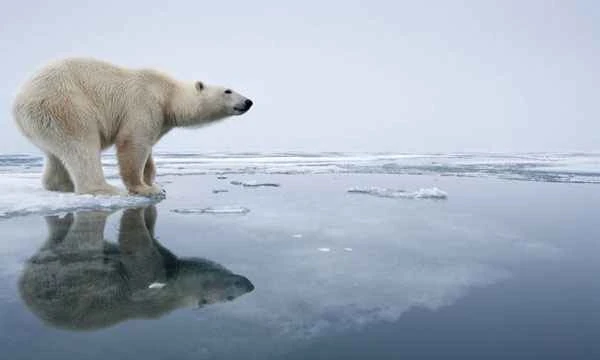
The Arctic and Antarctic habitats share many similarities, but the creatures that inhabit them are quite different. Both polar regions have seals and whales, but only the Arctic is home to the largest bear on Earth—the polar bear.
Polar bears (Ursus maritimus) are typically found around the Arctic Circle in Alaska, Canada, Greenland, Norway, Russia, and Iceland. Their fur is particularly well-suited to temperatures below 30 degrees Celsius. These animals spend most of their time on the ice, feeding on fatty seals for energy, and consuming food in long intervals between meals.
Antarctica also has sea ice, low temperatures, and seals, but there are absolutely no polar bears.
According to Andrew Derocher, a biology professor at the University of Alberta (Canada) who has studied polar bears for nearly 40 years, most bears live in the Northern Hemisphere. With the exception of the Andean short-faced bear (Tremarctos ornatus) of South America, bears are found only in the Northern Hemisphere.
Derocher says there's no particular reason for this; it's just that some species evolve in certain places while others don't. "Biogeography is full of quirks. Some species arrive in new lands, and some don't," he explains.
Throughout the evolutionary history of polar bears, the Arctic and Antarctic have never been connected by ice or land. "People often say that polar bears are the largest land carnivores in the world, but they hardly even live on land," DeRoche said. In fact, these animals spend most of their lives on sea ice, only occasionally coming ashore to breed.
In terms of evolution, polar bears are relatively young animals. They evolved from a common ancestor with brown bears (Ursus arctos) approximately 5 million to 500,000 years ago.
But even 5 million years ago, the continents of today were in the same location, so polar bears had no opportunity to move from one pole to the other.
The closest landmass to Antarctica is the southern tip of South America, including Chile and Argentina. To reach Antarctica, polar bears need to cross the treacherous Drake Passage. This region is known for its strong storms and turbulent seas as cold water flows from the south into warmer waters to the north.
However, polar bears would still thrive if given the opportunity to go to Antarctica, DeRoche says. In the Arctic, they eat seals, and sometimes birds and eggs. Antarctica has an abundance of all three, with six species of seals and five species of penguins. Furthermore, none of these species have evolved to defend themselves against large, agile land predators.
The Antarctic environment would be a feast for polar bears. This is why they shouldn't be brought there. The polar bears' voracious appetites and the local animals' lack of awareness of large land predators could lead to ecological collapse. Therefore, perhaps this great white bear should remain in the north.