Before the earliest vertebrates were discovered in the Chengjiang Fauna in China, the earliest traces of vertebrates were found in Ordovician freshwater sedimentary rocks in Colorado, USA, with bony scale fossils.
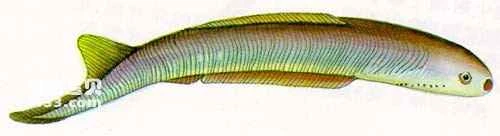
Moss fish
More complete fossils of early vertebrates have been discovered in marine sediments from the Middle Silurian period in England. These fossils represent some very primitive vertebrates that resemble fish: slender, tubular bodies; no upper or lower jaws, only a sucker-like mouth at the front of the body; a row of circular gill openings behind the eyes and on each side of the head; and a tail fin divided into upper and lower lobes, the lower lobe being longer and the upper lobe shorter and higher—this type of tail is called a heterocercal tail. These animals share many similarities with lampreys, which still live in the ocean today; they have been named *Morchella* and *Gymnocypris*, respectively.
During the Devonian period, this large group of early vertebrates reached its peak, with fossils of various jawless fish-like vertebrates discovered worldwide. Lacking upper and lower jawbones, their mouths, which served as feeding organs, could not open and close effectively, relying solely on sucking or even the natural flow of water to bring food into their mouths; therefore, they are called jawless vertebrates and are classified within the class Jawless within the superorder Ichthyformes. Furthermore, they lacked true paired fins, and their axial skeleton was composed of cartilage rather than true bone (i.e., hard bone). Representative jawless vertebrates possessed bony plates or scales on the anterior part of their bodies, interconnected like the armor of ancient warriors, serving a protective function; hence, they are generally also called armored fishes.
There are still considerable differences between different groups of jawless animals. It is very likely that these different groups had undergone long evolutionary processes before their fossil record was established. Based on these differences, all jawless animals, including modern types, can be divided into the following two subclasses and several orders:
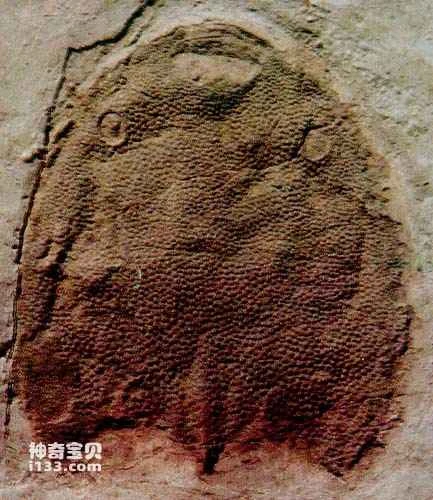
fossil of a multigill fish head shield
The subclass Mononoda is characterized by a single nostril, numerous gill slits, and a bony head shield (i.e., a bony armor covering the head). It includes four orders: Cephalosporidos, Gaelostomata, Apodiformes, and Cyclostomata. Cyclostomata includes modern jawless animals such as lampreys.
Dinoflagellates: Characterized by a pair of internal nostrils and the absence of external nostrils; they exhibit diverse morphologies and complex plates. They comprise three orders: Scutiformes, Placodontidae, and Polybrachyformes.
Multibranchs are jawless fish endemic to China, mainly found in Qujing and Wuding, Yunnan. They not only have a pair of internal nostrils, but also bony vertebrae that have not yet appeared in cephalopods; however, their bony vertebrae are still in their infancy, like those of lampreys, consisting only of small bony plates standing upright on the upper side of the notochord without other components.
Armored fishes had a relatively limited distribution throughout geological history, extending only to the Devonian period. They likely originated in the Ordovician, evolving from earlier, unarmored ancestors; *Mossichthys* may be a remnant of those ancestral types. Armored fishes achieved temporary success in the Devonian by developing into a large group of animals adapted to various aquatic ecosystems and with diverse lifestyles.
As many more advanced jawed vertebrates, which rapidly evolved along different evolutionary paths, gradually emerged from the Devonian period onward, jawless armored fishes ultimately lost out in the struggle for survival. By the end of the Devonian period, with the exception of a few remnants adapted to a particular lifestyle, the vast majority of armored fishes disappeared from the historical stage.