Lampreys resemble ordinary eels, with slender bodies, bare, scaleless skin, and a long dorsal fin that extends to the tail and wraps around it to form a caudal fin. They have no other fins. Lampreys have only one nostril, located on the top of their head between their eyes. Behind their eyes, on each side of their body, are seven gill openings, hence their name "lamprey."
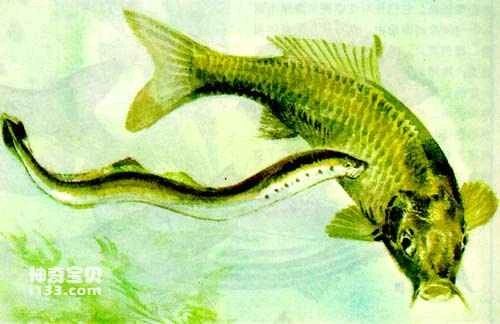
lamprey
The lamprey has a peculiar mouth shape, round like a sucker, filled with sharp teeth, but lacking a jaw structure. In the early stages of its development, the lamprey lives in the bottom waters of rivers or lakes, using its sucker-like mouth to feed on small animals. Once fully developed, its lifestyle shifts to parasitism, attaching itself to other fish with its sucker-like mouth, then using its file-like teeth to carve a hole in the host's body before burrowing inside and sucking its blood. Sometimes, the lamprey abandons the host before it dies and seeks a new victim; other times, it remains parasitic on the fish until it dies of blood loss.
In fact, lampreys are highly specialized remnants of some of the earliest vertebrates on Earth—jawless vertebrates—and their specialization manifests in many ways. For example, they lack bony skeletons or armor, which is clearly a result of skeletal degeneration in adaptation to a parasitic lifestyle. However, we can still gain insight into the state of the earliest jawless vertebrates from the lamprey's very primitive general characteristics.
Lampreys have a close relative called the hagfish, which has degenerated to the point of lacking eyes. Both are jawless vertebrates, belonging to the class Jawless, and are very similar to the earliest jawless vertebrates on Earth. Through lampreys, we can roughly imagine what those ancient vertebrates looked like and lived more than 500 million years ago.