In the history of biological evolution, several momentous events have occurred. These events, far exceeding the sum of all other events, were revolutionary in nature and profoundly influenced the direction of subsequent evolution. The first such revolution after vertebrates entered the historical stage was the origin of the jaw.
Origin of the jaw
The process of evolution from earlier to later animals is actually accomplished through the transformation of their structures from having one function to having another. Jaws, for example, evolved from structures that originally performed functions unrelated to feeding.
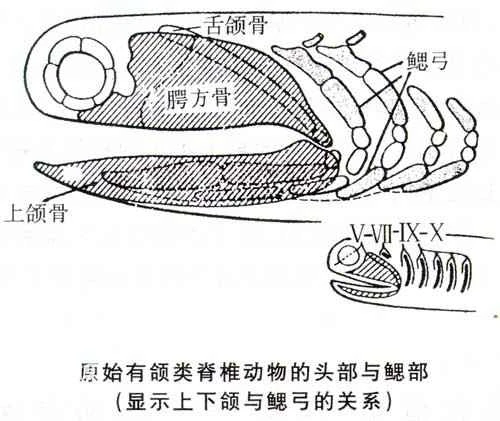
Armored fish have numerous gills supported by a series of skeletal structures, each composed of several bone segments, shaped like a reclining "V" with its tip pointing backward. Each such "V"-shaped structure is called a gill arch. In primitive vertebrates, all gill arches are arranged in two rows of horizontal "V"-shaped structures: >>>>>>
In an early stage of vertebrate evolution, the two front pairs of gill arches disappeared, and teeth grew on a third pair of gill arches, which hinged together at the tips of a "V" shape. In this way, the upper and lower jaws, capable of opening and closing freely and effectively biting food, were formed.
Along with the appearance of upper and lower jaws, true paired fins also began to appear on these primitive jawed vertebrates.
The most primitive jawed fish discovered to date are placoderms, which first appeared in the Late Silurian period and flourished during the Devonian period.