Flamingos are unique birds known for their long legs and pink plumage, their vibrant color derived from the accumulation of carotenoids in their diet. They typically inhabit brackish or alkaline waters and are gregarious, forming striking large pink flocks. While often called "flamingo" in English, the more accurate Chinese name is "火烈鸟" (huǒlièniǎo).
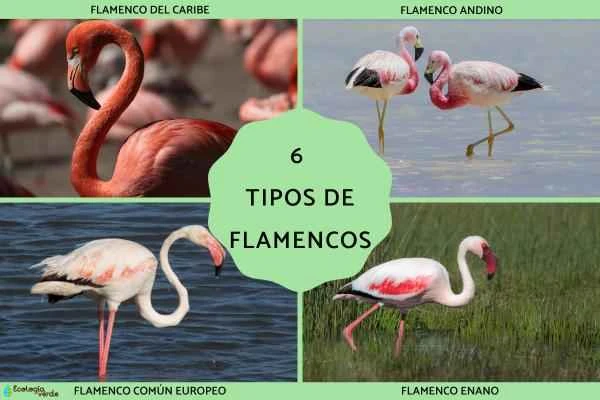
Currently, only six major flamingo species remain globally, divided into the large flamingo genus (Phoenicopterus) and the small flamingo genus (Phoenicoparrus, commonly known as "parina"). The following details the distribution, characteristics, and conservation status of these six flamingo species.
Introduction to 6 main flamingo species
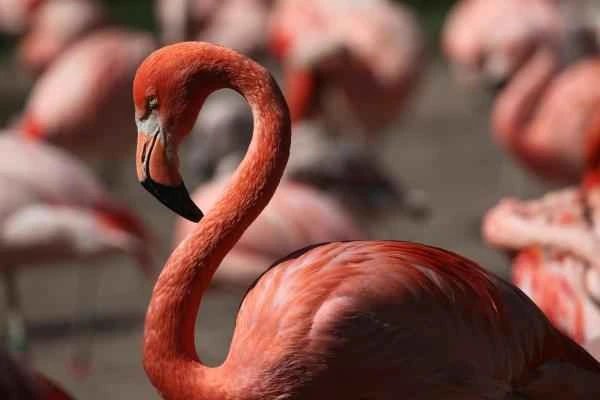
Caribbean Flamingo (Phoenicopterus ruber)
Distributed in tropical regions of the Americas, such as the Yucatan Islands in Mexico, Florida in the United States, the Galapagos Islands, Venezuela, and northern Colombia. Measuring 1.2 to 1.4 meters in length, with vibrant pink to almost red plumage, it is the largest flamingo in the Americas. Its curved beak is well-suited for feeding on algae, small crustaceans, and insects.
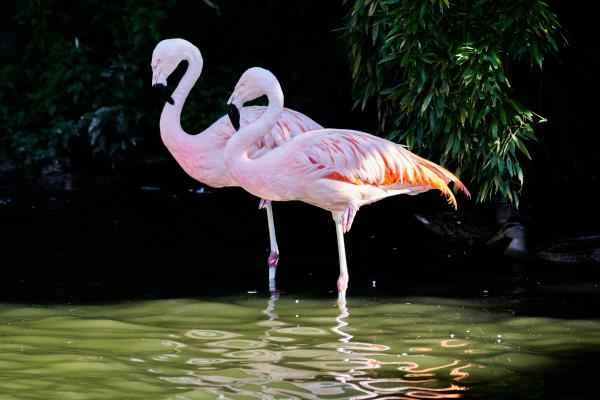
Chilean Flamingo (Phoenicopterus chilensis)
Widely distributed in South America, from Peru to Chile and Argentina. It measures 1 to 1.3 meters in length, with greyish-pink legs, a mostly black beak, and light pink feathers.
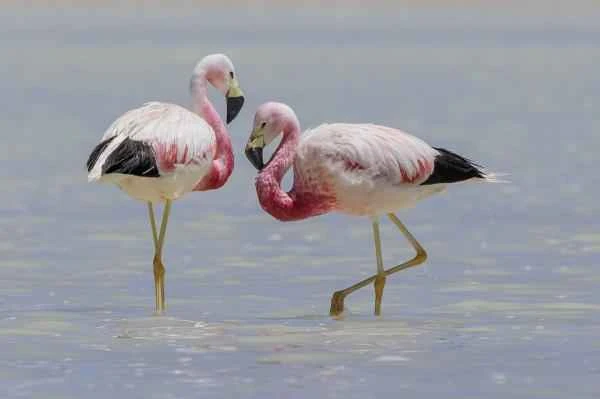
Andean Grand Parina (Phoenicoparrus andinus)
Found in the Andes Mountains, it has yellow legs and is about 1 meter in length. Its tail is black, and its neck and chest are pink. It is the largest flamingo in the Andes.
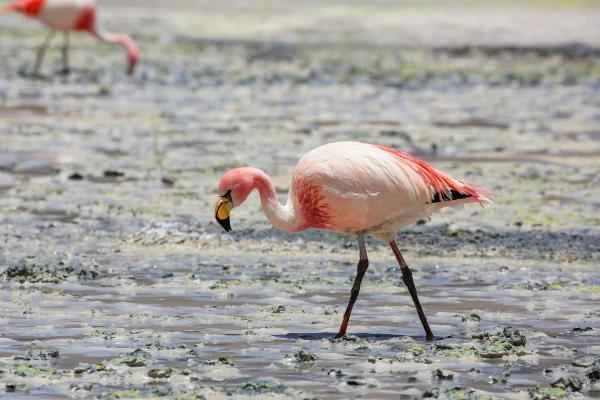
James Parina (Phoenicoparrus jamesi)
Endemic to the Andes Mountains, it is the smallest in size, with a relatively straight and orange beak, a red neck and back, and fewer black feathers on its tail.
European common flamingo (Phoenicopterus roseus)
Widely distributed, covering southern Asia, Africa, and southern Europe. It measures 1.1 to 1.5 meters in length, with light pink plumage and bright red wings. It has a long neck that bends in a U-shape when feeding.
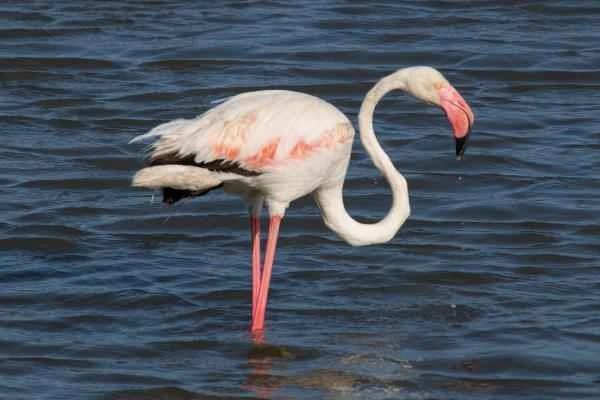
Lesser Flamingo (Phoenicopterus minor)
The smallest in size, ranging from 80 cm to 1 meter, it is distributed in South Asia and Africa, and occasionally appears in Spain. It primarily inhabits rift valley lakes, feeding on algae-rich water. Its beak is entirely black with a red tip, and its plumage is pale pink to white.
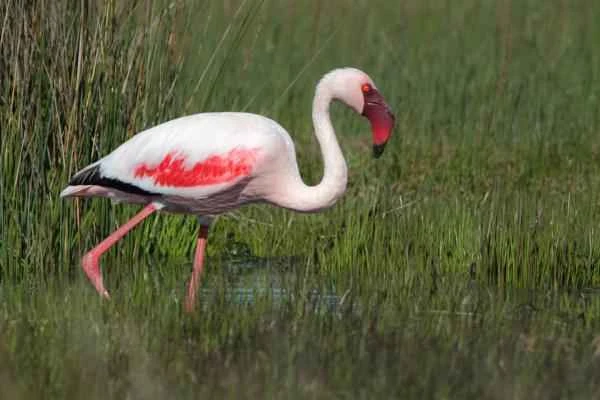
Which flamingos are endangered?
Chilean flamingos : Close to being threatened, their numbers are declining due to egg collection and water resource exploitation.
James Parina Jr .: Close to being threatened by climate change leading to food shortages, and impacted by egg harvesting and tourism pressures.
Andean Grand Parina : Vulnerable, declining population, egg harvesting, declining water levels, and habitat destruction due to mining.
Little Flamingos : Nearly threatened, with only three breeding grounds remaining, affected by hydroelectricity and mining.
To learn more, please visit the sections on "Fox Species" and "Seagull Species".