The earliest record of humans and pandas traveling together can be traced back to the Lufeng ape in Yunnan. Records of humans and pandas traveling together can also be found at dozens of well-known archaeological sites, including Lantian Man, Peking Man, Hexian Man, Maba Homo sapiens, Liujiang Homo sapiens, Heliang Homo sapiens, and Guandu Homo sapiens.
The term "coexisting" refers to the fact that prehistoric humans and pandas once lived in the same natural environment, coexisting for 8 million years to the present.
In the years that humans and pandas have lived together, their relationship has not always been smooth sailing. From the perspective of human thought development, it has roughly gone through several stages: harmonious coexistence, pandas becoming "dinner delicacies," and pandas being treated as pets.
Early stage: Harmonious coexistence
Harmonious coexistence indicates fewer conflicts and that humans and animals are not in a subordinate relationship. Such a harmonious environment can only be seen in the era of Lufeng apes and early pandas.
The Lufengpithecus lived 8 to 7 million years ago. While its physical morphology showed potential for bipedalism, its overall structure had not yet completely deviated from the ape category. Generally, they would not actively attack other animals. Looking at the composition of the Lufeng fauna, the greatest threat to the early panda was not Lufengpithecus, but the saber-toothed tiger.
In earlier times, there were also a Lesser Panda and a Wuling Mountain Panda, living alongside "Wushan Man," "Jianshi Man," and a large primate called Gigantopithecus. In such an ecological environment, could the Lesser Panda have been prey for "Wushan Man," "Jianshi Man," or even Gigantopithecus? The answer is yes. However, the burial information at the "Wushan Man" and "Jianshi Man" sites shows that the Lesser Panda fossils are well-preserved, with no signs of cutting or smashing on the bone surface. In contrast, the bones of large herbivores such as elephants, rhinoceroses, cattle, and deer often have numerous cutting and smashing marks. These characteristics indicate that the Lesser Panda and the Wuling Mountain Panda were not considered prey by "Wushan Man" and "Jianshi Man." However, regardless of the type of panda, an encounter with these ancient humans would likely have been fraught with peril.
Overall, the relationship between the early panda, the lesser panda, the Wuling Mountain panda, and the Lufeng ape, the Wushan ape-man, and the Jianshi ape-man was more harmonious than fearful.
Mid-term: "Delicious Food for the Dining Table"
The period between 100,000 and 20,000 years ago was the peak of the population growth of *Ailuropoda bazheni*, coinciding with a period of high development in human intelligence. Preliminary statistics show that *Ailuropoda bazheni* fossils or sub-fossils have been found at sites including those of *Lantian Man*, *Yunxi Man*, *Peking Man*, *Hexian Man*, and Homo sapiens such as Changyang Man, Maba Man, Liujiang Man, Xichou Man, Xinglongdong Man, Heliang Man, and Guandu Man. Moreover, the unearthed fossils are relatively abundant, with a corresponding increase in well-preserved materials such as skulls and mandibles. Complete *Ailuropoda bazheni* skeletons have also been discovered in places like Yanjingou in Chongqing and Qujiang in Guangdong.
The author examined numerous fossils of *Pterocarya spp.* unearthed from various human archaeological sites and discovered that many specimens bore cut marks. For example, the fracture of the *Pterocarya spp.* humerus from the Peking Man site did not appear to have been caused by natural factors. Similarly, the *Pterocarya spp.* from the Hexian Man site showed fragmented material with pitted scars on the fracture surface. This information suggests that during the panda's heyday, its relationship with the hominids and Homo sapiens it coexisted with evolved from an early "harmonious" one to a subordinate one. To put it bluntly, at this time, the panda had become a "delicacy" for prehistoric humans.
Late stage: Treating pets
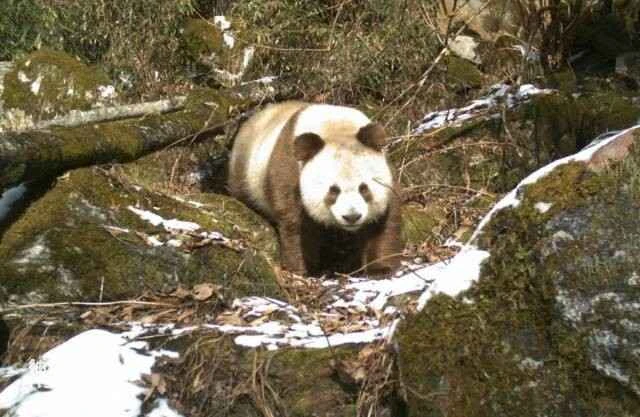
From the Neolithic Age to the present day, humankind, who have accompanied them, has transitioned from primitive society to civilized society, and from destroying the ecological environment to protecting nature and caring for the global village. Needless to say, the panda, hidden deep in the mountains and forests, has also changed its fate, gaining worldwide attention and becoming a pet for men, women, the old, and children.