Chitons are a very ancient and primitive group of marine mollusks belonging to the class Polyplacophora. They have a unique appearance, with their shells composed of multiple plates. They are incredibly diverse, with over 850 known extant species worldwide, not including extinct fossil species. Although often overlooked, chitons are of immense research value in evolutionary, physiological, and ecological studies.
This article will provide a detailed introduction to the morphological characteristics, feeding methods, living habits, and unique reproductive strategies of chitons, helping readers to gain a comprehensive understanding of this mysterious primitive marine creature.
Morphological characteristics of chitons
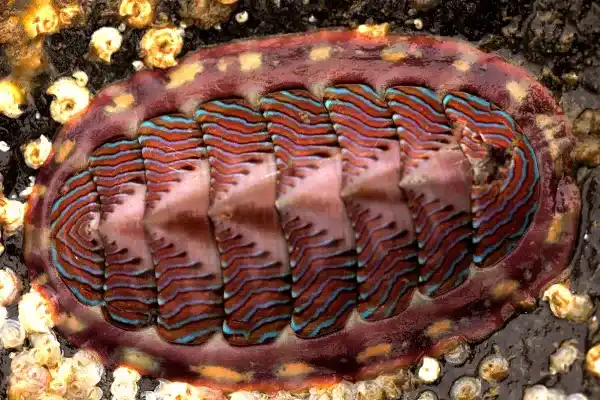
As a member of the molluscs family, the chiton differs from common shellfish (such as mussels and clams) in that its body structure is highly specialized and possesses the following distinctive characteristics:
Eight overlapping shell plates : arranged in an interlaced pattern on the back, highly flexible, helping to adapt to irregular rock surfaces or curl the body into a ball to defend against predators. These plates are divided into inner (for connection) and outer (for protection).
The mantle with fleshy structures at its edges , called the "skirt," extends from the body's mantle. This skirt is covered with channels for water intake and drainage, through which water passes through the gills for gas exchange. Each individual has 11 to 80 pairs of gills.
Photoreceptor cells "aesthete" : Although it has no eyes, the chiton's shell is covered with thousands of photoreceptor cells that can sense changes in light. These cells regenerate continuously due to water erosion.
Their body length is mostly 1 to 10 centimeters , with a few species reaching over 30 centimeters.
The soft abdomen and body are hidden under the carapace, the head is degenerate, the mouth is located at the front and the anus is located at the tail end.
It has no appendages , but moves by using a strong central ventral foot. The ventral foot also has an adhesive function, allowing it to firmly adhere to substrates such as rocks and resist tidal impacts.
The reproductive pore and excretory pore are located on both sides of the body and are used for reproduction and excretion, respectively.
It has a well-developed muscular system , which facilitates movement and enhances the suction power of the abdomen and feet.
Typical nocturnal animals : They are almost inactive during the day, have excellent camouflage, move slowly, and their hard shells make them difficult to spot in the wild. They have very few natural predators, and in some areas, humans consume them as food, especially in some coastal communities in tropical regions.
Chitons have had their body structure for 500 million years and have remained virtually unchanged since then, making them one of the oldest living mollusks.
Chiton diet: mainly algae and microorganisms.
Most chitons are herbivorous or microbial , primarily feeding on algae and bacteria attached to rocks. Their feeding ability depends on the following two major physiological structures:
Rádula : A file-like organ covered with countless tiny teeth made of iron and silicon, incredibly hard, capable of scraping algae off rock surfaces. It also feeds on microorganisms, such as protozoa, that live on the surface of these algae.
Cilia : They transport food in the mouth and throat and secrete mucus to send it to the stomach for digestion.
Some large chiton species prey on small invertebrates. These species typically have smaller shells and more developed mantles, which they can lift to form a "lid" that attracts crustaceans or fish fry to escape predators. Once inside their range, they quickly "close" their bodies to capture the prey.
Habitat distribution of chitons
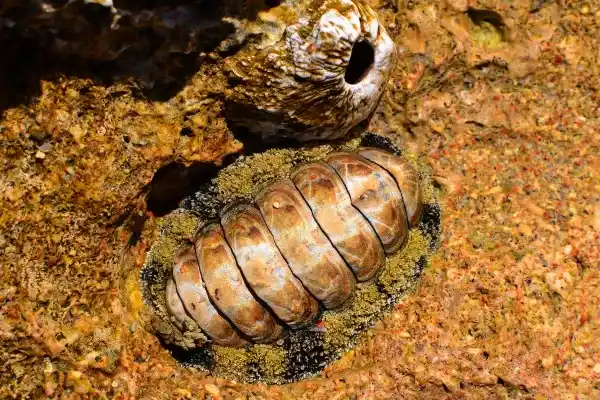
Chitons are typical marine organisms that live only in seawater . They are widely distributed in shallow seas and intertidal zones around the world, from temperate waters to tropical coral reefs, and even in Antarctica.
Most live on intertidal rocks , but some species are found in deep water, even in dark, lightless deep-sea areas.
It can tolerate short periods of dryness and survive even when the tide recedes.
Their habitats are diverse , including natural rocks, coral reefs, and even man-made structures such as docks, ship bottoms, and seawalls.
Migratory behavior based on memory : Chitons possess the ability to "remember topography" and "track chemical cues". Even if they leave their original location due to tides or other reasons, they can still return to their original habitat through the sensing of photoreceptor cells, touch, and chemical substances.
Chiton reproductive methods
Chitons are animals that reproduce through external fertilization and are dioecious. Their reproductive process is as follows:
The female encapsulates her eggs in mucus and releases them in strings into the seawater.
The male releases sperm at the same time, and the sperm and egg meet through the water flow to complete fertilization.
After fertilization, it develops into a free-swimming larva, gradually developing a carapace and abdominal foot, and finally settles on the base to begin a benthic life.
Some species have internal fertilization mechanisms, where the female fertilizes inside her body and lays the eggs externally. Even rarer is ovoviviparity , where the embryo develops inside the female's mantle until it is fully formed and then born.
In summary: Why should we pay attention to chitons?
Although chitons are not familiar to most people, they represent "living fossils" of mollusc evolution and possess extremely high scientific and ecological value. Their unique feeding structure, ecological behavior, and ancient morphological structure enable them to play an important role in marine ecosystems.
References
Beatty, R., Beer, A., & Deeming, C. (2010). The Book of Nature. Dorling Kindersley, UK.
Ibáñez, C., Sellanes, J., & Pardo-Gandarillas, MC (2016). Diversity of tropical polyplacopods in the southern provinces of Panama. Journal of Latin American Aquatic Research, 44(4), 807–814.