Keeping pandas as pets is not in the nature of modern people. Turning to historical records, we can trace it back to the Western Han Dynasty. The origin of the story begins with the discovery of the Southern Han Mausoleum.
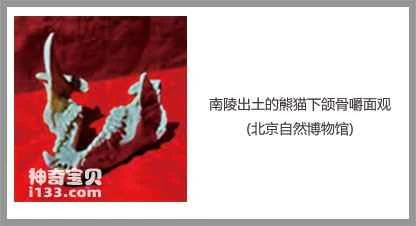
In early June 1975, news spread from Bailuyuan, a suburb of Xi'an, Shaanxi Province: local farmers, while constructing a reservoir on Bailuyuan (locally known as Dizhaiyuan), discovered several small rectangular pits near the Han Nanling Mausoleum. Pottery figurines and animal bones were unearthed from these pits. Among these remains, the most noteworthy was a well-preserved panda skull. Later, the Shaanxi Provincial Institute of Archaeology verified that this skull originated from the "Han Nanling," dating back over 2100 years, the tomb of Empress Dowager Bo of the Western Han Dynasty.
The famous imperial garden rhapsody, *Shanglin Fu*, also mentions tapirs, or pandas, in the garden. It seems those who arranged the funeral knew of Empress Dowager Bo's affection for pandas, which is why they allowed them to be buried with her. So why did Empress Dowager Bo love pets? The Han Dynasty history records the following:
Empress Dowager Bo, originally named Bo Ji, was a concubine of Emperor Gaozu of Han (Liu Bang). She bore him a son named Liu Heng. After Emperor Gaozu's death, Empress Lü seized power. From then on, Bo Ji suffered mistreatment. Empress Lü sent her to live in Liu Heng's fiefdom in Shanxi. There, she immersed herself in the beautiful scenery of the mountains and forests, befriending cattle and sheep, and living a peaceful, idyllic life...
After Empress Lü's death, the court officials unanimously supported Liu Heng as emperor. Thus, Consort Bo became Empress Dowager Bo. In this light, it's not difficult to understand why pandas and other animals were among Empress Dowager Bo's burial goods, as she loved animals during her lifetime.
Measurements revealed that the panda skull found in the burial goods was 312 mm long, with a base length of 254 mm, a height of 159 mm, an orbital distance of 50 mm, and a width of 210 mm. These measurements are approximately one-eighth smaller than fossil panda skulls from 200,000 years ago, but similar to those of modern pandas. The specimen's bone surface is white and not fossilized. The sutures are fused, and the teeth show signs of wear, indicating it was an adult panda. Chronologically, only about 2100 years have passed since the Western Han Dynasty; fossilization is generally impossible in such a short period. However, what is intriguing is why this panda skull was preserved in Empress Dowager Bo's burial pit.
Two questions are worth exploring: First, did pandas live in the Xi'an area more than 2,100 years ago? Second, were the pandas in the burial pit of Empress Dowager Bo her pets?
Historical research indicates that my country's climate has fluctuated several times over the past 5,000 years, experiencing both cold and warm periods. During the Qin and Han dynasties, the climate was warm, with abundant rainfall in the Guanzhong Plain. The area near Fanxi (southeast of present-day Baoji City) was described as having "dense bamboo groves and lush forests," a scenic spot praised by poets, with "Hudu Bamboo Grove" being a renowned name. Therefore, archaeologists believe that the panda found in Empress Dowager Bo's burial pit was not captured from elsewhere before her burial, but rather evidence of the local presence of this animal.
I agree with this analysis. At that time, the climate and natural environment north of the Qinling Mountains were perfectly suitable for pandas to survive. Aren't there still pandas active in the Changqingshan area of the Qinling Mountains today? Moreover, given the warm climate at that time, pandas could have easily expanded their activity radius slightly to cross the Qinling Mountains and reach the outskirts of Xi'an or even further afield.
As for whether Empress Dowager Bo kept pandas as pets, we can no longer visit her now. However, considering her life of enjoying the beauty of the mountains and forests, living a peaceful and idyllic life with her cattle and sheep, would she have been indifferent when she first saw a panda with a short head, a wide face, black eye rings and black ears against a backdrop of white fur, its elegant appearance resembling a natural cartoon animal? Of course not. In Empress Dowager Bo's mass grave, besides pandas, there are also cats and dogs. People both in ancient and modern times have loved these mammals and kept them as pets.
In my opinion, when Empress Dowager Bo saw the image of the panda, her emotions were no less than those of an American explorer, Ms. Ruth, when she saw the panda "Shulin" in Xikang, Sichuan.
Ms. Ruth described her encounter with the panda "Shulin" as follows: In 1928, when I was holding a panda cub in Xikang, Sichuan, I was very excited. It was warm in my arms. It kept rubbing its nose against my clothes and instinctively searched for my breast. It looked like it had just been born and weighed less than 4 pounds. I immediately named it "Shulin".
Ruth's affection for the panda "Shulin" expresses the love that all of humanity has for pandas.
Reading archaeological excerpts about humans and pandas has prompted us to reflect on the future of pandas. Pandas are an endangered species; how much longer can they continue to coexist with us? This is a question I've long shared. As mentioned above, from the earliest panda to the modern panda, their reproduction has been continuous, without interruption or abnormalities. From a microscopic perspective, bone structure, tooth structure, and trabecular bone have all developed naturally.
Recently, researchers including Wei Fuwen from the Institute of Zoology, Chinese Academy of Sciences, extracted DNA from panda feces and confirmed that wild pandas possess above-average genetic diversity among endangered carnivores, indicating a healthy population with high genetic diversity and evolutionary potential for rejuvenation and even long-term survival. This suggests that pandas have a better survival ability than previously thought.
I agree with the research findings of Wei Fuwen and other scholars. However, for a species to be removed from the endangered list, the integrity and stability of its population and the inherent genetic diversity of the species must be guaranteed; none of these three can be lacking.
In this way, pandas will continue to thrive alongside humans, unless they are deprived of their habitat.