Around the world, scientists have discovered numerous tiny fossils in various marine strata from the Cambrian to the Triassic periods. These fossils resemble various types of teeth, but because they cannot be linked to the teeth of any known animal, scientists have been unable to determine their taxonomic classification. They have been grouped together and named "conodonts," and are believed to be organs of some extinct marine animal.
Conodonts exhibit diverse morphologies, broadly categorized as conical, rod-shaped, plate-shaped, and platform-shaped. Scientists have correspondingly classified them into three main types: conical, composite (including rod-shaped and plate-shaped conodonts), and platform-shaped.
The main chemical component of conodont is calcium phosphate, which is generally insoluble in weak acids. Conodonts excavated from strata are often amber-brown, but as the temperature rises, their color changes from amber-brown to black to light gray, becoming transparent or opaque, and their texture becomes very brittle after metamorphism.
Conodonts are abundant in strata coexisting with cephalopod fossils and fish fossil fragments. They are also present in rock strata containing brachiopods, bivalves, gastropods, trilobites, crinoid stems, and graptolites. However, they are less abundant in limestone containing stromatoporoids, reef corals, large brachiopods, and ostracods.
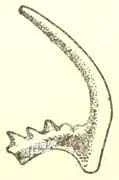
conodont