The Tasmanian tiger is to Australia what Bigfoot is to North America—a creature frequently sighted by bewildered amateurs but never actually kept in captivity. The difference, of course, is that Bigfoot is entirely mythical, while the Tasmanian tiger was a true marsupial that went extinct only about a hundred years ago.

1. It is not a real tiger.
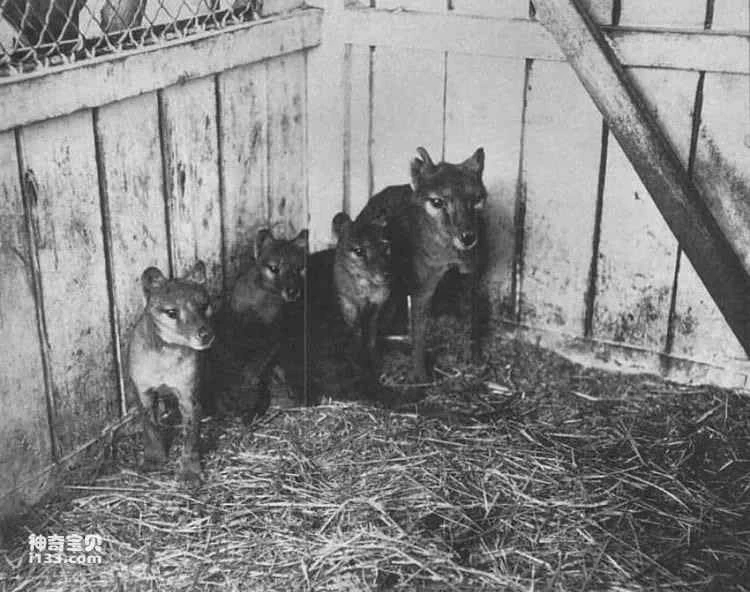
A thylacine with three cubs, Hobart Zoo, 1909
The Tasmanian tiger gets its name from the distinctive tiger-like stripes on its lower back and tail, making it more like a hyena than a large cat. Although this "tiger" is a marsupial, possessing a typical marsupial pouch in which the female raises her cubs, it is more closely related to wombats, koalas, and kangaroos. Another common nickname is the Tasmanian wolf, which makes more sense given the animal's resemblance to a large dog.
2. It is also known as the thylacine.
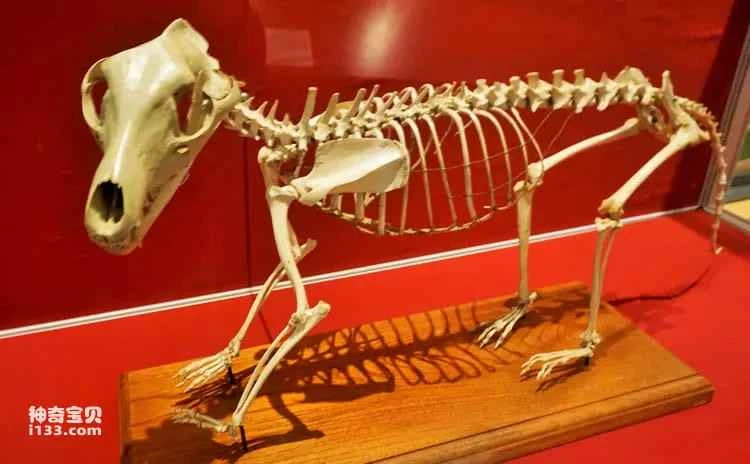
Tasmanian skeleton at the National Museum of Australia
What if "Tasmanian tiger" is a deceptive name? The genus and species name for this extinct predator is *Thylacinus cynocephalus* (literally Greek for "mammal with a pouch on its head"), but naturalists and paleontologists usually call it the Tasmanian wolf. If the word sounds familiar, it's because it contains one of the roots of *Thylacoleo*, a saber-toothed tiger-like predator that disappeared from Australia around 40,000 years ago.
3. It became extinct in the mid-20th century.
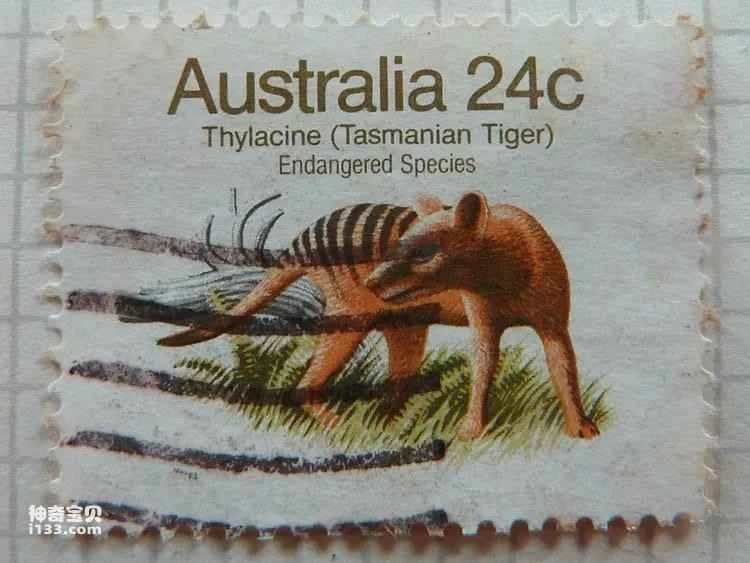
Tasmanian stamps
Around 2,000 years ago, the Tasmanian tiger population in Australia declined rapidly due to pressure from Aboriginal settlers. The last remaining survivors lived on the Australian island of Tasmania until the late 19th century, when the Tasmanian government issued bounties for the tiger due to its predatory diet of sheep, a vital part of the local economy. The last Tasmanian tiger died in captivity in 1936, but it remains possible to avert the species' extinction by recovering fragments of its DNA.
4. Both males and females have brood pouches.

Tasmanian tiger
In most marsupials, only females possess a brood pouch, which they use to incubate and protect their premature offspring (unlike placental mammals, which give birth in the uterus). Oddly enough, male Tasmanian tigers also have a brood pouch, which can cover their testicles when necessary—presumably when it's cold outside, or when they are competing with other male Tasmanian tigers for mating rights.
5. They sometimes hop like kangaroos.
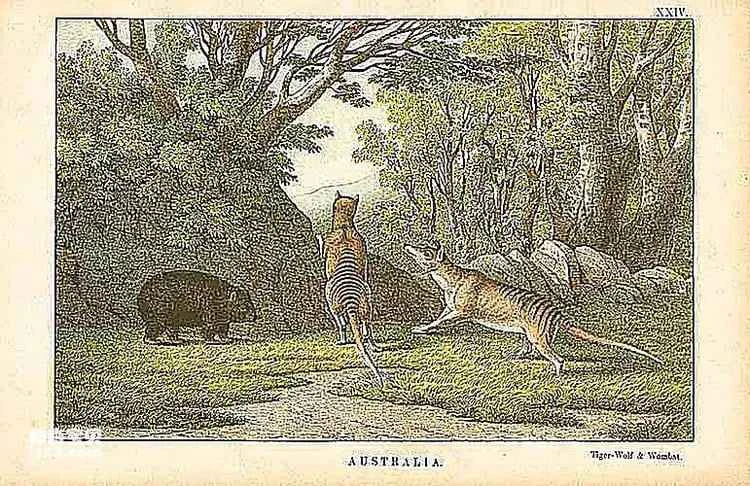
Artwork depicting the Tasmanian tiger
Although Tasmanian tigers resembled dogs, they did not walk or run like modern canids, and they were certainly not suited for domestication. When startled, Tasmanian tigers would briefly and nervously leap on their hind legs, and witnesses testified that their movement at high speeds was stiff and clumsy, unlike that of wolves or large cats. It is speculated that this lack of coordination did not prove effective when Tasmanian farmers relentlessly hunted them, or when their imported dogs chased them.
6. A typical example of convergent evolution
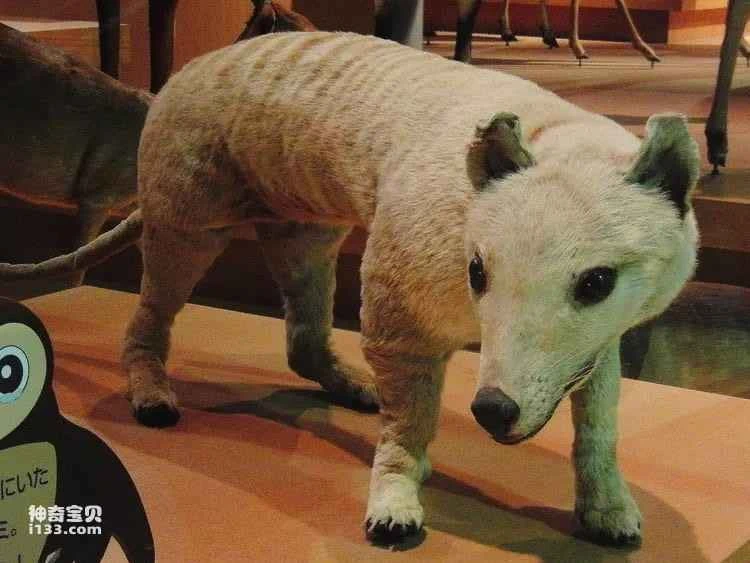
Tasmanian tiger specimen
Animals occupying similar ecological niches often evolve the same general characteristics; witness the similarities between ancient long-necked sauropod dinosaurs and modern long-necked giraffes. Although strictly speaking, the Tasmanian tiger was not a canid, it played the role of a "wild dog" in Australia, Tasmania, and New Guinea—so much so that even today, researchers often have difficulty distinguishing dog skulls from those of the Tasmanian wolf.
7. It may hunt at night.
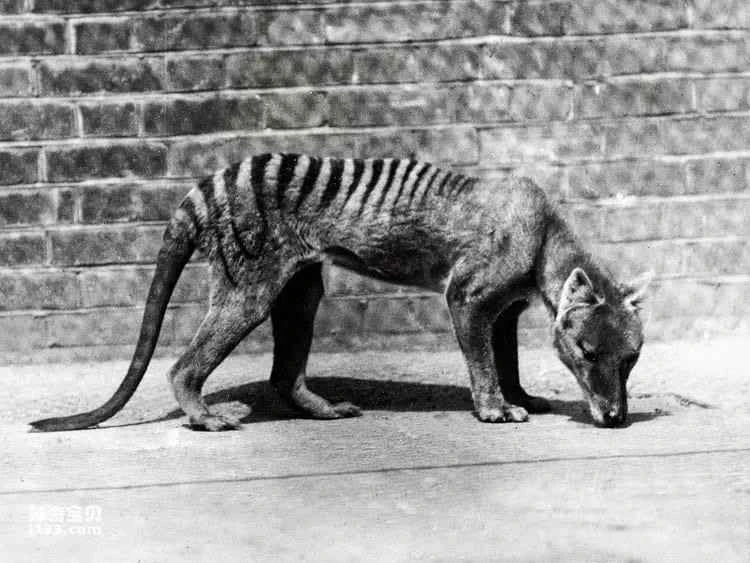
Tasmanian tigers in captivity
Thousands of years ago, when the first indigenous humans encountered the Tasmanian tiger, the Tasmanian tiger population was already declining. Therefore, we don't know whether the Tasmanian tiger's nocturnal hunting was a given, as European settlers at the time pointed out, or whether it was forced to adopt a nocturnal lifestyle rapidly due to centuries of human encroachment. In any case, it would have been far more difficult for European farmers to find the sheep-eating Tasmanian tiger in the middle of the night, let alone shoot it.
8. Its bite force is surprisingly weak.

The last female Tasmanian tiger captured before its extinction.
Until recently, paleontologists speculated that the Tasmanian tiger was a social animal capable of hunting larger prey, such as giant wombats the size of SUVs and weighing over two tons, through cooperative hunting. However, a recent study suggests that the Tasmanian tiger's jaw was relatively weak compared to other predators, making it unable to hunt animals larger than small wallabies and ostriches.
9. The closest living relative is the ribbon anteater.

The marsupial anteater is a close living relative of the Tasmanian tiger.
The Pleistocene epoch saw a dizzying array of marsupial ancestors in Australia, making it challenging to determine the evolutionary relationships of any particular genus or species. The Tasmanian tiger was once thought to be closely related to the extant Tasmanian devil, but evidence now suggests a closer relationship with the marsupial anteater, a smaller and less exotic animal.
10. Some people insist that the Tasmanian tiger still exists.
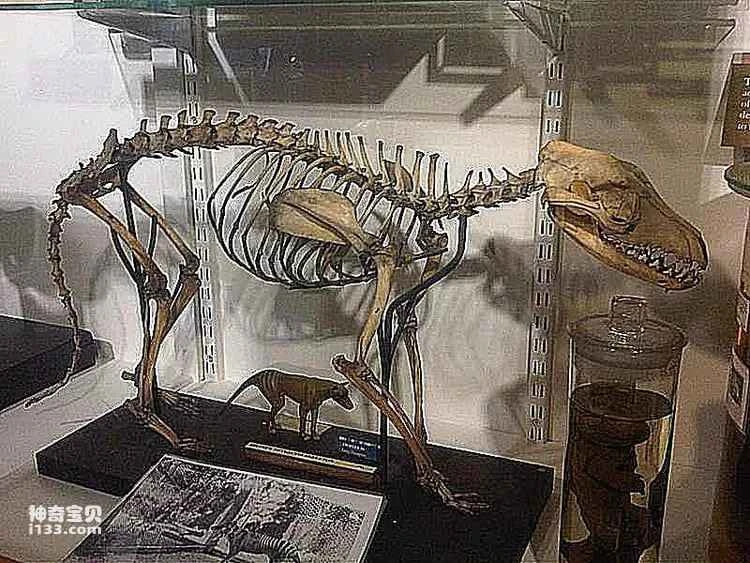
Grant Zoological Museum
Given that the last Tasmanian tiger died in 1936, it's reasonable to assume that scattered adult tigers roamed Australia and Tasmania throughout the mid-to-late 20th century, but any subsequent sightings are purely speculative. In 1983, the somewhat eccentric American media mogul Ted Turner offered a $100,000 reward for a live Tasmanian tiger, and in 2005, an Australian news magazine increased the reward to $1.25 million. No one has yet made a purchase, which strongly suggests that the Tasmanian tiger is truly extinct.