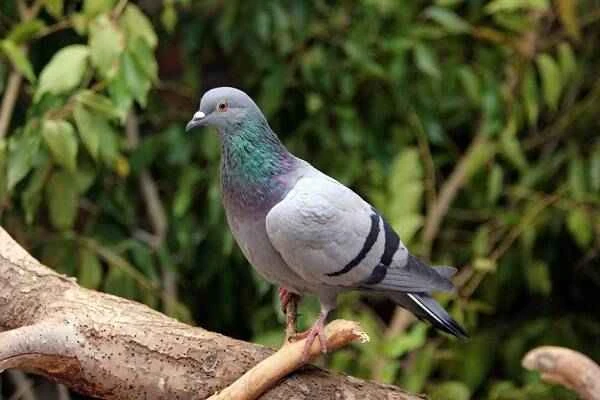
Pigeons, also known as doves, belong to the Columbidae family of the Dove genus. There are many species, including wild pigeons and domestic pigeons. Humans have been raising pigeons for over 7,000 years. According to Darwin's *On the Origin of Species*, "The earliest pigeon raising occurred in Egypt during the Fifth Dynasty, around 3000 BC."
Domestic pigeons were first domesticated in the Arabian region. Pigeon statues appeared in the Near East as early as 3100 BC. In Egypt, pigeon breeding began around 2600 BC.
Where does the name "pigeon" come from? According to the book *Hua Jing*, "The word 'pigeon' means 'to unite,' because it likes to unite, hence the dove also pairs with it." This means that pigeons are gregarious, which is why people call them pigeons. In Europe and America, pigeons are called "peace doves." Tracing its origin, there's an ancient myth: Legend has it that one day in ancient times, God discovered that human morality was deteriorating and was very angry, deciding to send a flood to destroy everything. However, some creatures had to be spared. God sent messengers to carefully investigate everywhere and determined that Noah and his wife were the only good couple. So, God instructed Noah to prepare a large, square wooden ark. A few days later, the flood came, turning everything into a vast ocean, swallowing everything. Only Noah's ark escaped the disaster and survived, drifting on the boundless waters. After a long time, the flood gradually receded, and some of the highest mountains were revealed. Seeing this, Noah sent one of the doves from the ark out to see what was happening elsewhere. Soon, a pigeon flew back carrying a green olive branch to announce: peace has arrived, and the world has regained its vitality.