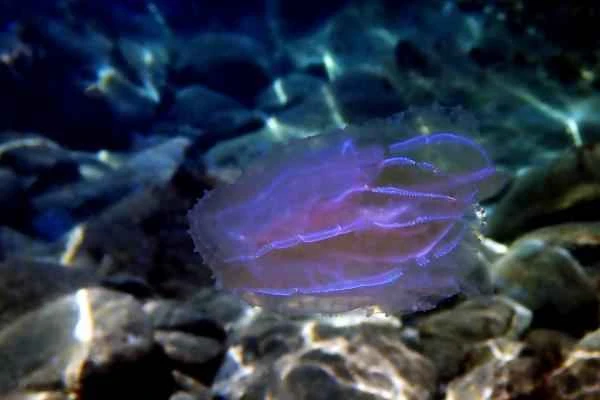
Comb jellyfish (Mnemiopsis leidyi) are amazing comb jelly-like invertebrates, renowned for their gelatinous appearance, ability to swim using cilia, and shimmering bioluminescence. Research suggests they appeared approximately 700 million years ago , making them among the earliest animals to evolve on Earth , even predating sponges. This discovery has revolutionized our understanding of animal origins.
What is a comb jelly?
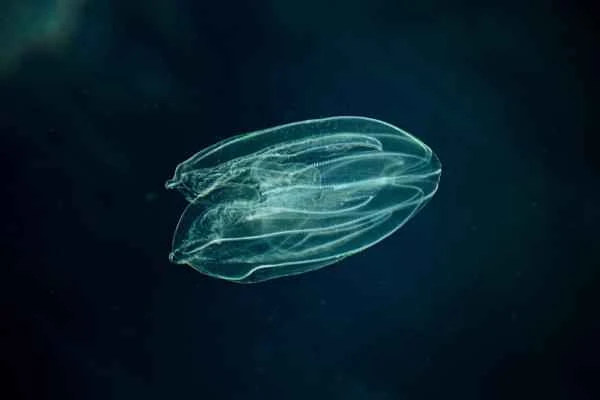
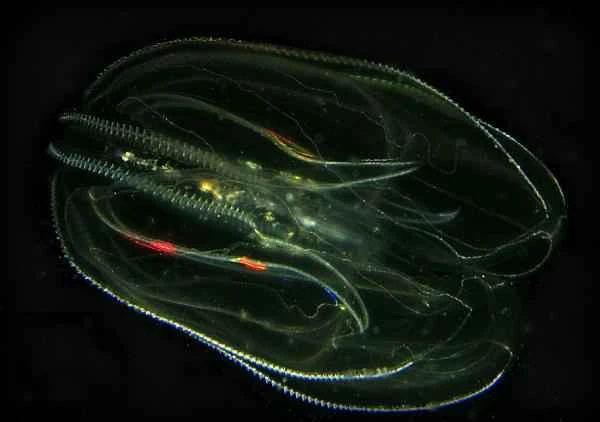
Comb jellyfish, also known as comb jellies , belong to the phylum Ctenophora. They are about 10 centimeters long and have transparent, soft bodies. They swim using rows of cilia and can produce blue or green bioluminescence for defense against predators. They are biblastic animals , with their bodies composed of an ectoderm and an endoderm, separated by a gelatinous mesoglea.
The comb mother lacks stinging cells on its surface, but instead possesses specialized coloblasts used to trap prey such as zooplankton, crustacean larvae, and fish juveniles. Distributed in the western Atlantic , it has now become an invasive species in parts of European and Asian waters, severely disrupting ecosystems.
There are about 100 to 150 known species of comb jellies in the world, many of which have colorful iridescent bands that are visually striking in the ocean.
When did they appear on Earth?
According to a recent study from the University of California, Berkeley, scientists have confirmed through chromosome-level genomic analysis that comb-shaped jellyfish are the earliest group of animals to diverge from a common ancestor , appearing in the Precambrian oceans approximately 700 million years ago .
Previously, the scientific community generally believed that sponges were the earliest animals, but this study shows that although they may share a common ancestor, comb jellies occupy an earlier branch on the evolutionary tree . They had soft bodies and therefore have no fossil record, but researchers were able to infer their primitive form by comparing their genes with those of extant species.
This finding redefines the origin of animals and provides a new perspective for understanding the evolutionary process of early multicellular life .
The evolutionary mystery of comb jellies
A research team led by Dr. Schultz discovered in the genome that the chromosome gene sequence of comb jellies differs from that of any other animal , yet shares similarities with certain non-animal single-celled organisms . This suggests that they may have evolved from a branch of a primitive single-celled ancestor .
In this hypothesis, some offspring evolved into comb jellies, retaining the chromosomal structure of their ancestors; while others underwent genetic recombination, evolving into sponges, cnidarians, and all other subsequent animal groups.
This profound divergence event can still be traced in the genomes of animals today, indicating a highly diverse evolutionary path in the early animal kingdom.
Summarize
Comb jellyfish are not only among the oldest animal groups on Earth, but their unique structure, physiology, and genetic characteristics also reveal another possible path to the origin of life. Their existence reminds us that the branches of the tree of life may be more diverse and complex than we once imagined.