The Helmeted Guinea Finch (scientific name *Numida meleagris*), also known as the Guinea fowl, is a unique bird species renowned for its distinctive appearance and pearly plumage. They hold an important place not only in nature but also in human culture, the food chain, and agricultural economies. Today, let's learn about this mysterious bird and explore its habits, physical characteristics, ecological roles, and relationship with humans.
Scientific Classification: Understanding the Scientific Name and Family of the Helmeted Guinea Frog
Before learning about the Helmeted Guinea Fowl, let's first look at its scientific classification.
Kingdom: Animalia
Phylum: Chordata
Class: Aves
Order: Galliformes
Family: Numididae
Genus: Numida
Species: Helmeted Guinea Fowl (Numida meleagris)
Other names: Guinea fowl, wild pheasant, pheasant, little pearl pheasant, mountain pheasant, and Guinea bird
Scientific classification tells us that the helmeted guinea fowl belongs to the order Phasians, a large group of birds including chickens and turkeys. Its distinctive pearly-spotted feathers and helmet-shaped head make it extremely conspicuous among birds, establishing it as a unique species.
Helmeted guinea fowl's appearance: distinctive feathers and a "helmet-shaped" head.
Appearance Overview
The Helmeted Guinea Finch has a very distinctive appearance. It is a medium-sized bird with a robust build, typically measuring 50 to 70 centimeters in length. Adults usually weigh between 1.5 and 2.5 kilograms , with little weight difference between males and females, though males are slightly heavier. Their wingspan is approximately 1.2 meters, and they are strong fliers, particularly adapted for fast flight and short glides. Their plumage is a mix of greyish-blue and dark blue, with white or grey spots covering the feathers on their chest and back, giving them the appearance of being draped in a magnificent, pearl-like coat from a distance.
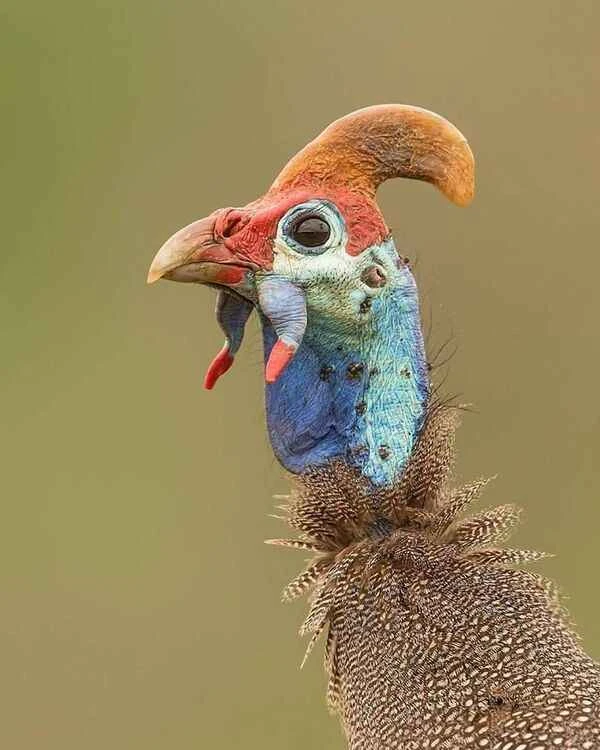
But what's most striking is undoubtedly the "helmet" on their heads. The helmeted guinea fowl has a hard, horny, armor-like protrusion on the top of its head, which contrasts sharply with its feathers and color, hence its name. This helmet-shaped protrusion helps it identify itself within the group, especially during courtship, where males display their "helmets" to attract females.
Feather diversity
The helmeted guinea fowl's feathers exhibit subtle color changes under varying light, a truly remarkable phenomenon. These feathers are not merely decorative; they play a crucial role in its survival in the wild. Through these spotted plumage, the helmeted guinea fowl blends better into its environment, avoiding detection by predators. Furthermore, these feathers provide a distinctive marking within the flock, facilitating communication and social behavior within the group.
How to identify the sex of a helmeted guinea fowl
Sex differences in helmeted guinea fowl are not very significant, but they can still be identified through the following aspects:
Size differences : Male helmeted guinea fowl are usually slightly larger than females, especially in weight and body length. Males are generally heavier, and their helmets are relatively larger and more prominent.
Head "helmet" : The male helmeted guinea fowl usually has a more prominent head "helmet," which is larger and more noticeable than that of the female, and its color is also more vibrant. The female's "helmet" is relatively smaller and its color is duller, presenting a more plain appearance.
Calling : Male helmeted guinea fowl emit a loud call during the mating season, which is higher-pitched and louder than that of females. Females, on the other hand, have a lower and softer call.
Feather characteristics : Male feathers are relatively brighter in color, especially the feathers on the neck and back, while female feathers are more subdued and the colors tend to be plain.
Habits and Life of Helmeted Guinea Frog
Lifestyle
Helmeted guinea fowl are gregarious birds, preferring to live in flocks, usually in small groups. Wild helmeted guinea fowl flocks can number in the dozens or even hundreds, communicating through calls and movements. When foraging, they search for food together in grasslands, forest edges, or open fields. Helmeted guinea fowl primarily feed on seeds, roots, and small insects, making them a typical omnivorous bird.
Foraging methods
Although helmeted guinea fowl are omnivorous birds, their favorite food is seeds, nuts, and fruits. Especially in autumn and winter, helmeted guinea fowl gather in areas with abundant vegetation to prey on ripe seeds and small insects. They are ground-foraging birds, often pecking at food on the ground or searching for hidden insects in the grass.
Courtship and Reproduction
The breeding season for Helmeted Guinea Finch is typically in the spring. During this time, males engage in intense courtship displays, showcasing their impressive plumage and "helmets," and attracting females with loud calls. Females usually choose larger males with more vibrant plumage as mates.
During the breeding season, females choose suitable locations to build nests, typically a simple nest on the ground covered with grass and twigs, where they lay about 6 to 12 eggs . The female is responsible for incubating these eggs, which takes about 25 days . After the chicks hatch, the female leads them to the ground to forage until they are capable of surviving independently.
Helmeted guinea fowl typically live 10 to 12 years in the wild, but under captive conditions, with proper management and feeding, they can sometimes live up to 15 years or even longer . Their lifespan is influenced by a variety of factors, including threats from predators, food availability, climate conditions, and habitat stability. In some areas, helmeted guinea fowl are also threatened by human activities, particularly habitat loss and overhunting, all of which negatively impact their lifespan.

Helmeted Guinea Finch Brooding Techniques
Helmeted guinea fowl are very meticulous in raising their chicks, and they have a very sophisticated set of breeding and chick-raising techniques.
Nest selection : During the breeding season, female helmeted guinea fowl will choose a secluded location to build their nest, usually in grass, bushes, or open ground. The nest is small and usually consists of dry grass, twigs, and other natural materials.
Incubation and rotating care : The female is responsible for incubating the eggs, while the male is responsible for providing food for the female and guarding against potential predators. The female incubates the eggs for about 25 days, during which time the male often loiters nearby, remaining vigilant.
Care of the chicks : After hatching, the female leads them to the ground to forage and teaches them how to find food. The male continues to protect the family nearby. The chicks are not entirely dependent on their parents for feeding in the first few weeks, but they still receive protection and care from them.
Parental roles : Males and females have a clear division of labor during the chick-rearing period. Females are primarily responsible for incubation, while males are mainly responsible for foraging and protection. Even after the chicks hatch, males continue to play a crucial role in the chicks' development, ensuring they are protected from predators.
Helmeted Guinea Frog Habitat and Distribution
Habitat preference
The helmeted guinea fowl's habitat is mainly concentrated in sub-Saharan Africa , especially in areas near grasslands, open forests, and farmlands. They prefer to inhabit areas with dense vegetation, which provides them with ample food sources and refuge. In addition to grasslands, the helmeted guinea fowl can also survive in semi-arid regions and can even adapt to some mildly arid conditions.
Distribution range
Helmeted guinea fowl are widely distributed across the African continent , especially in the tropical and subtropical regions south of the Sahara Desert. Their range extends from West Africa to parts of East and South Africa. Although their native habitat is in Africa, helmeted guinea fowl have been introduced and domesticated in some areas, particularly in parts of Asia, South America, and Europe, where they have become part of poultry farming as a bird with high ornamental and economic value.
Natural enemies and survival challenges of the helmeted guinea fowl
Natural enemies
Helmeted guinea fowl are not without enemies in their natural environment. Their main predators are birds of prey and some ground predators. For example, eagles, foxes, and some large reptiles, such as snakes, will attack chicks or adults. Especially when the chicks have just hatched, their small size makes them easy targets for predators.
The impact of human activities
Human activities, particularly agricultural development and habitat destruction, also threaten the survival of the helmeted guinea fowl. In some areas, habitat destruction due to agricultural expansion and urbanization has led to habitat loss and impacted food supplies. Furthermore, overhunting and illegal trade are also serious problems facing the helmeted guinea fowl.
List of Helmeted Guinea Finch Breeds
Below is a list of helmeted guinea fowl breeds, categorized by subspecies and varieties. The helmeted guinea fowl ( Numida meleagris ) has several major subspecies and local varieties, differing in appearance, habits, and habitat. The following table lists these breeds:
| Variety/Subspecies Name | describe | Distribution area |
|---|---|---|
| Helmeted Guinea Finch (Standard Breed) | It is medium-sized, with bluish-grey feathers, white or grey spots on its back, and a hard, horny, armor-like protrusion on its head. | Sub-Saharan Africa |
| Blue Helmet Guinea Fowl | It is relatively large in size, with predominantly blue feathers and densely packed spots, and its head armor is slightly blue. | West Africa, particularly Senegal and Gambia. |
| White-helmed Guinea Fowl | Its main features are white feathers and a helmet-shaped protrusion on its head. It is usually quite rare and has high ornamental value. | West Africa and East Africa |
| Highland Helmeted Guinea Finch (Numida meleagris melegaris) | It is smaller in size, with duller plumage, and its helmet is less prominent than that of the standard species. | The East African plateau region, particularly Kenya and Tanzania |
| South African Helmeted Guinea Finch | Similar to the standard species, but with more vibrant plumage, larger spots, a slightly more robust build, and a more prominent helmet protrusion. | South Africa and neighboring regions |
| Madagascar Helmet Guinea Finch | It is slightly smaller in size, with a more uniform feather color, mainly gray, with fewer spots, and its helmet is not as large as other breeds. | Madagascar |
| Angolan Helmet Guinea Finch | The feathers are relatively light in color, with a unique grayish-white hue, and the spots are evenly distributed. The helmet protrusion is relatively small. | Angola and Namibia |
illustrate:
The Standard Helmeted Guinea Finch is the most common breed, widely distributed across most of sub-Saharan Africa.
Blue-helmed guinea fowl and white-helmed guinea fowl are in high demand in the ornamental market because of their distinctive plumage and "helmet"-shaped protrusions, and are often kept as ornamental birds.
Highland Helmeted Guinea Finch mainly inhabit areas at relatively high altitudes. They are usually small in size and have rather plain plumage.
South African helmeted guinea fowl, with its bright plumage and large size, has become an important breed in commercial farming.
The Madagascar helmeted guinea fowl and the Angolan helmeted guinea fowl are unique breeds of their respective regions. Although their numbers are relatively small, there is still a certain market demand.
These varieties all belong to the same species—the Helmeted Guinea Finch. Different subspecies and local varieties differ in appearance, but they have similar living habits and habitats, mainly living in tropical and subtropical grasslands, forest edges, and open areas.
Exploring the history and origins of the helmeted guinea fowl
The helmeted guinea fowl is native to the grasslands and semi-arid regions south of the Sahara Desert in Africa. Their history dates back thousands of years, with archaeologists finding records of them in ancient Egyptian and other North African cultures.
Native habitat : The helmeted guinea fowl originated in the African continent, especially in the grasslands, forest edges, and farmlands of West and East Africa. They adapted to the arid and warm climate of these regions and gradually evolved unique physiological characteristics in these environments, such as the "helmet" protrusion on their heads and spotted feathers.
Relationship with humans : Helmeted guinea fowl held a special place in ancient African cultures. They were not only a food source but also frequently appeared in totems symbolizing wealth and good fortune. Over time, helmeted guinea fowl were gradually introduced to other regions, such as Asia, Europe, and South America, and became one of the domesticated poultry in many countries.
Domestication process : Helmeted guinea fowl have a long history of domestication. Although they originally lived in the wild, early farmers and tribes gradually discovered their good meat quality and adaptability, and thus began to domesticate them. Today, helmeted guinea fowl are poultry in many parts of the world, especially in rural areas of Africa, Asia, and Europe.
Five common diseases of helmeted guinea fowl and their prevention
Helmeted guinea fowl may encounter some common diseases during their rearing. Understanding these diseases and their prevention is crucial for ensuring the health of helmeted guinea fowl.
Pullorum disease : This is a common digestive system disease in helmeted guinea fowl, mainly caused by bacteria. Symptoms include diarrhea, decreased appetite, and weight loss. Prevention includes regularly cleaning the rearing environment, keeping feed fresh and dry, and vaccination.
Newcastle disease in chickens : This viral disease is fatal to helmeted guinea fowl, with symptoms including difficulty breathing, coughing, and watery eyes. Prevention mainly involves vaccination and avoiding contact with other infected birds.
Avian influenza : Avian influenza is a highly contagious disease that can be transmitted through the air. Helmeted guinea fowl can die rapidly once infected. Prevention methods include avoiding contact with other wild birds, maintaining cleanliness, and vaccination.
External parasite infestation : Helmeted guinea fowl are susceptible to external parasites such as ticks and fleas. Infestations can cause skin inflammation, feather loss, and other problems. Regular deworming of helmeted guinea fowl can effectively prevent these problems.
Chronic respiratory disease : Respiratory diseases are usually caused by bacterial or viral infections, and symptoms include coughing, runny nose, and difficulty breathing. Maintaining a well-ventilated environment and timely treatment are key to preventing this disease.
Economic value and cultural significance of helmeted guinea fowl
Helmeted guinea fowl not only play an important role in nature, but also have high economic value and cultural significance in human society.
Economic Value : Helmeted guinea fowl meat is delicious and rich in protein, vitamins, and minerals, making it an important meat source in some regions. Their eggs are also popular with consumers, especially in some restaurants and high-end markets. Furthermore, the helmeted guinea fowl's feathers, with their beautiful speckled effect, are often used as ornaments, giving them commercial value.
Cultural Significance : In Africa, the helmeted guinea fowl is considered a symbol of wealth and good fortune. In some traditions, its feathers are used as headdresses, handicrafts, or gifts. In certain cultures, the helmeted guinea fowl also symbolizes prosperity and family happiness, and often appears in festivals and ceremonies.
Ecological Value : Helmeted guinea fowl also play an important role in the ecosystem, helping to control insect and plant populations and maintain food chain balance through foraging. In agricultural areas, they are sometimes used as natural pest controllers, reducing pest numbers in farmland.
Helmeted guinea fowl annual sales
The annual sales volume of Helmeted Guinea Finch is influenced by a variety of factors, including regional demand, market acceptance, and the scale of breeding. Because it is widely raised as poultry or ornamental birds in some countries and regions, its annual sales volume varies significantly. The following are some common trends regarding the annual sales volume of Helmeted Guinea Finch:
1. Poultry Market
Helmeted guinea fowl are a popular poultry breed in some countries, particularly in Africa and Asia. Their meat is tender and nutritious, making them a premium meat product. They are especially favored at festivals and banquets. Depending on market demand, annual sales of helmeted guinea fowl can range from several million to hundreds of thousands. For example, in some African countries, annual sales can reach hundreds of thousands.
2. Meat consumption
In some high-end markets (such as the Middle East, Southeast Asia, and parts of Europe), helmeted guinea fowl are favored as a delicacy, especially during festivals and in upscale restaurants. Their meat is considered more tender than that of traditional poultry, making them a significant consumer product in the meat market. Depending on market demand, sales in this segment could range from tens of thousands to hundreds of thousands of birds.
3. Pet and Pet Market
Helmeted guinea fowl also have a certain market demand in some regions as ornamental birds and pets. Their distinctive appearance, especially the "helmet"-shaped protrusion on their heads, makes them popular among bird enthusiasts. Therefore, a certain number of helmeted guinea fowl are bred and sold as ornamental birds each year. Although sales in the ornamental market are relatively low, they remain a popular species in some specific bird trading markets.
4. International Trade
The trade in helmeted guinea fowl also extends to some international markets, especially in regions with strong bird enthusiast and culinary cultures. In some countries, helmeted guinea fowl enter the market as imported poultry, and their sales are affected by the global trade environment.
Summarize
The annual sales volume of helmeted guinea fowl varies greatly depending on market demand in different countries and regions, making it difficult to provide a single, unified figure. Generally speaking, the annual sales volume of helmeted guinea fowl may range from hundreds of thousands to millions of birds, depending on the demand for them as poultry and ornamental birds, as well as market acceptance.