On December 7, 2000, the prestigious British scientific journal Nature published a scientific paper by Xu Xing, Zhou Zhonghe, and Wang Youlin, young scientists from the Institute of Vertebrate Paleontology and Paleoanthropology of the Chinese Academy of Sciences, revealing their latest discovery of the world's smallest theropod dinosaur—Microraptor.

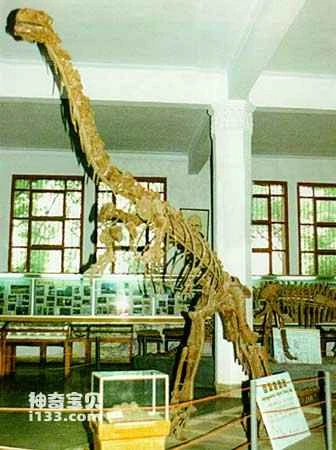
Paleozoological Museum of China
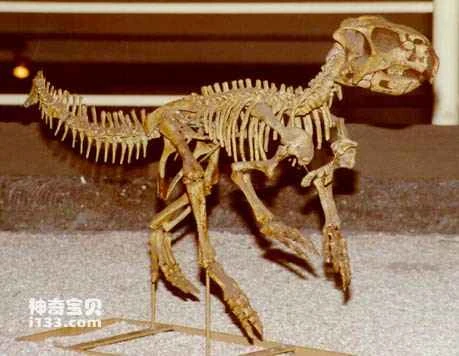
Psittacosaurus
For a long time, influenced by various media, dinosaurs have been perceived by the general public as enormous creatures. However, scientists have long discovered many small dinosaurs. The Psittacosaurus exhibited at the Paleozoological Museum of China is one example, measuring less than 1 meter in length. However, all previously discovered adult dinosaurs were larger than Archaeopteryx, the world's most primitive bird. This time, Chinese scientists have finally discovered a dinosaur whose adult form is even smaller than Archaeopteryx, measuring less than 40 centimeters in length. This "dwarf dinosaur," named Microraptor, belongs to the Pondosauridae family and is a close relative of the Velociraptor depicted in the famous movie *Jurassic Park*.
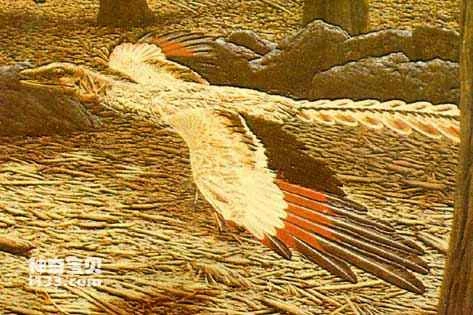
Archaeopteryx
Even more interestingly, through their study of the hind leg bone structure of Microraptor, Xu Xing and other scientists discovered that Microraptor was not only adept at running like other small theropod dinosaurs, but it also possessed the ability to climb trees, suggesting that it may have had amphibious habits. This discovery provides important evidence for the first time for the arboreal theory of the origin of birds' flight ability.
Looking back at the research history of recent decades, although a growing number of paleontologists have supported the theory that birds originated from dinosaurs, the debate over the origin of birds' flight ability has remained intense. Since theropod dinosaurs are generally considered to be terrestrial animals adept at running, most scholars who support the theory of bird origin from dinosaurs also support the theory that birds' flight ability originated from running. However, some scientists support the arboreal theory of the origin of birds' flight ability.
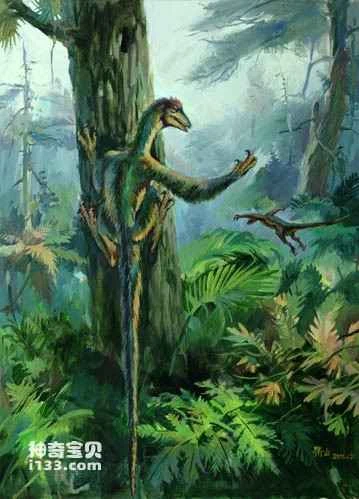
Microraptor
Scientists Chatterjee from Texas Tech University and Witmer from Ohio University believe that birds may have evolved from a small, arboreal theropod dinosaur. They suggest that a small theropod dinosaur, originally roaming the ground, moved to the trees for some reason. This theropod dinosaur then gradually developed the ability to glide between branches or down to the ground, eventually evolving into primitive birds capable of active flight.
However, this hypothesis has not received sufficient attention in the past, mainly due to the lack of fossil evidence. Previously known small theropod dinosaurs closely related to birds were all terrestrial animals, and their skeletal structures only indicated strong running abilities. Although Chatterjee et al. suggested that porphyrosaurids and other pygmy dinosaurs might have been tree-climbing, no strong evidence regarding their skeletal morphology has been found.
This time, Xu Xing and his colleagues studied the position, length, and morphology of the terminal phalanges of the small theropod dinosaur, comparing them with typical terrestrial dinosaurs, terrestrial birds, and arboreal birds. They found that Microraptor differed significantly from most theropod dinosaurs, exhibiting distinct arboreal characteristics in its hind feet. In their comparisons, they also discovered that not only did Microraptor possess arboreal characteristics, but the hind foot structure of its close relatives—other dromaeosaurids—had also clearly changed. These findings suggest that small theropod dinosaurs were not only capable of running as previously thought; some small theropod dinosaurs already possessed the ability to climb trees. Therefore, the lifestyle of small theropod dinosaurs may not be as simple as previously believed, and some traditional ecological reconstructions of theropod dinosaurs may need to be redrawn.
To date, Microraptor is the dinosaur most morphologically similar to birds, and its discovery provides crucial information for scientists understanding the evolution of theropod dinosaurs into birds. Furthermore, the study of Microraptor clarified a major error that occurred recently in paleontological history. Xu Xing and his colleagues found conclusive evidence through their research on Microraptor, demonstrating that the once-sensational "Liaoning Archaeopteryx" was actually a forgery. Xu Xing had previously published a short article in the March 2000 issue of *National Geographic* pointing out the error surrounding "Liaoning Archaeopteryx." Now, Xu Xing and his colleagues have corrected this error for the first time in an academic paper published in *Nature*.