Early paleontologists considered dinosaurs to be a separate category of reptiles, classifying them all within the order "Dinosauria." Later, as scientists gained more knowledge about these animals, they discovered that they actually comprised two different orders of reptiles: Saurischia (commonly known as saurischians) and Ornithischians (commonly known as ornithischians) . The difference between the two lies in the skeletal structure of their hips and pelvis (anatomically called the pelvic girdle): the pelvic girdle of saurischians is trident-shaped when viewed from the side, with the pubis extending forward below the ilium and the ischium extending backward—a structure similar to that of lizards.
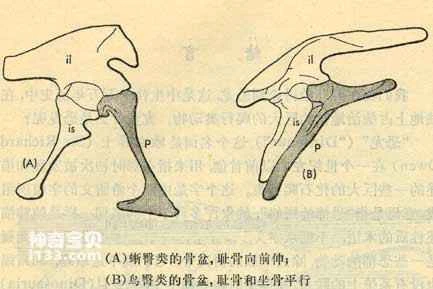
Comparison of the pelvic girdle of saurischia and ornithischia

Lufeng Dragon
In ornithischians, the pelvic girdle is greatly expanded both anteriorly and posteriorly, while the pubis has a large anterior projection extending below the ilium. Therefore, the pelvis appears tetraradial when viewed from the side, with the four projections (branches) formed by the anterior and posterior parts of the ilium, the anterior ramus of the pubis (also called the anterior projection or prepubis), and the tightly packed ischium, pubis body, and posterior ramus of the pubis (also called the posterior projection). Now, as you look at these two images of dinosaur pelvic girdles, have you noticed that both saurischia and ornithischians have a hole between the ilium, ischium, and pubis in their pelvic girdle? This hole is absent in other orders of reptiles. Scientists speculate that this hole indicates a close kinship between these two orders, known as dinosaurs, compared to all other orders of reptiles.
The two types of dinosaurs originated from the coccodactyls in the Late Triassic period.
I. The Saurischia order is divided into three suborders: Archaeopoda, Sauropoda, and Theropoda .
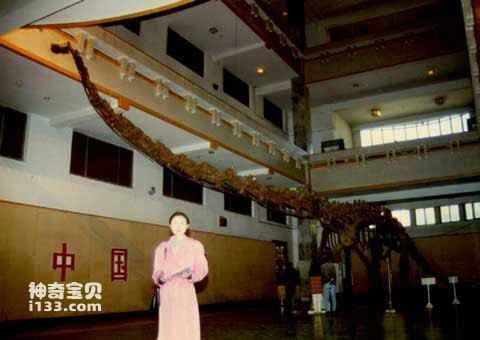
Mamenchisaurus
1. The Paleopoda suborder comprises small to medium-sized dinosaurs that lived during the Late Triassic period, formerly known as prosauropods or plateosaurs. They were relatively robust and walked on semi-quadrupedal locomotion. The famous Lufengosaurus discovered in Yunnan, my country, belongs to the Paleopoda suborder.
2. Sauropods evolved from Paleopoda and mainly lived during the Jurassic and Cretaceous periods. The vast majority were giant herbivorous dinosaurs. They had small heads, long necks, long tails, and spoon-shaped teeth. A famous representative of Sauropoda is Mamenchisaurus, found in Sichuan and Gansu, my country, during the Late Jurassic period; its neck, composed of 19 cervical vertebrae, was approximately half the length of its body.
3. Theropods lived from the Late Triassic to the Cretaceous. They were all carnivorous dinosaurs, bipedal, with sharp claws at the tips of their toes, and dagger-like or knife-like teeth in their mouths, often with serrated edges. Tyrannosaurus Rex is a famous example.
II. Ornithischians are divided into 5 suborders: Ornithopoda, Stegosauria, Ankylosauria, Ceratopsians, and Pachycephalosauria.
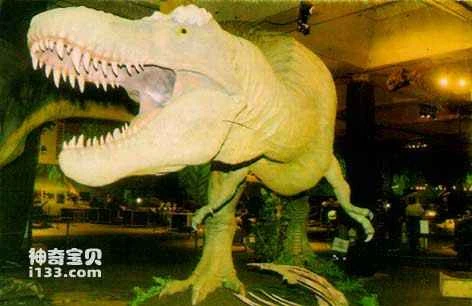
Tyrannosaurus Rex
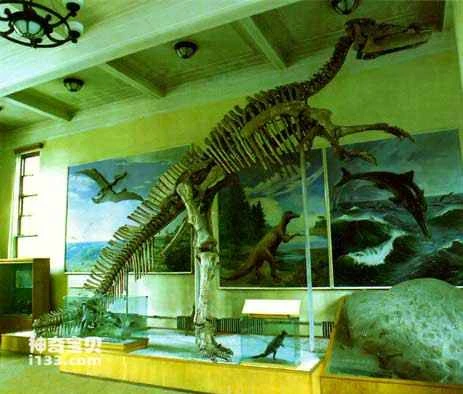
Shandong Dragon
1. Ornithopods are the most fossil-rich group among ornithischians, and even among the entire dinosaur group. Some, like *Tsingtaoosaurus*, were bipedal, while others were quadrupedal. They generally had flattened snouts, long faces, and a separate predentary bone in front of the mandible. Their teeth grew only in the cheeks, were closely spaced, and had one to several rows of replacement teeth. The femur of their hind legs was longer than the humerus of their forelimbs. The fifth toe was vestigial. Both the anterior and posterior rami of the pubis were developed. They lived from the Late Triassic to the Cretaceous, flourishing most during the Cretaceous. They were all herbivorous dinosaurs. Notable examples include *Shandongosaurus*, which lacked a crest (flat-headed), and *Tsingtaoosaurus*, a ctenosaur with a crest.
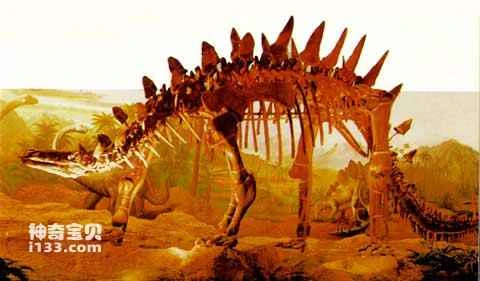
Tuojiang Dragon
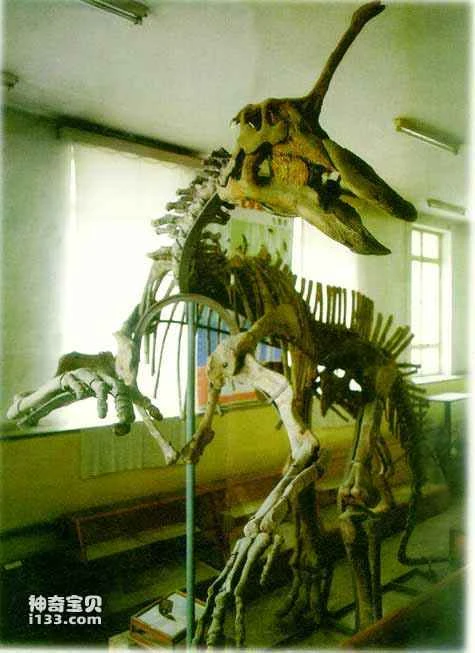
2. Stegosauria were herbivorous dinosaurs that appeared in the Jurassic and continued into the early Cretaceous. They walked on four legs; their backs had upright bony plates or clubs, and their tails had two pairs of bony spikes at the rear; their heads were small and low-set, their brains were small, with small superior temporal fenestrae and large lateral temporal fenestrae; their teeth were small and flat; they had no teeth on their premaxilla; their hind limbs were long and their forelimbs were short; their vertebrae were gradually raised posteriorly by neural spines and neural arches; the ilium was fused with the sacrum and widened, forming a roof-like structure over the acetabulum; the posterior process of the ilium was underdeveloped, but the anterior process was very long; the sacral ganglia were huge, forming a "second brain" that controlled the movement of the posterior part of the body, especially the tail and hind limbs. A representative of the Stegosauria is the Tuojiangosaurus from Sichuan, my country, whose anterior half of its back had plates, while the posterior half had flattened conical bony clubs.
3. Members of the Ankylosauria suborder were short and stocky, covered in thick bony armor, and moved clumsily. Their superior temporal foramen was closed, and their lateral temporal foramen remained only as small slits. They had weak teeth, short limbs, with their hind limbs slightly longer than their forelimbs. The Ankylosauria suborder primarily lived during the Cretaceous period.
4. Ceratopsians are a distinctive suborder of dinosaurs that evolved during the Cretaceous period. Their skulls are enlarged in the posterior half, with a neck frill formed by the parietal and squamous bones, which branches to form horn-like projections. Horns, formed by the enlargement of the nasal and postorbital bones, are often present on the skull. The most famous representatives include Triceratops. Psittacosaurus, whose distribution was limited to northern my country and Mongolia, is another representative of this suborder. They had short, wide, and high skulls, and their snouts were curved like a parrot's beak, hence the name Psittacosaurus.
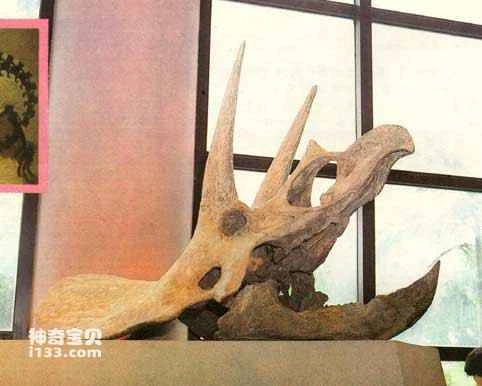
Triceratops
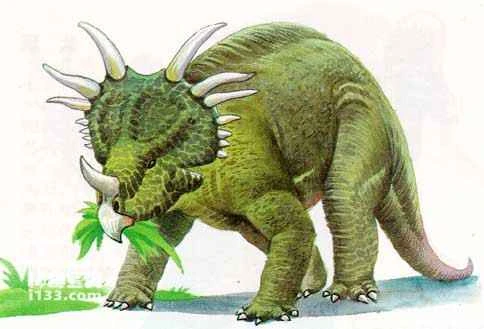
Tridentosaurus
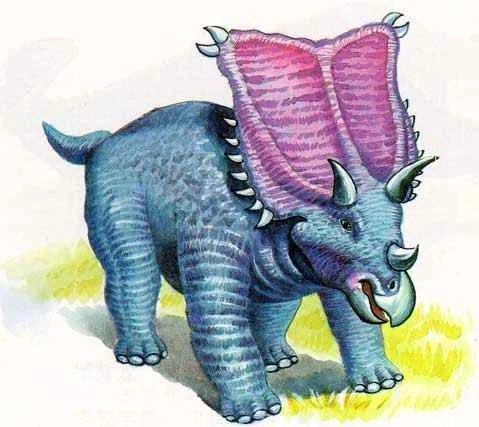
Gap Dragon
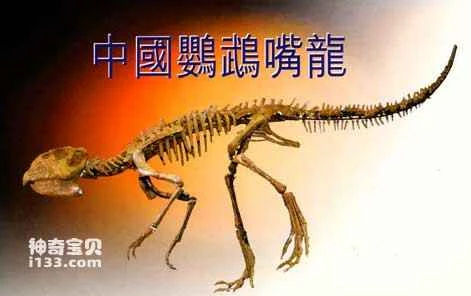
Psittacosaurus
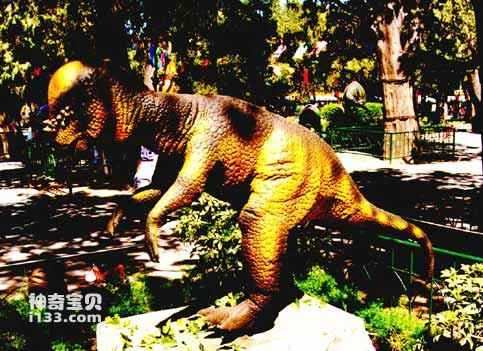
5. The most prominent feature of members of the Pachycephalosaur suborder is their swollen skull and closed temporal foramen; in the pelvic girdle, the pubis is displaced by the ischium and does not participate in the formation of the acetabulum. Representatives include Vertebrosaurus, etc.

Ankylosaurus
Spinosaurus