I. Early Ornithopod Dinosaurs
Compared to the numerous sauropod dinosaurs of the Late Triassic period, ornithischian dinosaurs of that time are extremely rare, truly a rarity.
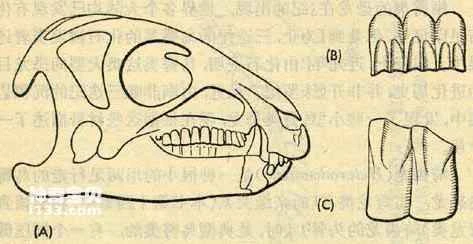
The skull, mandible, and teeth of Heterodontosaurus
The Haematopois, discovered in Late Triassic sedimentary strata in South Africa, is the earliest known ornithischian dinosaur and also the earliest representative of ornithopod dinosaurs.
Heterodontosaurus was a small ornithischian dinosaur that walked on two hind legs, with a skull only about 10 centimeters long. The skull featured a depressed jaw joint and a separate, toothless predentary bone at the front of the lower jaw—a distinctive skull feature of ornithischian dinosaurs. Both the upper and lower jaws of Heterodontosaurus had specialized small teeth along their edges, clearly adapted for cutting and cracking plant matter. Surprisingly, Heterodontosaurus possessed a large canine tooth at the front of its lower jaw, similar to that of a mammal.
The skeleton of the head after the malformed dragon is a typical bird-rump type, and the pelvic girdle is no exception. The pubis and ischium are parallel and connected.
Although ornithischian dinosaurs did not occupy a particularly prominent position in the entire dinosaur family during the Late Triassic period, based on the body structure laid by Heterodontosaurus, ornithischian dinosaurs, including ornithopods, flourished in the later Jurassic and Cretaceous periods, becoming the most diverse branch of the dinosaur family.
II. Lesotho Dragon
During the Early Jurassic period, 200 million years ago, ornithopods, a type of ornithischian dinosaur, were a very active group. Lesothoosaurus, discovered in South Africa, is a prime example.
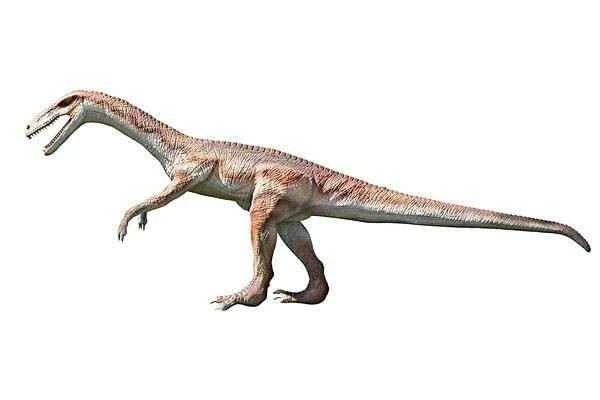
Lesotho Dragon
The small and exquisite Lesothoosaurus was less than 1 meter long and weighed less than 10 kilograms. Its mouth was covered with a keratinous substance that helped it cut plants. Then, its irregularly shaped teeth processed the food that came into its mouth. The teeth on both sides of its jawbone were arrow-shaped, which was well-suited for biting food.
Although small in size, Lesothoosaurus's excellent balance in its body structure ensured its agility, allowing it to adapt and live well in an environment with limited resources and constant threat of predators.