Similar to sauropod dinosaurs, stegosaurs likely appeared as early as the Early Jurassic. However, scientists' understanding of early stegosaurs actually began with the discovery of the Huayangosaurus in Dashanpu, Zigong, Sichuan, my country.
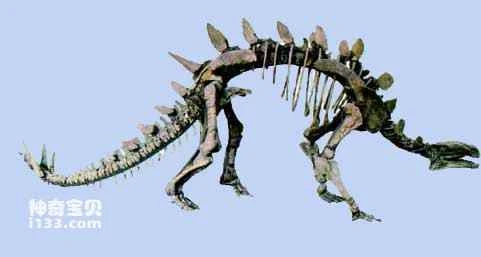
Huayanglong
I. Huayang Dragon – The earliest Stegosaurus from China
Huayangosaurus was nearly 4 meters long and weighed 1 to 4 tons. Compared to other dragons such as Shu-dragon, Qiu-dragon, and Emei-dragon that lived in the same era and region, Huayangosaurus was much shorter and smaller. Therefore, while those larger creatures stretched their necks to chew on leaves from tall trees, Huayangosaurus could only nibble on low-lying plants near the ground.
The relatively small size of Huayangosaurus likely made it an easier target for predators like Qisaurus. However, as one of the earliest Stegosaurus species, Huayangosaurus had developed a unique set of defensive weapons: long spikes on its shoulders, waist, and tail tip. When a hungry Qisaurus attacked, Huayangosaurus would maneuver its body to position its spikes facing the attacker, while simultaneously lashing out with its spiked tail. While these weapons and defensive maneuvers weren't powerful enough to kill large predators, they were usually enough to deter them from pursuing Huayangosaurus to avoid injury, and instead seek out easier prey.
During the Middle Jurassic period, riverbanks were typically covered with dense, green carpets of low-lying ferns, and tall trees were generally absent. When Huayangosaurus used its small, gnawed teeth, adapted for gnawing and grinding, to feed on these open "grasslands," its young often became targets for predators such as Qisaurus. However, as long as the young Huayangosaurus stayed close to their parents, these predators dared not easily launch an attack. Clearly, parental protection of their young was essential for Huayangosaurus.
On the back of Huayangosaurus, two symmetrical rows of heart-shaped blades run from the neck to the middle of the tail. Many later stegosaurs, however, have two rows of blades on each side of their backs. Furthermore, Huayangosaurus's forelegs and hind legs are roughly the same length, while the forelegs of later stegosaurs are significantly shorter than their hind legs. These characteristics indicate that Huayangosaurus was indeed a primitive stegosaur.
II. Earthworm – A possible ancestor of stegosaurs represented only by a fragmented lower jaw
We introduce Huayangosaurus as the earliest stegosaur because its fossil material is relatively complete and can be accurately identified as a stegosaur. In fact, some fossil material in the Early Jurassic period already indicated the existence of stegosaurs, but these fossils were too fragmented or too scattered, so scientists' understanding of them was largely based on speculation.
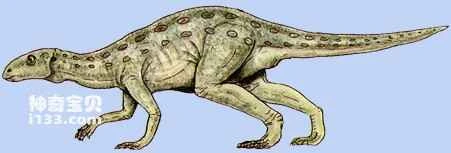
Earth Dragon
The Dadilong, discovered in the Early Jurassic strata of Dadi Village, Lufeng County, my country, is an example of this.
Scientists found only a partially intact left lower jawbone. In front of the lower jawbone was a predentary bone characteristic of ornithischian dinosaurs, but it lacked teeth. Other teeth were also few and somewhat overlapping, gradually increasing in size from front to back. These teeth grew in alveoli, hence the name alveolar teeth. It is precisely because of the similarity between its teeth and predentary bone features and those of later stegosaurs that scientists speculate it is the most primitive stegosaur known to date.