The Black-backed Pygmy Kingfisher—doesn't that sound special? If you're also interested in kingfishers, these small and beautiful birds, then you definitely can't miss this miniature kingfisher—the Black-backed Pygmy Kingfisher. Today, let's step into the world of this tiny kingfisher and learn about its habits, habitat, dietary preferences, and breeding characteristics.
What is a black-backed dwarf kingfisher?
The Black-backed Pygmy Kingfisher (scientific name: *Ceyx erithaca*) is a small kingfisher belonging to the class Aves, family Alcedinidae, and genus *Ceyx*. Like most kingfishers, the Black-backed Pygmy Kingfisher has brightly colored plumage, especially its back, which resembles a natural jewel. Despite its name meaning "pygmy," it possesses excellent hunting skills, and its small size does not hinder its agility and activity.
Scientific classification
Kingdom: Animal Kingdom
Phylum: Chordata
Class: Birds
Order: Ploverformes
Family: Kingfisher
Genus: Ceyx
Species: Black-backed Pygmy Kingfisher (Ceyx erithaca)
Other names: Little Yellow Kingfisher, Three-Toed Kingfisher, Black-Backed Kingfisher, Oriental Dwarf Kingfisher, Black-Backed Kingfisher, Oriental Pygmy Kingfisher, Kingfisher, Fish Tiger, Fish Dog, Fisherman, Golden Bird, Blue Kingfisher, Qin Pepper Beak, Fisherman, Fish Shooter
From a scientific classification perspective, the Black-backed Pygmy Kingfisher belongs to the genus Pygmy Kingfisher in the family Kingfisheridae. Like other kingfisher species, it has an extremely strong ability to catch fish.
Appearance features: A small and sleek "underwater hunter"
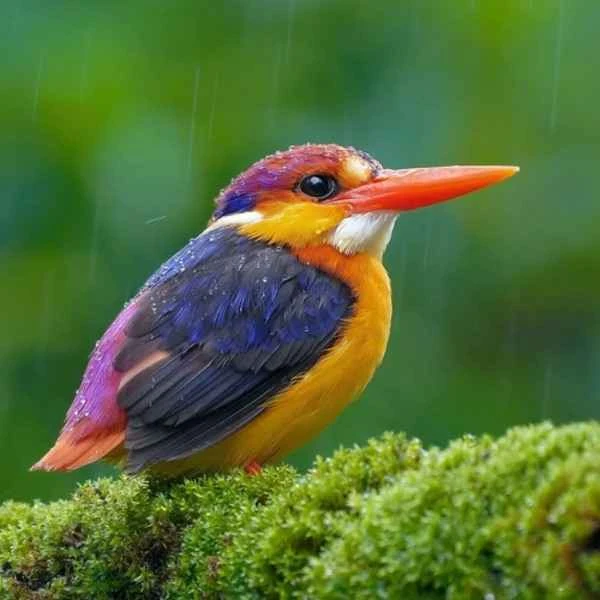
When people think of the Black-backed Pygmy Kingfisher, the first thing that comes to mind is its vibrant plumage. Its back is deep black, smooth as ink, making it particularly striking compared to the bright blue and green plumage of other kingfishers. The Black-backed Pygmy Kingfisher is quite small, with adults typically only 15-17 centimeters long and weighing around 30 grams . Their beaks are sharp and strong, ideal for catching small fish and insects.
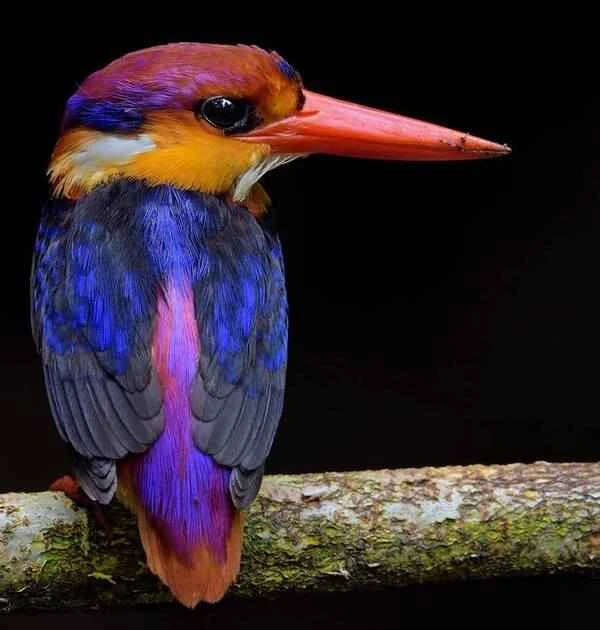
Their bellies are often orange or white, a vibrant color that stands out brightly in the sunlight. But what truly catches the eye are their black eyes, which often give the impression of intelligence and alertness.
Habitat: Where do they like to live?
The Black-backed Pygmy Kingfisher inhabits mostly tropical and subtropical regions , particularly wetlands, rivers, and lakes in Southeast and South Asia. They prefer to live near water sources, especially clear, flowing water. Because their prey consists mainly of small fish and aquatic insects, their habitat requirements are very specific. Black-backed Pygmy Kingfishers typically choose locations near dense vegetation or with branches for perching, where they patiently wait for their prey to approach.
In addition, the Black-backed Pygmy Kingfisher prefers to inhabit the banks of small rivers and mountain streams in forests. They rely on water sources to find food, usually looking for footholds near water and flying across the water to find suitable prey.
Lifestyle
The Black-backed Pygmy Kingfisher is a very active little bird that mainly lives around wetlands, rivers, and lakes. They are very active during the day, usually hunting at dawn and dusk, and their lifestyle is closely related to water. As Black-backed Pygmy Kingfishers are excellent fishermen, they usually choose to perch at the edge of water and catch small fish or aquatic insects by flying and hovering.
Dietary Habits: The Little Hunter of the Water
Like most kingfishers, the Black-backed Pygmy Kingfisher primarily feeds on small aquatic animals. They are highly skilled fishermen, typically swooping down to the water's surface and using their sharp beaks to precisely catch small fish or aquatic insects. They like to hover above the water for a period of time, focusing their eyes on any movement beneath the surface; once they spot prey, they quickly swoop down.
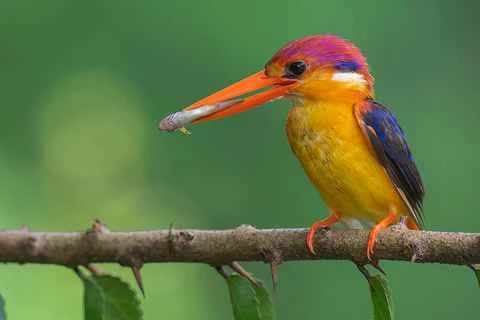
Besides fish, the Black-backed Pygmy Kingfisher also preys on small aquatic insects, especially dragonflies, mosquitoes, and water flies. Their hunting methods are extremely swift, capturing prey almost instantly. As a result, the Black-backed Pygmy Kingfisher is an important predator in aquatic ecosystems, effectively controlling the populations of small aquatic organisms.
social behavior
Black-backed pygmy kingfishers are typically solitary birds. Although they nest with a mate during the breeding season, they prefer to live alone at other times. They are highly dependent on their habitat and usually stay within a fixed area, rarely venturing far from their roost.
Reproduction: Small yet full of vitality
Growth and Reproduction
The breeding cycle of the Black-backed Pygmy Kingfisher is usually closely related to seasonal changes. Their breeding season typically begins in spring, when temperatures are suitable, food resources are abundant, and males and females pair up to breed.
Reproduction process
Nesting : Black-backed pygmy kingfishers typically choose tree hollows, cliff crevices, or caves along riverbanks to build their nests. The nest is lined with twigs, feathers, and soft materials as a place for the female to incubate the eggs.
Egg laying : Each laying typically produces 2 to 3 eggs, which are pale blue or white and of moderate size. The female bird is responsible for incubation, which lasts approximately 14-16 days.
Raising the chicks : After hatching, the chicks need to be fed by their parents. The female bird is responsible for feeding the chicks, while the male bird helps the female find food. The chicks grow relatively quickly and can begin to live independently after about two weeks.
Maturity : Young birds reach sexual maturity at around 6 months to 1 year old and begin to participate in reproduction.
Reproductive characteristics
The breeding season for the Black-backed Pygmy Kingfisher is relatively short, mainly concentrated in spring and summer. However, in environments with abundant food resources, they may also breed out of season. They can breed once or twice a year, laying 2-3 eggs each time. The chicks grow quickly and are able to live independently in a relatively short period of time.
Ecological role: Guardian of waterways
Although small in size, the Black-backed Pygmy Kingfisher plays a vital role in the ecosystem. As predators, they are key players in controlling the populations of small fish and insects, maintaining the ecological balance of aquatic waters. The fish they prey on are typically small populations in the water, which helps prevent these small species from overpopulating and impacting the health of the water.
In addition, the Black-backed Pygmy Kingfisher also plays a role in dispersing plant seeds. During their hunting, they often come into contact with plant seeds, which are then dispersed further through their droppings, helping to expand plant populations.
Preserve the status quo
The survival of the Black-backed Pygmy Kingfisher is threatened by habitat loss and environmental pollution. Water pollution, wetland development, and habitat destruction are gradually shrinking their living environment. Therefore, protecting the Black-backed Pygmy Kingfisher 's habitat and aquatic environment is of paramount importance.
Preserve the status quo
Currently, the Black-backed Pygmy Kingfisher is not listed as critically endangered, but its numbers have declined in some habitats, especially in areas with heavy human activity. To protect this species, many wetland reserves and nature reserves have begun implementing conservation measures, such as:
Habitat protection : Protecting important habitats such as wetlands, rivers and lakes, and restricting human development activities.
Environmental restoration : Water quality restoration and wetland restoration will improve the ecological environment and provide better habitat conditions for kingfishers.
Ecotourism : On the basis of ensuring ecological balance, develop ecotourism to increase public awareness of the protection of black-backed pygmy kingfishers .
variety
Here are some common species of the Black-backed Pygmy Kingfisher , along with their characteristics:
| Variety name | Main features | Distribution area |
|---|---|---|
| Common Black-backed Dwarf Kingfisher | Black back, orange belly, black eyes, small body size | Southeast Asia and South Asia |
| Indian Black-backed Pygmy Kingfisher | Its back is deep blue with fine feathers, and its beak is a bright orange. | India and surrounding areas |
| Philippine Black-backed Pygmy Kingfisher | Black on the back, whitish on the belly, it prefers to inhabit tropical rainforests and wetlands. | the Philippines |
| Sumatran Black-backed Pygmy Kingfisher | The back is darker, the abdomen is lighter, the body is slightly larger, and the mouth is orange. | Sumatra and surrounding islands |
| Malaysian Black-backed Pygmy Kingfisher | Its back is black, its belly is orange and yellow, and it has tiny feather protrusions on its neck. It flies swiftly. | Malaysia, Southern Thailand |
The relationship between humans and the black-backed pygmy kingfisher
In some areas, the Black-backed Pygmy Kingfisher has also become part of local ecotourism. Tourists enjoy watching these beautiful kingfishers near wetlands and rivers. Their swift flight and precise hunting often attract photographers and bird enthusiasts. With increasing awareness of ecological conservation, the Black-backed Pygmy Kingfisher's habitat has gradually received more protection, especially within wetland reserves, where their habitat has been better protected.
However, it is worth noting that with the intensification of human activities, pollution of some pristine wetlands and rivers has also affected the survival of the Black-backed Pygmy Kingfisher. To protect these precious birds, many nature reserves and wildlife conservation organizations are providing better protection measures for their habitats.
Summarize
The Black-backed Pygmy Kingfisher is a small but captivating bird that holds a place in nature with its vibrant plumage, agile hunting skills, and crucial ecological role. Whether as a predator in the water or a star of ecotourism, the Black-backed Pygmy Kingfisher plays a vital role in the ecosystem. By protecting their habitat, we are not only protecting a species, but also protecting the balance of the entire ecosystem.