The food chain refers to the food relationship between organisms where the strong prey on the weak and they depend on each other. As the saying goes, "Big fish eat little fish, little fish eat shrimp, and shrimp eat mud at the bottom," which vividly illustrates this interdependent food chain relationship.
The first link in the food chain of the Southern Ocean is phytoplankton, mainly diatoms, as is the case in other oceans around the world. Phytoplankton can perform photosynthesis, converting carbon dioxide and water into organic matter under sunlight, that is, converting solar energy into chemical energy for storage. Phytoplankton are primary producers, supplying other consumers with this energy.
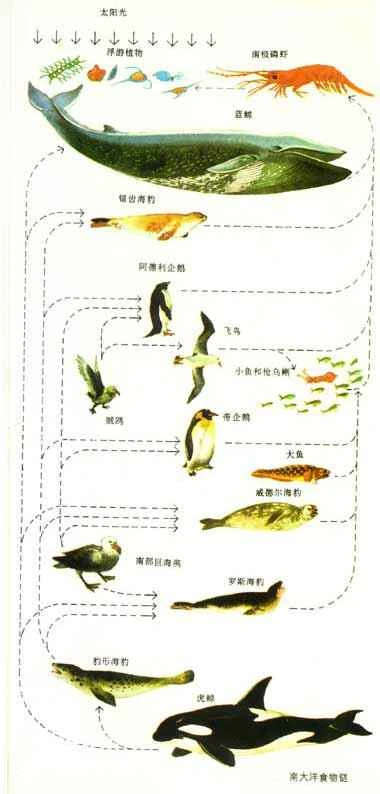
Food chain in the Southern Ocean
Another link in the food chain is zooplankton, primarily krill in the Southern Ocean, which feed on phytoplankton. In turn, zooplankton are food for other organisms at higher trophic levels, such as seals, penguins, and whales.
The last link in the food chain is human exploitation and utilization of marine biological resources. Over the years, people have exploited krill, fish, seals and whales in the Southern Ocean to varying degrees.
The food chain in the Southern Ocean is quite fragile because Antarctic krill plays a crucial role. This marine ranch boasts abundant phytoplankton, over 90% of which are diatoms, serving as food for the enormous numbers of krill. In turn, the krill sustains a small but incredibly large population of higher animals, such as seals, penguins, and whales. If this link in the krill chain is disrupted, the entire Southern Ocean food chain collapses.

Food chain in the ice floe area
The dense and abundant biodiversity of the Southern Ocean is primarily due to the rich nitrogen, phosphorus, and other nutrients in the warm ocean currents from the north. These nutrients rise to the surface, promoting the growth of phytoplankton. In the upwelling zones and near the Antarctic coast, phytoplankton are exceptionally abundant, turning the seawater and ice floes a deep green or brown. This rich phytoplankton provides ample food for zooplankton, which in turn nourishes other higher animals.