In the primate family, besides the well-known orangutans, chimpanzees, and monkeys, there are some lesser-known but equally amazing members. The slow loris (Loris perezoso) is one of them, not only adorable and charming in appearance but also the only known primate with venom . So, is the slow loris dangerous? Where does it live? What does it eat? And how does it reproduce? This article will take you deeper into the world of this mysterious and endangered animal.
Physical characteristics and behavioral habits of slow lorises
Small and mysterious nocturnal primates
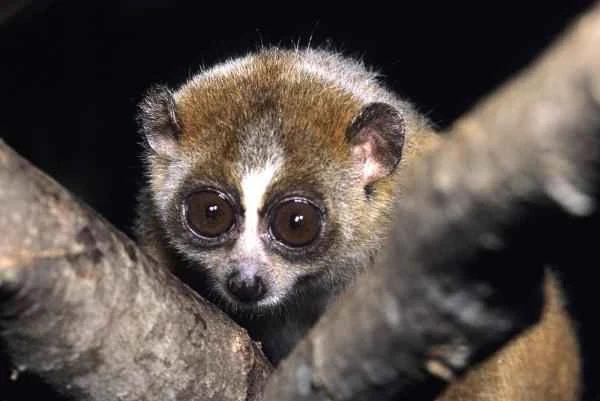
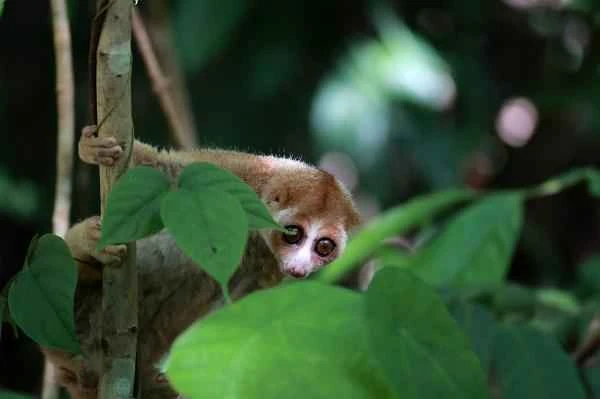
Physical characteristics : The slow loris is about 26-38 cm long, with a relatively long body structure and a short tail.
Extra-large eyes : It has large, forward-facing eyes with three-dimensional vision, making it suitable for nighttime activities; there is a luminescent layer (tapetum lucidum) behind the eyes to enhance night vision.
Coat color : Covered with thick white-brown fur, the color varies considerably between individuals.
Head features : round head, small ears, short nose, and black rings around the nose make the eyes appear more prominent.
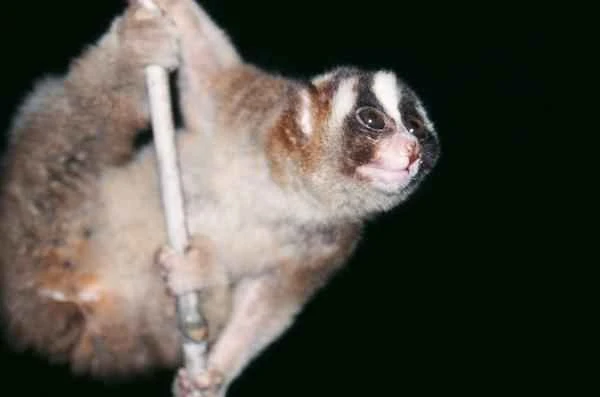
Limb structure : The forelimbs and hindlimbs are of similar length, with the thumbs opposing each other, which facilitates climbing and hanging. They cannot jump, but are good at moving slowly in trees.
Personality and Lifestyle
They are quiet, secretive, and live alone , spending most of their time alone.
Lacking the ability to jump , they primarily climb slowly and move with extreme caution.
Nocturnal animals , hiding during the day and foraging or active at night.
How potent is the venom of the slow loris? — Does it really bite?
The slow loris's bite is venomous , which is its most striking feature.
Sources and mechanisms of toxins
Location of the venom gland : The toxin is not in saliva, but is secreted in the brachial gland at the elbow of the forelimb.
Activation method : Slow lorises lick their own venom glands, mixing the toxins with their saliva to make them toxic, which are then transmitted through biting.
Toxicity : It has a lethal effect on small animals and also causes a strong physiological reaction in humans.
Symptoms of being bitten by a slow loris include:
Blood pressure drop
burning sensation in the throat and tongue
Involuntary muscle twitching
Difficulty breathing
Heart rhythm abnormality
Loss of consciousness
In severe cases, death may result from anaphylactic shock .
Bites
If bitten, seek medical attention immediately for a tetanus shot and antibiotic treatment to prevent infection and allergic reactions.
Habitat: Where do slow lorises live?
The slow loris is an arboreal animal that lives in the tropical rainforests of Asia, and is mainly distributed in the following countries:
Vietnam
Indonesia
Malaysia
the Philippines
India
Bangladesh
They usually hide deep in the rainforest, living during the day and active at night, making them difficult for humans to spot.
Dietary structure: What do slow lorises eat?
Slow lorises are omnivorous , with a diverse and varied diet.
Plant-based : fruits, leaves, nectar
Animals : Insects, snails, bird eggs, small reptiles, and vertebrates
Even edible plants that are poisonous to humans
Metabolic characteristics
Despite its rich diet, it has a slow metabolism , similar to a sloth. This low metabolism may help digest complex or toxic foods, and also makes it move slowly and save energy.
The reproductive methods of slow lorises revealed
The reproductive behavior of slow lorises is also very unique. The following are their main reproductive characteristics:
Reproductive behavior and estrus
Males engage in fierce competition for females, and toxins may be used in this sexual competition.
Females actively attract male mates by releasing information through urine and vocalizations.
They undergo internal fertilization , and mating also takes place in the tree.
After mating, males leave behind a mating plug to prevent other males from mating.
Childbirth and Childcare
Slow lorises typically give birth to one offspring at a time, but twins are occasionally born.
The gestation period is approximately 188 days .
The mother monkey uses toxins to protect her offspring.
The young are weaned at 3 to 6 months , after which they leave the nest, and the males exhibit aggression towards them, forcing them to become independent.
Slow lorises reach sexual maturity at around 20 months of age .
Why is it not recommended to keep slow lorises as pets?
Due to its toxicity and high dependence on its habitat, the slow loris is extremely unsuitable as a pet .
In many illegal trades, the venom glands are cruelly removed , causing great harm to the animals.
Slow lorises kept in captivity face difficulties in reproduction and suffer from deteriorating health due to being separated from their natural environment and other species.
Human "love" has actually accelerated their endangerment.
The slow loris is currently listed as an endangered species and has been under high protection since 2012.
Conclusion: What can we do to protect slow lorises?
The slow loris not only occupies a unique position in the ecosystem, but also serves as a reminder of our respect for and protection of wildlife. Not participating in the illegal pet trade and refusing to buy related products are simple yet important decisions that each of us can make.
If you are interested in wildlife and natural ecology, please continue browsing our website's "Wildlife Encyclopedia" section to explore more amazing species!
References
Dodd, T., Ankel-Simons, F., Berkowitz, B., et al. (2018) Nocturnal animals—an overview. Available at: https://www.sciencedirect.com/topics/agricultural-and-biological-sciences/nycticebus
Peña, P. (2013) "Nycticebus coucang" is available at: https://animaldiversity.org/accounts/Nycticebus_coucang/
Beatty, R., Beer, A., & Deeming, C. (2010). The Book of Nature. UK: Dorling Kindersley.