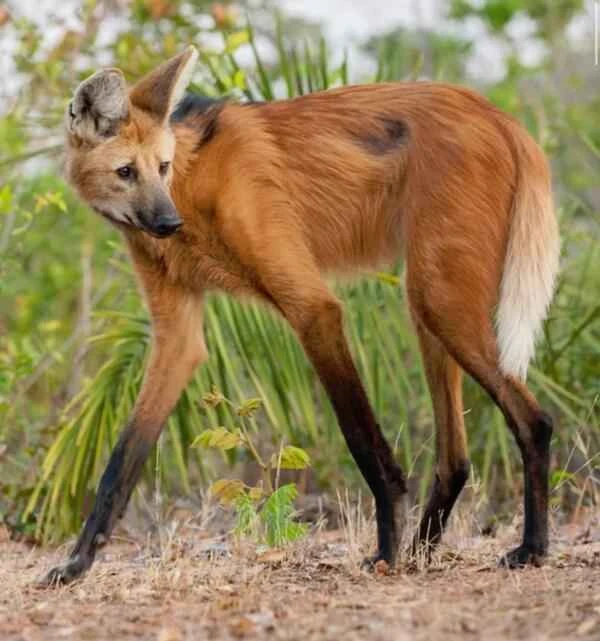
The maned wolf ( Chrysocyon brachyurus ), also known as the Brazilian wolf or South American wolf, is one of the most unique species in the canid family, with a body size and appearance significantly different from other wolves. Maned wolves typically range in length from 1.2 to 1.5 meters, with tails reaching up to 50 centimeters in length. Their relatively long bodies and exceptionally long legs give them a slender and elegant appearance. Compared to other canids, the maned wolf's long legs allow it to run quickly across open grasslands, an adaptation to its vast habitat.
The maned wolf's fur is primarily golden or orange-red, with a darker back and a lighter belly. Its fur is dense and long, especially on the neck and back, forming a mane-like covering, hence the name "maned wolf." This fur not only helps them camouflage themselves on the grasslands but also provides warmth during the cold season.
Maned wolves have large, erect ears; their sharp points help them detect surrounding sounds, especially when hunting prey on the grasslands. Their tails are long and bushy, usually held horizontally while running. The maned wolf's eyes are yellow or blue, highly distinctive, giving them a mysterious and sharp appearance.
Furthermore, the maned wolf's claws are very strong, adapted for rapid movement across various terrains, and also serve a gripping function when hunting. Overall, the maned wolf's physical characteristics make it a flexible and efficient predator on the vast grasslands.
Scientific classification of maned wolves
To understand the maned wolf, we must first start with its scientific classification. The maned wolf (scientific name: *Chrysocyon brachyurus*) belongs to the kingdom Animalia, phylum Chordata, class Mammalia, order Carnivora, and family Canidae. It is one of the most unique members of the Canidae family, differing from ordinary wolves in both morphology and lifestyle. Next, let's learn about this mysterious creature and see why it is called "nature's ghost hunter."
Kingdom: Animalia
Phylum: Chordata
Class: Mammalia
Order: Carnivora
Family: Canidae
Genus: Chrysocyon
Species: Chrysocyon brachyurus
Maned Wolf Appearance and Size
Mysterious Long-Legged Hunter
One of the most striking features of the maned wolf is its long legs. Compared to other canids, the maned wolf's legs are unusually long. They have a slender body, a long neck, and the whole animal looks very elegant. The maned wolf's back is typically golden or orange-red, while its belly is lighter in color. They have large, erect ears and a long, bushy tail.
Their legs are perfectly suited for running across open grasslands and meadows. Unlike wolves, which primarily inhabit forests, maned wolves typically live in the open plains and grasslands of South America. Therefore, their long legs are highly advantageous for chasing prey across vast areas and for long runs.
Blue eyes, mysterious gaze
The maned wolf's eyes are another striking feature. Their eyes possess a unique blue or yellow hue, giving them a deep, mysterious quality. Many studies have shown that the maned wolf's eyes are adapted to the demands of its vast habitat, allowing it to clearly spot prey at a distance. Its exceptionally keen eyesight is one of its most important hunting weapons.
Distribution and Habitat of the Maned Wolf
Living a leisurely life on the South American grasslands
Maned wolves are mainly distributed in the grasslands and open areas of South America, especially the vast grasslands of Argentina, Brazil, and Paraguay. They prefer to inhabit low-altitude areas, usually below 1,000 meters above sea level. Due to their large size and adaptation to open environments, maned wolves do not hide in dense forests like other canids, but rather frequently roam in open grasslands.
Maned wolves are highly adapted to tropical grasslands and arid sandy environments, which allows them to survive in some harsher climates. Grasslands, scrublands, and deserts are all suitable habitats for them, as these areas have relatively mild climates and moderate rainfall, making them ideal for maned wolves to breed and thrive.
Threats to habitat
Although maned wolves have adapted to the grassland environment of South America, their habitat faces several threats. Human expansion, agricultural development, and grazing activities are constantly reducing their living space. Many grassland areas inhabited by maned wolves are gradually being encroached upon by urbanization and farmland, leading to a gradual shrinking of their habitat. Deforestation and climate change have also had an impact on maned wolves, increasing their survival pressure.
Diet and hunting methods of maned wolves
The natural hunter of the grasslands
Maned wolves are typical carnivores, primarily feeding on small mammals on the grasslands, such as rabbits, birds, and small deer. They possess excellent hunting skills, typically utilizing their long legs for high-speed running and swiftly pouncing on their prey. Maned wolves are extremely fast runners, easily catching even slower prey.
Furthermore, maned wolves are adept at hunting through group cooperation. Although they don't form fixed packs like wolves, maned wolves often rely on a degree of teamwork when hunting. They cooperate and divide tasks to catch larger prey. Maned wolves can also exhaust their prey by chasing it until the prey is too tired to escape.
Diversity of dietary habits
Besides small mammals, maned wolves also consume some plant-based foods, such as fruits and roots. These foods provide additional nutrition, helping them survive during seasons when food is scarce. Especially during the dry season, when prey is scarce on the grasslands, maned wolves will seek out these plant-based foods to compensate for nutritional deficiencies.
Social structure and behavior of maned wolves
Acting alone and occasionally cooperating
Unlike wolves, which typically live in packs, maned wolves have a relatively loose social structure. Most of the time, maned wolves act alone, only occasionally forming temporary small groups during the breeding season or when food is scarce. They do not rely on pack hunting like wolves, but rather on their individual hunting skills and independence for survival.
Maned wolves exhibit relatively simple social behavior within their packs, typically communicating through simple means such as barking and howling. During the breeding season, both male and female maned wolves attract mates with distinctive howls, which are highly recognizable and can be heard from potential mates at a distance.
The mysterious "ghost hunter"
Maned wolves are often called "ghost hunters," a name closely associated with their mysterious appearance and stealthy movements. They are typically active at dusk or dawn, giving them an air of unapproachability. Their fur coloration is also highly adapted to the grassland environment, allowing them to blend in and avoid detection by prey.
Reproduction and lifespan of maned wolves
Reproduction
Maned wolves typically breed during the annual breeding season, primarily in autumn and winter. The gestation period for females is approximately two months, and they usually give birth to two to four pups per litter. Their reproductive behavior is similar to other canids, but their breeding cycle is more flexible. Male maned wolves attract females through a series of courtship behaviors, such as distinctive barking. Females, in turn, select mates based on the male's physique and health, preferring strong and healthy males.
The maned wolf's parenting style is also quite unique. After birth, the mother takes meticulous care of the pups, providing ample food and protection until they are able to live independently. For the first few months after birth, the pups rely on their mother for feeding, then gradually begin to learn how to hunt and participate in hunting training with their parents. Around 9 to 12 months of age, the pups begin to move independently, but will still rely on their parents for support for a period of time.
life
Maned wolves typically live 10 to 15 years. However, in the wild, their lifespan is influenced by factors such as predators, food resources, and habitat changes, and many maned wolves may have shorter lifespans. In suitable habitats and without predators, maned wolves can live up to 15 years. Their interactions within their pack and favorable living conditions also contribute to extending their lifespan.
The Maned Wolf's Natural Enemies and Survival Challenges
Main predators: humans and large carnivores
The maned wolf's main predators are large carnivores and humans. In their habitat, especially where grasslands meet forests, there are often more powerful predators such as jaguars and aardwolves. Jaguars, in particular, possess formidable hunting abilities and can easily prey on maned wolves.
However, the greatest threat to the maned wolf comes from humans. As human activity continues to expand, their habitat is being destroyed, and their food resources are dwindling. Furthermore, climate change and illegal hunting are also significant threats to them.
The current state and future of maned wolf conservation
Protection status and efforts
According to the International Union for Conservation of Nature (IUCN), the maned wolf is currently listed as a "vulnerable" species. Although they still have stable populations in some areas, their overall numbers are declining, and habitat destruction and changes in the food chain pose serious challenges to their survival.
To protect the maned wolf, several South American countries have implemented a series of measures, including habitat protection, combating illegal hunting, and conducting scientific research. These efforts aim to provide a safer environment for the maned wolf and ensure the stability of its population.
Close differences between maned wolves and other canids
The following table shows the main differences between the maned wolf ( Chrysocyon brachyurus ) and several other common canids (such as gray wolves, red foxes, and American wolves) in terms of appearance, size, habitat, and diet:
| feature | Maned wolf ( Chrysocyon brachyurus ) | Gray Wolf ( Canis lupus ) | Red fox ( Vulpes vulpes ) | American wolf ( Canis latrans ) |
|---|---|---|---|---|
| body shape | Long legs, slender build, large build, weight approximately 23-46 kg | They are relatively large in size and typically weigh between 30-50 kg. | Small, weighing about 5-6 kg | Medium build, weighing approximately 8-20 kg |
| Leg features | Exceptionally long legs, adapted for running on grasslands | Medium-length legs, adaptable to various environments | With shorter legs, they are adapted to forest and grassland environments. | Legs of moderate length, adapted to desert and grassland environments |
| fur color | Golden yellow or orange-red, darker on the back and lighter on the belly | Gray, white, or brown, with relatively dense fur | Multiple colors including red, gray, and black. | Yellow, gray, and brown, adapted to desert environments. |
| Habitat | Grasslands, open areas (South America) | Forests, grasslands, mountains, etc. are widely distributed | Forests, farmland, and urban peripheries | Widely distributed in grasslands, deserts, and mountainous areas |
| Dietary habits | It feeds on small mammals and also consumes plants. | Primarily preys on large mammals and small animals | They mainly prey on small mammals and birds. | Feeds on small mammals and insects |
| social structure | Mostly acts alone, occasionally forming small groups. | Primarily communal living, with strong social characteristics | They usually live alone, but occasionally in small groups. | They usually live in small groups, occasionally forming larger groups. |
| Reproduction | They breed once a year, producing 2-4 offspring. | They breed once a year, producing 4-7 offspring. | They breed once a year, producing 4-5 offspring. | They breed once a year, producing 3-7 offspring. |
| life | 10-15 years | 10-16 years | 3-5 years (in the wild), up to 10 years | 3-5 years (in the wild), some can live up to 10 years. |
As the table shows, the maned wolf differs significantly from other canids in appearance, habitat, diet, and social structure. In particular, the maned wolf's distinctive long legs are an adaptation to grassland life, unlike gray wolves or American wolves which rely on pack cooperation. Diet-wise, the maned wolf not only preys on small mammals but also consumes some plant matter, which is another difference from other canids.
The maned wolf, this mysterious hunter of nature, has become a focus of attention due to its unique appearance, intelligent hunting skills, and enigmatic lifestyle. From scientific classification to habitat, diet, behavior, and conservation status, the maned wolf showcases its unique charm. With continued conservation efforts, we may see more maned wolves roaming freely in the wild in the future, becoming ghostly hunters of the grasslands, continuing to write their own natural legend.
Frequently Asked Questions (FAQs):
Are maned wolves aggressive?
No, maned wolves are generally not aggressive towards humans. They are known for being shy and elusive. These creatures are primarily solitary and tend to avoid confrontation whenever possible. Unlike more social predators such as wolves or coyotes, maned wolves are not pack animals and do not exhibit territorial aggression. Much of their behavior revolves around foraging or maintaining their solitary nature, rather than protecting territory or hunting in packs. They are more likely to flee or hide than to engage in aggressive behavior.
However, like many wild animals, maned wolves can become defensive if threatened or cornered. But overall, they pose little threat to humans, and are often more feared than we are.
Why isn't the maned wolf a wolf?
Despite having the word "wolf" in its name, the maned wolf is not actually a member of the genus *Canis*, which includes true wolves such as the gray wolf (*Canis lupus*) and the coyote (*Canis latrans*). Instead, the maned wolf belongs to the genus *Chrysocyon*, a unique canid found only in South America. This is why it is not considered a "true" wolf:
Genetic differences: Despite its name, the maned wolf is genetically distinct from wolves and other canids in the genus *Canis*. It has a different evolutionary lineage and shares more similarities with other South American canids, such as the bush dog (*Speothos*).
Physical characteristics: The maned wolf has several unique features that distinguish it from the typical wolf. Its slender legs, large ears, and long, red mane make it look quite different from the more muscular and robust wolf.
Behavior: Wolves are known for their social, pack-like behavior, while maned wolves are mostly solitary, unlike the social structure of true wolves. Their diets also differ—maned wolves are omnivores, feeding on various fruits, vegetables, and small animals, while wolves are primarily carnivorous.
Therefore, although maned wolves share some characteristics with wolves, they belong to different genera and differ greatly in behavior, diet, and genetics.
Why are the legs of the maned wolf so long?
The maned wolf's long legs are one of its most distinctive features. These slender legs serve several important purposes:
Habitat adaptation: Maned wolves are native to the open grasslands, prairie, and forests of South America, where tall grasses and shrubs grow. Their long legs allow them to see above the tall grass and vegetation, giving them a better view of their surroundings and making it easier to spot potential prey or threats.
Efficient locomotion: The maned wolf's long legs help it cover large distances quickly. Its long strides allow it to traverse vast areas in search of food. Its long legs are also well-suited for running in open spaces, making it a highly efficient predator in its environment.
Hunting and foraging: Long legs help the maned wolf reach high places to find food, such as fruit or small animals, and also make it better at leaping over obstacles. Its long limbs are particularly well-suited for foraging in areas with tall grass or uneven terrain.
Thermoregulation : Long legs also play a role in thermoregulation. They help animals maintain a lower body temperature by increasing their body surface area, allowing heat to dissipate more efficiently in the hot South American climate.
In short, the maned wolf's long legs are a special adaptation that helps it navigate and survive in its environment.
What animal is closest to the maned wolf?
The maned wolf is unique, but its close relatives are other South American canids, especially the bush dog (Speothos), which share similar ecological niches and behaviors.
The bush dog (Speothos venaticus): The bush dog is generally considered one of the closest relatives of the maned wolf. It is another South American canid with exceptional environmental adaptability, although its body is much more compact. Bush dogs and maned wolves share a common ancestor and both belong to the subfamily Caninae. However, bush dogs are more social and pack-like, unlike the solitary maned wolf.
Other South American canids: Other relatives of the maned wolf include the Andean fox and the Curpeo fox. Although these species are not as closely related to bush dogs, they share similar ecological characteristics and habitats in South America.
Canidae: Broadly speaking, the maned wolf is part of the Canidae family, which also includes domestic dogs, wolves, and jackals. Although these animals belong to the same family, their behavior, diet, and physical characteristics vary greatly.
In summary, while the maned wolf is a unique species, it is most closely related to other South American canids, such as the bush dog. These animals have distant evolutionary lineages but have adapted to their respective environments in different ways.