Flying lemurs (scientific name: *Plecturocebus moloch*), also known as colugos, are small primates that live in the canopy of tropical rainforests. They are nocturnal animals with large eyes and agile limbs, making them one of the most nimble small mammals in the forest. Their name comes from their alert and active lifestyle, as well as their small size and nimble movements, making them very endearing.
Scientific classification of flying squirrels
Kingdom: Animalia
Phylum: Chordata
Class: Mammalia
Order: Primates
Family: Cebidae
Genus: Plecturocebus
Species: Flying lemur (Plecturocebus moloch)
Appearance features – a blend of cuteness and wit
Colossus size and fur color
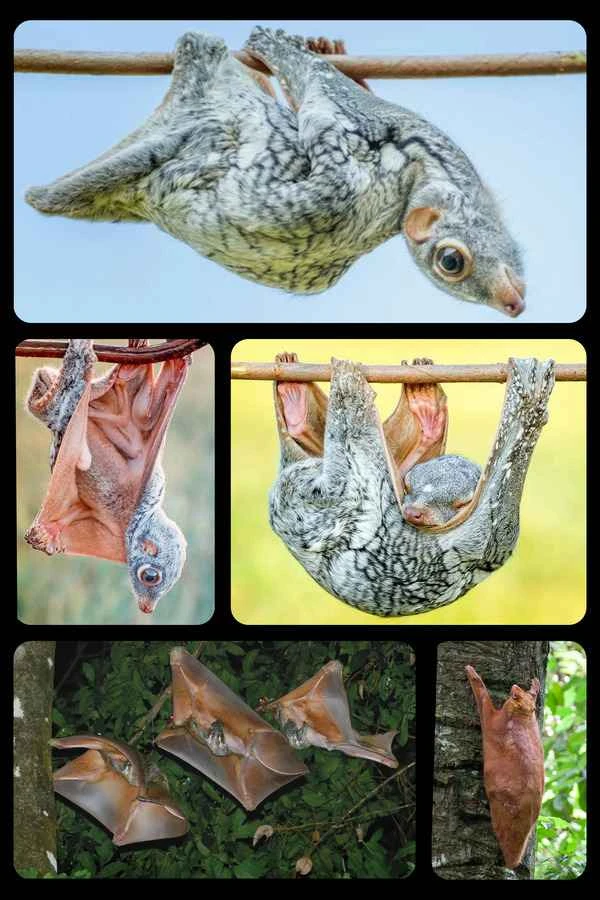
Flying slugs are small monkeys, about the size of a cat. They possess hairy wing membranes extending from their neck, forearms, hind feet to their tails, allowing them to glide between trees for distances exceeding sixty meters. They have a pair of nipples on their chest. Each of their fore and hind limbs has five digits. Their first and second pairs of lower incisors are comb-like, used for grooming and scraping leaves. Their light brown fur with white markings provides excellent camouflage against tree trunks. They typically measure between 40 and 60 centimeters in length, with a tail as long as, or even longer than, their body. They weigh approximately 5 to 7 kilograms. Flying slugs have dense, soft fur, ranging in color from grayish-brown to yellowish-brown, with the back usually slightly darker than the belly. Adult males, in particular, have even denser fur, giving them a more imposing appearance. The flying slug's tail is highly flexible and possesses a grasping function, used to increase stability, especially crucial when rapidly traversing the canopy.
Facial features of flying squirrels
Flying slugs have small, delicate faces with large, bright eyes that almost cover their entire faces. Their eyes are characteristic of nocturnal animals; their large size helps them effectively detect prey in low light conditions at night, allowing them to locate food or avoid predators. Flying slugs have relatively small nostrils, and their facial expressions are typically quite flexible and expressive.
The limbs and tail of a flying squirrel
Flying squirrels have very strong limbs, adapted to arboreal life. Their hands and feet are capable of grasping, and their long tails, in particular, not only help them maintain balance but also serve as additional footholds when climbing. The tails are flexible and have a strong grasping ability, even able to grip branches, allowing them to move through the trees with ease.
Flying Squirrel Habits
nocturnal behavior of colugos
Flying slugs are typical nocturnal animals. Their activity is primarily concentrated at night, during which they typically rest in tree hollows or canopies to avoid being discovered by predators. Their eyes are adapted to nocturnal life, possessing exceptionally keen night vision, allowing them to quietly forage at night. Their behavioral pattern is typically active from dusk or night onwards, using branches and vines to traverse the forest in search of food.
Social life of flying squirrels
Although flying slugs are generally solitary animals, they form small groups during the breeding season, with males and females maintaining a degree of social interaction. Females usually live with their young, while males often hunt alone. Flying slugs' social behavior is quite complex, primarily communicating through body language and vocalizations, especially at night. They frequently use vocalizations to convey information, warning their companions of predators or searching for food.
food for flying squirrels
Flying slugs are omnivorous, with a diverse diet including fruits, leaves, insects, and bird eggs. They particularly enjoy fruits, especially tropical fruits such as bananas, mangoes, and durians. Flying slugs also supplement their protein intake by hunting insects and small animals, and may even consume some plant matter such as resin and bark.
Colugo habitat
forest habitat
Flying squirrels live in tropical rainforests and subtropical forests, especially dense woodlands. They typically inhabit the canopy, moving nimbly between trees using their limbs and tails. Flying squirrels have specific habitat requirements; they prefer tall, dense forests to ensure sufficient food while avoiding predators. They often inhabit higher locations to avoid threats from ground predators.
Habitat Change and Conservation
With the expansion of human activities, the habitat of flying squirrels is being gradually destroyed. Deforestation and land reclamation are constantly shrinking their habitat, leading to survival pressures. In some areas, the number of flying squirrels has declined due to habitat loss. Therefore, protecting their habitat, reducing deforestation, and restoring the ecological environment have become key measures for the conservation of flying squirrels.
Colugo reproductive habits
Breeding season
The breeding season for flying slugs is usually closely related to their habitat environment, especially the abundance of food. Female flying slugs are more likely to breed during seasons with plentiful food. Although flying slugs are mostly solitary, males and females interact during the breeding season, with males attracting females by displaying their impressive physique and agile movements.
Courtship behavior
Female flying slugs' courtship behavior is not as complex as that of some other species, but male flying slugs attract females through specific behaviors. Male flying slugs typically win females' favor by displaying their strength, health, and agility. They perform a series of actions, such as climbing trees, jumping, and wagging their tails, to demonstrate their abilities in hunting and escaping predators.
Sometimes, male flying squirrels will engage in small-scale "dance battles" with females, a behavior that uses body language and movements to demonstrate their superiority. In these courtship behaviors, the male flying squirrel's physique, agility, and adaptability to its habitat play a crucial role.
Pairing and mating
Female flying slugs typically enter their breeding season after reaching maturity, usually between the ages of 2 and 3. During the breeding season, males seek out females and attempt to win their favor. After a successful pairing, the male and female will stay together in their habitat, and the male may sometimes help the female guard her territory to prevent other males from encroaching.
Mating itself is infrequent and usually occurs at night because flying slugs are nocturnal animals. Mating behavior is generally short-lived and infrequent, typically concentrated during the breeding season.
Pregnancy and childbirth
The gestation period for female flying slugs is approximately 140 to 170 days (about 5 to 6 months). During pregnancy, the female will build a nest in a relatively secluded and safe place, usually a crevices or hollows in a tree, to protect herself and her unborn offspring during childbirth.
During childbirth, female flying slugs typically choose a quiet time, free from excessive external disturbance. Once born, the female usually stays in the nest to nurse the infant until it grows up and can move independently. Newborn monkeys are very vulnerable, their eyes not yet open, and they rely on their mother's protection and nursing to grow.
Breastfeeding and parenting
Newborn flying lemurs rely on their mothers' milk for nourishment, and for the first few months after birth, they depend almost entirely on their mothers for food. Female flying lemurs are very caring towards their offspring, typically choosing a safe and secluded habitat to nurse them. As the young lemurs grow, they continuously learn how to live in the forest, how to climb trees, and how to find food.
During the nursing period, infant monkeys grow relatively quickly, and generally begin to eat solid food and learn to be self-reliant within a few months of birth. After about 6 to 12 months, infant monkeys can begin to live independently, although they still rely on their mothers for some protection.
Social Structure and Childcare
Although flying squirrels are typically solitary animals, the bond between mother and offspring is very close during the incubation period. When the young are very small, they are essentially "attached" to their mother, who leads them through the forest, teaching them how to survive.
Under their mother's care, young flying slugs learn various survival skills, including finding food, identifying predators, and how to move among trees. Mothers typically care for their young patiently until they are independent. Male flying slugs, however, usually do not participate in the parenting process.
Reproductive cycle and lifespan
Flying slugs typically have a long breeding cycle, with females having approximately one breeding opportunity per year. Under ideal conditions, flying slugs can reproduce for many years, but their reproductive success is closely related to environmental conditions. If their habitat is threatened or food is scarce, their breeding opportunities will decrease.
Flying squirrels typically live between 10 and 20 years. Some individuals survive longer in the wild, but their lifespan is shorter in harsh environments. The frequency and number of reproductions vary between males and females at different stages of their life cycle.
Environmental threats to reproduction
Habitat loss
The colugo's breeding environment is facing significant threats due to habitat destruction. Deforestation, agricultural expansion, and urbanization are causing a continuous reduction in colugo's habitat, making breeding sites increasingly scarce. Habitat destruction not only reduces food resources but also makes their breeding environment more unstable.
Ecological and environmental changes
Climate change may also affect the reproduction of flying slugs. Rising temperatures and changes in precipitation patterns could disrupt their food chain, further reducing reproductive success. In addition, an increase in external predators could threaten their reproductive activities and the survival rate of their young.
Protection and Restoration
To ensure the successful reproduction and population continuation of flying slugs, protecting their habitat and restoring their ecological environment are of paramount importance. Strengthening forest protection, limiting habitat destruction, and reducing human interference with the natural environment are currently the most crucial conservation measures. Furthermore, establishing nature reserves to provide safe habitats and breeding environments is of great significance for the reproduction and long-term survival of flying slugs.
Natural enemies of flying squirrels
Predators and Threats
Despite their small size and agility, flying squirrels still face certain predatory threats. Their greatest predators include large birds of prey (such as eagles and vultures) and other arboreal carnivores. Although flying squirrels are adept at using trees to evade predators, they sometimes still become prey themselves. Furthermore, human activities are also a significant threat to flying squirrels. Habitat destruction, illegal hunting, and ecosystem changes all impact their survival.
Preserve the status quo
Currently, flying squirrels are not listed as critically endangered, but their survival is gradually attracting attention due to habitat loss and other environmental pressures. Protecting flying squirrel habitats, reducing environmental pollution, and maintaining ecological balance are among the main conservation measures implemented globally.
The relationship between flying squirrels and humans
The cultural significance of flying squirrels
In some regions, flying squirrels are regarded as symbols of wisdom by locals due to their clever and agile behavior. Because of their nocturnal nature and nimble movements, flying squirrels have been imbued with a mystical aura in many cultures. In folk tales and legends, they often appear as representatives of wisdom or embodiments of mysterious power, becoming an integral part of human culture.
The research value of colugos
Scientists' research on flying squirrels not only helps us better understand the behavior of nocturnal primates, but also provides us with important information about forest ecosystems. Flying squirrels play a role in the ecosystem that extends beyond being predators; their activities also have a significant impact on seed dispersal and forest health.
FAQ:
1. What kind of animal is a flying squirrel?
The flying squirrel (scientific name: *Plecturocebus moloch* ) is a small primate that lives in tropical rainforests and subtropical forests, primarily inhabiting the canopy layer of trees. They are nocturnal animals with large eyes and flexible limbs, allowing them to move freely among the trees. Flying squirrels are relatively small, typically measuring 40-60 cm in body length, with a tail that is almost or slightly longer than their body.
2. What do flying squirrels mainly eat?
Flying slugs are omnivorous with a very wide range of food sources. Their diet consists mainly of fruit, with a particular preference for tropical fruits such as bananas, mangoes, and durians. In addition, they also eat leaves, insects, bird eggs, and even some resin and bark. They sustain themselves by foraging for food and traversing the forest.
3. Where do flying squirrels live?
Flying slugs primarily inhabit the canopy layer of tropical rainforests and subtropical forests. They prefer dense forests, especially tall trees, which provide ample food and concealed habitats. Flying slugs typically inhabit high locations above the ground to avoid threats from ground predators.
4. How do flying squirrels reproduce?
The breeding season for flying squirrels is typically linked to food availability, with females generally having one breeding opportunity per year. Males attract females by displaying strength and agility, and mating occurs during the breeding season. The gestation period is approximately five to six months, and females nurse their offspring in secluded locations after giving birth. The infants rely on their mother's milk for several months after birth until they are able to forage independently.
5. What are the main natural enemies of flying squirrels?
Flying slugs face several natural predators, including birds of prey (such as eagles and vultures) and other arboreal predators. Despite their agility and ability to use trees to evade predators, they can still become prey. Furthermore, flying slugs also face threats from human activities due to habitat loss; deforestation and habitat destruction pose significant challenges to their survival.