The scientific classification of the blue-footed booby is as follows:
Kingdom : Animalia
Phylum : Chordata
Class : Aves
Order : Procellariiformes
Family : Sulidae
Genus : Sula (Boobies)
Species : Blue-footed Booby ( Sula nebouxii )
Appearance
The Blue-footed Booby ( Sula nebouxii ), also known as the Stuttering Booby, has a stout, nearly conical beak with serrated edges on both the upper and lower mandibles. It lacks nostrils, has a well-developed throat pouch, narrow, long, and pointed wings, and a thick neck. The beak is dark green, blue, or gray; the eyes are yellow, with the female's pupils slightly larger than the male's; the facial skin is dark with distinctive eye bags; the head and neck have heavy brown and white stripes; the wings, tail, and underparts are dark brown, while the back and belly feathers are white; the webbed feet are blue. It has a slender body, measuring approximately 70 to 80 centimeters in length. Their plumage is primarily white and grayish-blue, with a dark gray or bluish-gray back and wings. The most striking feature is its bright blue feet, a hallmark of the male Blue-footed Booby used to attract females. During the mating season, the male displays its blue feet to demonstrate its health and reproductive ability.
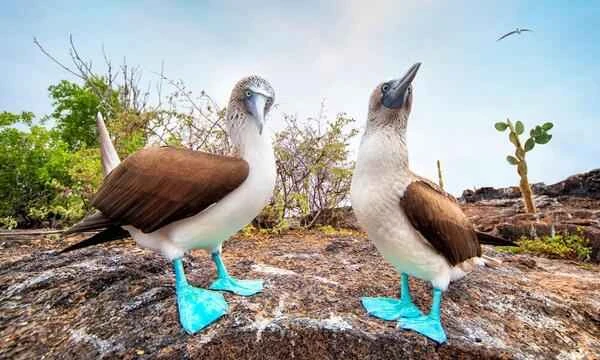
Weight and size
Blue-footed boobies weigh between 0.9 and 1.5 kilograms, with females slightly larger than males. They have a wingspan of about 1.5 meters, enabling them to fly quickly and glide across the water. Their moderate size is adapted for long-duration flight and diving.
life
Blue-footed boobies typically live between 15 and 25 years, with the exact lifespan depending on environmental factors and reproductive success. The breeding season is crucial for the survival of their population; birds that successfully breed live longer.
Habitat
Blue-footed boobies primarily inhabit tropical and subtropical regions, especially islands in the Pacific Ocean, such as the Galapagos Islands, Ecuador, and the Paracel Islands. They prefer to inhabit rocky islands or the edges of islands near the coast, where food is abundant and they are far from predators. Blue-footed boobies typically build their nests on rocks, beaches, or in trees.
Why are blue feet so important?
When talking about blue-footed boobies, many people immediately think of their distinctive blue feet. Every time a picture of a blue-footed booby appears, its blue feet are breathtaking. However, those blue feet aren't natural; rather, they are a result of special display behaviors employed by males to attract females. In this way, males can demonstrate their health, as only healthy birds can maintain such vibrant foot coloration.
The blue coloration of the blue-footed booby is closely related to its diet. Their feet are blue due to certain chemicals in their food, particularly carotenoids. When male birds consume abundant carotenoids, their feet become more vibrant. If the males are healthy and provide ample food, their blue feet will be even brighter, attracting more females to choose them as mates.
The allure of blue feet – how female birds choose mates
The male blue-footed booby's blue feet aren't something that comes easily; it's displayed to "prove" it's worthy of a female's choice. When the breeding season arrives, the male begins a series of courtship behaviors, the most crucial part of which is their "blue-footed dance." The male repeatedly raises its feet and thumps the air to display the brightness and vibrancy of its soles. Even more interestingly, the male blue-footed booby will use its beak to pick up small pebbles or food, "dance" along with its blue feet. All of this is to showcase their "resources"—a healthy, strong body and abundant food sources.
When observing these courtship dances, female birds choose their mates based on the male's performance and the brightness of his blue feet. Studies show that females tend to choose males with bluer, brighter feet, as this often indicates health, strength, and capability. These traits are crucial for ensuring the healthy development of offspring.
The close relationship between the blue-footed booby and the breeding season
Every year during the breeding season, blue-footed boobies gather on a tropical island. Typically between winter and spring, males and females begin preparing for mating based on a series of physiological signals. This period is particularly important for blue-footed boobies, and their breeding activity is usually one of the busiest times on the island.
For these birds, the arrival of the breeding season means they must exert every effort to attract mates. At this time, the performance of the males is particularly important—they must not only display their bright blue legs but also provide food for the females, proving themselves to be capable fathers. In this competition, only the strongest survive, and only the most dominant males can successfully mate.
Blue-footed booby family life
How to raise offspring
Once mating is successful, the female blue-footed booby will establish a nest in a safe location. Generally, they choose secluded rocky areas or trees away from human activity as nesting sites. The female usually lays two eggs in the nest, and the incubation period is about 40 days. During this time, the female is responsible for incubating the eggs, while the male forages for food, bringing back small fish and invertebrates to feed the female.
After hatching, the parents of blue-footed boobies become even more attentive to their young. Although the chicks are still fledged and their eyes are not yet open, they possess a strong survival instinct. The parents will feed them and guard them against predators. Generally, blue-footed boobies learn to fly and survive independently after about three months.
Bird House
It's worth noting that the raising process for blue-footed boobies is relatively simple; they don't require the complex care systems of some birds. Blue-footed boobies parents typically breed in the same area for many years, so the chicks are often able to settle in the same spot after they grow up.
This simple yet effective brooding method ensures the continuation of the population. Even when the external environment changes, their brooding strategies can adapt to new challenges, guaranteeing the survival of the species.
Blue-footed booby's role in the food chain
hunters in the ocean
Blue-footed boobies occupy a place in the food chain, not only as predators of small fish and invertebrates in the ocean, but also in maintaining the balance of the ecosystem to some extent. By controlling fish populations, blue-footed boobies help maintain the health of marine ecosystems. Their position in the food chain makes them an important part of the ecosystem.
Although they are predators, blue-footed boobies do not directly threaten other larger species. They typically prey on small fish and marine invertebrates, and therefore, their presence actually helps maintain the stability of the marine food chain.
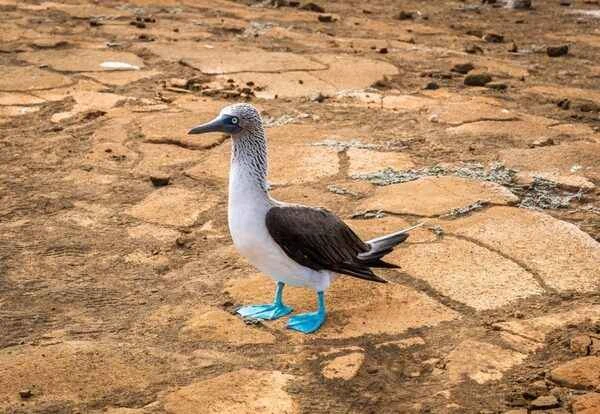
diet
Blue-footed boobies are typical seabirds, primarily feeding on small fish and invertebrates in the ocean. They hunt prey by diving or swooping, especially small fish and plankton. Their foraging methods include flight, gliding, and diving, allowing them to quickly capture prey. Their diet is also closely linked to the marine ecosystem, helping to maintain a balanced food chain.
Competition between the blue-footed booby and other seabirds
Blue-footed boobies are not the only predators in the ocean. They compete for food resources with other seabirds, such as golden-crowned gulls and mallards. Nevertheless, thanks to their excellent hunting skills and intelligent behavior, blue-footed boobies often manage to occupy the top of the food chain.
Their hunting methods are also highly efficient; they can quickly capture prey through flight, diving, and other means. The blue-footed booby's role in the food chain makes them an indispensable part of the marine ecosystem.
Natural enemies
Blue-footed boobies have virtually no natural predators after reaching adulthood, but their eggs and chicks are the primary targets of predators. Terrestrial predators, such as eagles, gulls, snakes, and other large birds, often attack nests and prey on juvenile blue-footed boobies. In addition, human activities, especially habitat development, pollution, and tourism disturbance, also pose a threat to blue-footed boobies.
The relationship between blue-footed boobies and humans
Tourism star
Blue-footed boobies are not only stars in the natural world but also play a vital role in tourism. In places like the Galapagos Islands, Ecuador, and Mexico, they have become a major tourist attraction. Every year, tens of thousands of tourists visit these islands specifically to witness the blue-footed boobies' courtship, breeding, and foraging activities.
The distinctive behaviors of these birds, especially the males' blue-footed dance, have become popular subjects for tourists to photograph and document. For the ecotourism industry in these areas, the presence of the blue-footed booby is one of the pillars of ecological conservation and tourism revenue.
Protection and Challenges
Although blue-footed boobies have relatively stable populations in some areas, they still face several ecological threats. Their habitats are threatened by climate change and increased human activity, particularly island habitat development and tourism expansion. To protect this species, governments and conservation organizations have implemented a range of measures, including limiting island development, strengthening habitat protection, and conducting environmental education.
The Future of the Blue-footed Booby
As a precious species in nature, the conservation of the blue-footed booby remains a crucial task in global ecological protection. Although they are not currently listed as endangered, their habitat and ecological environment remain fragile. With increasing human understanding of the natural environment and growing awareness of conservation, we believe that the blue-footed booby will continue to soar in the wild and maintain its important role in the ecosystem.