The Formosan Spotted-winged Laughingthrush (Actinodura morrisoniana) has a call that sounds like "jiao, jiao," soft and delicate, hence the name "Jiaojiao" given to it by the Buyi indigenous people of Taiwan. Its English name means "Striped-winged Laughingthrush" because of the beautiful, neat alternating black and chestnut stripes on its wings; and because its head is chestnut-colored, distinguishing it from other spotted-winged babblers, it is also known as the Chestnut-headed Spotted-winged Laughingthrush. This lovely, small bird is found only in Taiwan, my country, and is endemic to China.

In January 1906, British explorer and professional collector John Goofellow first discovered the Formosan spotted babbler in the Yushan mountain area of Taiwan, at an altitude of 2,440 meters. After identification by British ornithologist Grant, it was published as a new species in that year's *British Bulletin of Ornithology*. Grant wrote in the article: "This remarkable new species does not need to be compared with any known species, because its plumage is so distinctive."
The genus *Bambusa* comprises seven species, with the Formosan Babbler being the most recently discovered. Except for the Formosan Babbler, which is found only in Taiwan, the other six species are distributed from the Himalayan foothills to the Indochina Peninsula. This demonstrates the biogeographical connection between Taiwan and the Himalayas. Physically, the Formosan Babbler is characterized by its chestnut-brown head and throat, grayish-white nape and belly with dark brown stripes, a plumage significantly different from the other six species in the genus.
The Formosan Barbet does not possess a loud song or beautiful, vibrant plumage, but its soft call and varied shades of olive-brown plumage give it a distinctive appearance. Compared to other thrushes inhabiting Taiwan, the Formosan Barbet appears unassuming and composed; its gentle call is often overlooked or mistaken for the call of another animal. Its plain plumage blends seamlessly with the color of the branches, providing excellent camouflage. When flying in the mountains or moving among the branches of trees, even at close range, they are difficult to spot, leading some to call them "ninja birds."
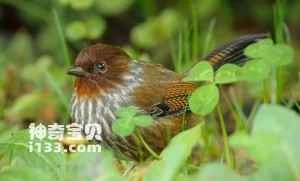
The Formosan Barbet is distributed in mid- to high-altitude mountainous areas, inhabiting broad-leaved forests and mixed coniferous and broad-leaved forests at altitudes of 1400-3000 meters. They typically live in solitary groups, usually small flocks of five or six individuals moving through the middle and upper canopies. They do not engage in long-distance flight, although there have been reports of single Formosan Barbets mixed in with flocks of White-eared Babblers (Heterophasia aurcularis). Generally, group activity helps the Formosan Barbets to be wary of predators and exchange foraging information, thus improving foraging efficiency.
The Formosan spotted-winged babbler has short, rounded wings and slender yet powerful claws, enabling it to climb tree trunks. It can skillfully hang upside down from twigs or peck at food in bark crevices, occasionally flying to the edge of the forest to feed on arthropods on the bark of trees or shrubs. According to Chen Dekang's 1994 study, in 229 foraging records, 90% of the feeding consisted of arthropods on the bark, 1% on the leaves, and 9% on fruits such as those of mountain cherry, alpine rose, oleaster, and Yushan false pear. Xu Haojie's 2002 study showed that 36% of the Formosan spotted-winged babbler's foraging behavior occurred in the middle and upper canopy, 50% in the lower canopy, and 7% each in the shrub and herbaceous layers.
The Formosan Barbet exhibits a distinct solitary flocking pattern, likely because they primarily feed on arthropods on the bark surface, a resource utilization strategy quite different from most birds that feed on leaf-borne arthropods. The Formosan Barbet cannot join other flocks to share the benefits of foraging, and other birds also find it difficult to join the Formosan Barbet flocks, thus missing out on the latter's hunting pleasures.
Due to extensive deforestation in the mid- and high-altitude forests of Taiwan, the habitat of the Formosan spotted-winged babbler has shrunk, and its current population is small. However, they are not a target for hunting, so their survival is not currently threatened. If afforestation in the local mid- and high-altitude areas is successful, the population of the Formosan spotted-winged babbler will increase over time.