In recent years, a large number of well-preserved bison fossils have been discovered in Northeast my country, providing important materials for further research on bison fossils. Researchers including Tong Haowen from the Institute of Vertebrate Paleontology and Paleoanthropology, Chinese Academy of Sciences, described two bison skulls and three mandibles dating back approximately 20,000 years from the Dabusu area of Qian'an County, Jilin Province, suggesting that the bison of the Late Pleistocene in the Northeast Plain of my country should be classified as steppe bison. This research was published in the fourth issue of the *Acta Anthropologica Sinica* in 2013, providing new evidence for further clarifying the biological characteristics, evolutionary system, and dispersal routes of fossil bison in my country.

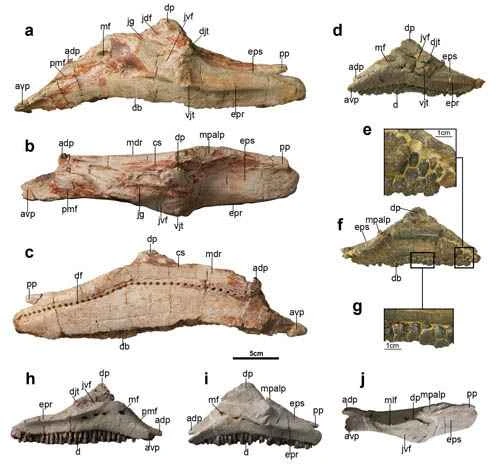
buffalo skull
Bison are relatively common animals in the Quaternary fauna of northern my country, especially the ancient Chinese bison (Bison palaeosinensis) from the Nihewan period, which some scholars consider to be the ancestor of bison in the entire Middle-Late Pleistocene region of the Holocene. Furthermore, bison are also an important member of the mammoth-woolly rhinoceros fauna of Northeast my country. Although they have been discovered for nearly a century and have been reported sporadically, there is still no dedicated literature on them, and none of the previously reported skull fossils are complete.
According to the researcher, the bison fossil described in this study is the best-preserved material reported to date. The shape and measurements of its skull and horn center fall within the range of the steppe bison (Bison priscus) species from Europe, America, and Siberia. Therefore, the Late Pleistocene bison fossils from the Northeast Plain of my country should be classified as steppe bison. Previous classifications of Late Pleistocene bison from the Northeast Plain into Bison exiguous (Matsumoto, 1915) have many problems, as the latter differs significantly from the Late Pleistocene bison of Northeast China in terms of type locality, geological age, and morphological characteristics. Steppe bison was a species widely distributed throughout the Holocene during the Middle to Late Pleistocene and was one of the most important members of the mammoth-woolly rhinoceros fauna.
The fossil record currently discovered in my country shows a gap between the Early-Middle Pleistocene *Paleosteus sinensis* and the Late Pleistocene *Steppe bison*. Therefore, the bison in Northeast my country likely migrated from Siberia during the Late Pleistocene, a period roughly coinciding with the explosive dispersal of early humans. The steppe bison was one of the most common animals in northern Eurasia during the Late Middle Pleistocene and is considered an ancestor of the North American bison. Bison fossils from the Northeast Plain of my country are found alongside mammoth-woolly rhinoceros faunas, dating to the Middle-Late Late Pleistocene.
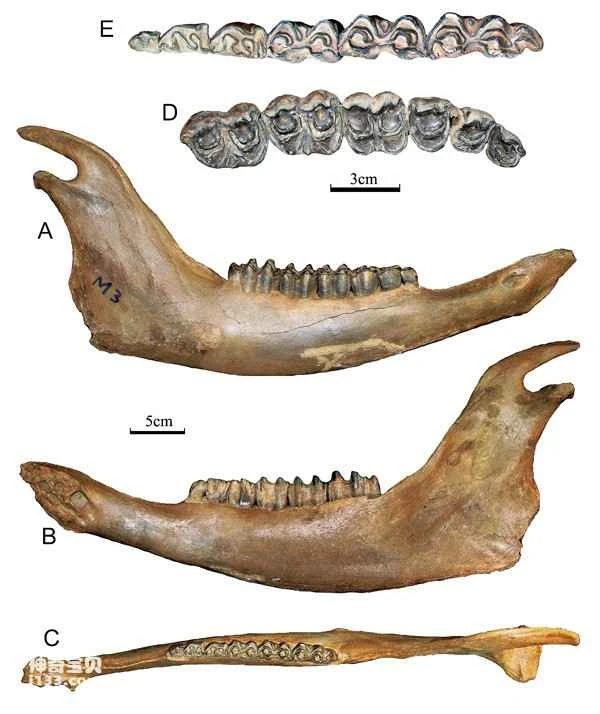
Lower jawbone and cheek teeth of the steppe bison