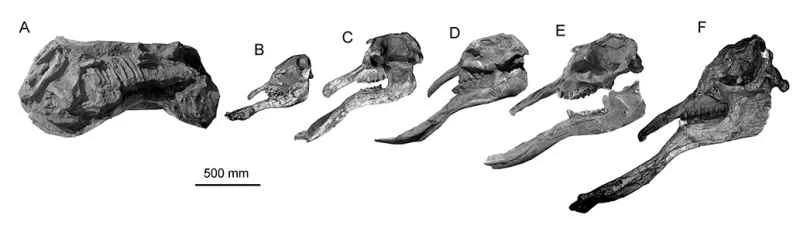
Hadrosaurids are a group of large, terrestrial, herbivorous ornithischian dinosaurs that lived during the Late Cretaceous period. Their fossils are widely distributed, found on every continent except Oceania. The most distinctive features of hadrosaurids are their elongated, flattened heads with duck-like bills, complex rows of teeth, and powerful chewing systems. The superfamily Hadrosauridae includes more primitive basal groups and more advanced hadrosaurid families. Some members of the Hadrosauridae family possessed diverse headdress structures. Based on the different forms of their headdresses, Hadrosauridae can be divided into the subfamilies of platy-headed and solid-headed caudal dinosaurs, and the subfamilies of Lamysaurinae, which possess hollow headdresses.
Over the past decade, the research team led by Professor Wang Xiaolin of the Institute of Vertebrate Paleontology and Paleoanthropology, Chinese Academy of Sciences, has collaborated with the Laiyang Municipal Government of Shandong Province to conduct continuous field scientific expeditions in Laiyang. Large-scale excavations were carried out at Sites 1 and 2 near Jingangkou Village, Lügezhuang Town, in the southern suburbs of Laiyang, in the Upper Cretaceous Wangshi Group strata. Currently, five consecutive layers of fossil-rich dinosaur and other vertebrate fossils have been discovered at Site 2. A large number of vertebrate fossils, primarily dinosaurs, have been salvaged, resulting in several important discoveries and research advances, such as the discovery of new materials and further research on the Qingdao dragon head ornament. Professor Wang Xiaolin and his doctoral student Zhang Jialiang, among others, have conducted detailed descriptions and comparative studies of some new materials from hadrosaurid skulls, naming a new genus and species belonging to the subfamily Ctenosaurinae of the Hadrosauridae family—Laiyangosaurus youngi. The species name is dedicated to Academician Yang Zhongjian, the founder of Chinese vertebrate paleontology, to commemorate the 120th anniversary of his birth and his significant contributions to the study of Laiyang dinosaur fossils. The relevant research findings were recently published online in the Proceedings of the Brazilian Academy of Sciences (Anais da Academia Brasileira de Ciências).
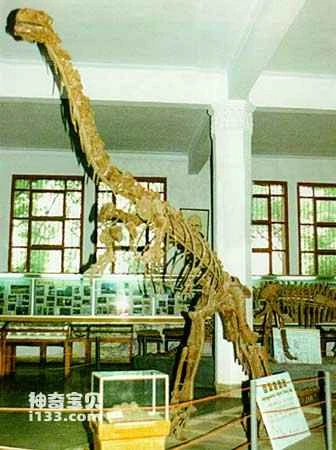
Laiyang, located in the central part of the Shandong Peninsula in my country, is the place where Chinese geologists and paleontologists first discovered fossils of dinosaurs, dinosaur eggs, pterosaurs, insects, and plants. It is also the birthplace of the Chinese Society of Vertebrate Paleontology and Paleoanthropology, holding a pivotal position in the study of dinosaur fossils in my country. The Cretaceous strata in Laiyang are complete and continuous, containing three important Cretaceous faunal assemblages: the Early Cretaceous Jehol Biota, the Late Cretaceous Laiyang Hadrosaurid Fauna, and the Laiyang Dinosaur Egg Fossil Assemblage. Since the 1920s, Laiyang has experienced three important fossil discoveries. In 1923, Tan Xichou first reported the discovery of dinosaur, fish, insect, and plant fossils in the Cretaceous strata of Laiyang. At the same time, Graeper studied the insect and fish fossils, Zhou Zanheng studied the plant fossils, and the Swedish paleontologist Wiman studied the dinosaur fossils, classifying them as hadrosaurids and naming them *Tanius sinensis* Wiman (1929). In 1951, Yang Zhongjian, Liu Dongsheng, and others conducted a large-scale survey and excavation in Laiyang, discovering the first dinosaur fossil skeleton found after the founding of the People's Republic of China at Xigou, Jingangkou Village (now Site No. 1). They studied and named the famous hadrosaur with a crested head—Tsintaosaurus spinorhinus Young, 1958—as well as a large number of dinosaur and dinosaur egg fossils, including Tansaurus jingangkouensis and Fragmented Tansaurus jingangkouensis. They also reported the first pterosaur fossils discovered in Laiyang. Subsequently, some scattered dinosaur fossils, such as the Hongtuya Pachycephalosaurus and dinosaur egg fossils, were discovered in Laiyang. Zhao Zikui also proposed a dinosaur egg classification and naming system mainly based on the research of Laiyang dinosaur egg fossils. From 2008 to the present, the Laiyang Joint Scientific Expedition Team, led by Wang Xiaolin, has conducted a detailed and comprehensive investigation of the Laiyang Group, Qingshan Group, and Wangshi Group of Cretaceous strata in Laiyang, discovering dozens of new fossil sites and strata, and also discovering the extremely rare plain dinosaur canyon group. Meanwhile, large-scale excavations and fossil and site protection work are being carried out at the two fossil sites in Jingangkou. Currently, the Laiyang Cretaceous National Geopark, along with its paleontology museum and two dinosaur fossil sites, has been established here, making it a key national protected fossil site and a research and popular science base for the Institute of Vertebrate Paleontology and Paleoanthropology.
Researchers, through morphological and systematic studies of the fossils of *Laiyangosaurus yangi*, have concluded that it differs from the basal members of the hadrosaurid superfamily represented by *Tansiosaurus*, exhibiting advanced hadrosaurid characteristics. Furthermore, *Laiyangosaurus yangi* differs from members of the Laiidae subfamily, represented by *Tsingtaoosaurus*, which possess crested features, exhibiting distinct ctenosaurinoid characteristics. In addition, *Laiyangosaurus yangi* possesses several features distinguishing it from other ctenosaurinoid members, such as a straight dorsal margin of the nasal bone with a narrow lateral ridge; a posteriorly positioned principal ridge of the maxillary teeth; a laterally curved postarticular process of the superior temporal bone; and an eye socket wider than the inferior temporomandibular foramen. The discovery of *Laiyangosaurus yangi* not only enriches the composition of the Laiyang hadrosaurid fauna but also provides new material for further discussions on the origin and evolution of hadrosaurid dinosaurs.
This research was supported by the National Natural Science Foundation of China (NSFC) General Program, the NSFC Basic Science Center Program, the Strategic Priority Research Program of the Chinese Academy of Sciences (Category B), and the Laiyang Municipal Government Cooperation Project.
Original link: http://www.scielo.br/pdf/aabc/2017nahead/0001-3765-aabc-201720160920.pdf
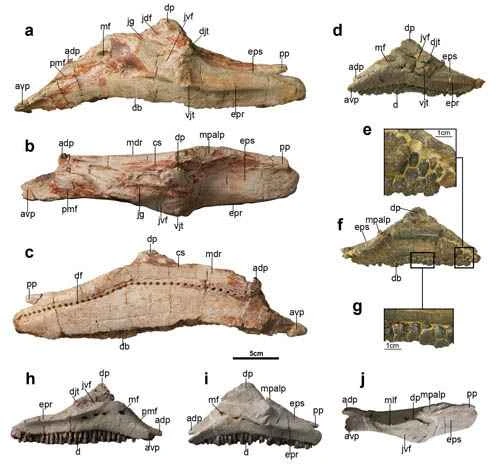
Figure 1. Maxilla of Yang's Laiyangosaurus (Photos provided by Zhang Jialiang and Wang Xiaolin)
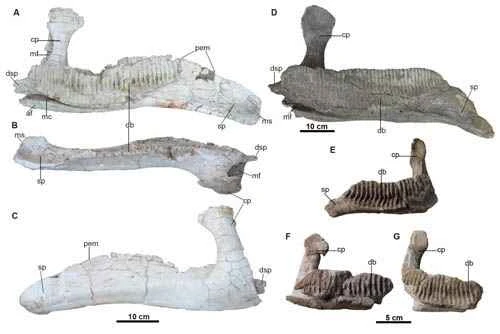
Figure 2. Mandible of Yang's Laiyangosaurus (Photos provided by Zhang Jialiang and Wang Xiaolin)
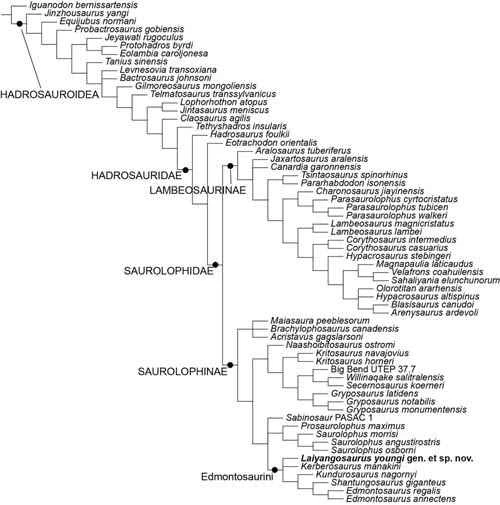
Figure 3. Phylogenetic diagram of Yang's Laiyangosaurus (provided by Zhang Jialiang and Wang Xiaolin)
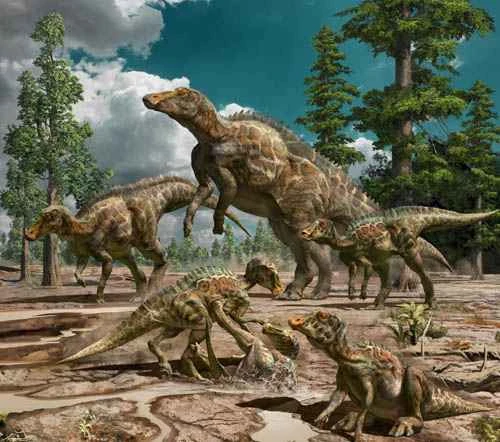
Figure 4. Ecological restoration diagram of Yang's Laiyangosaurus (drawn by Zhao Chuang)