On September 4th, the journal *Nature Ecology & Evolution*, a sub-journal of *Nature*, published online the latest research findings from the team led by Zhu Min at the Institute of Vertebrate Paleontology and Paleoanthropology, Chinese Academy of Sciences, in the field of fish terrestrialization. They discovered a 370-million-year-old ancient fish, *Zhou's Hongyu*, in Qingtongxia, Ningxia. This fish reached a length of 1.5 meters and exhibited characteristics of root-toothed fish, *Homo spp.*, and tetrapods, revealing that fish adaptations to terrestrial life occurred multiple times, and that the process of fish terrestrialization was far more complex than previously thought.
The common ancestor of all terrestrial vertebrates (tetrapods), including humans, can be traced back to fish that ventured onto land during the Devonian period, more than 300 million years ago. Over a century of fossil discoveries and in-depth research has painted a comprehensive picture of the process by which fish migrated onto land. It is now known that tetrapods evolved from a branch of lobe-finned fish. Tetrapods and this branch of lobe-finned fish are collectively known as the tetrapod lineage or tetrapodoids. Besides terrestrial vertebrates, the tetrapod lineage also includes some aquatic fish members, known as the tetrapod stem group. The oldest representatives are *Dongshengyu* and *Kan's fish*, discovered in the Early Devonian strata of my country. The tetrapod stem group flourished during the Devonian and Carboniferous periods, firmly occupying the ecological niche of large shallow-water predators. In the Late Devonian, *Hope salamanders*, such as *Tiktaalik*, evolved, their morphology already very close to that of the earliest tetrapods. The complex tetrapod stem group members between *Kan's fish* and *Hope salamanders* can be classified into two branches: rhizodonts and bony-squamous fishes. Among them, the tri-pterids, such as the well-known true palm-finned fish, are similar in many ways to the phrys, thus phrys and tetrapods are thought to have evolved from one branch of tri-pterids, while rhizodonts occupy a more primitive position in the tetrapod stem group. This evolutionary framework has remained largely stable over the past 20 years despite continuous new fossil discoveries.
The Devonian fish discovered by Zhu Min and others in Qingtongxia, Ningxia, disrupted this framework, casting a shadow of doubt over the picture of fish venturing onto land. The Shixiagou section, bordering Qingtongxia and Zhongning in Ningxia, exposes classic Devonian fish-bearing strata in northern China, where the earliest tetrapod fossil in China—*Sinosaurus pani*—was discovered. In the summer of 2002, Zhu Min, Zhao Wenjin, and Jia Liantao accompanied Professor Per Ahlberg of Uppsala University, Sweden, to investigate the Shixiagou section. They unexpectedly discovered a row of fossil cross-sections on the steep walls of a quarry. With the help of quarry workers, they removed a thick sandstone block, approximately one meter square, from the cliff and transported it back to Beijing. After nearly a year of careful restoration, they were delighted to find that it was a well-preserved fossil of a large lobe-finned fish, with more than 20 vertebrae preserved. Unfortunately, the very tip of the head had broken off before the discovery and may have already become part of a roadbed. After restoration, the specimen represents an individual that could reach 1.5 meters in length. They named this ancient fish Hongyu chowi, and the species name in honor of Zhou Mingzhen, an internationally renowned paleontologist and recipient of the Simpson Medal.
During the Late Devonian period, when *Hymenochys henryi* lived, many large lobe-finned fish representing different branches of the tetrapod group existed in the waters of Europe, North America, and Australia. True tetrapods and their close relatives, *Homo sapiens*, had already appeared. After detailed research, Zhu Min et al. discovered that *Hymenochys henryi* combined characteristics of many groups. In terms of the joint structure of the pectoral girdle and the scapula and forelimb bones, *Hymenochys henryi* showed a striking similarity to *Homo sapiens* and other primitive tetrapods. An occipital joint had already appeared between the first vertebra and the skull in *Hymenochys henryi*, and the pectoral girdle exoskeleton was detached from the skull. This is different from other aquatic fish but consistent with terrestrial vertebrates, indicating that *Hymenochys henryi* was highly adapted to shallow coastal life and was not far from true terrestrial life.
On the other hand, *Pteranodon* also possesses many characteristics of rhizodonts, such as the contact between the superior and lateral temporal bones, a strong pectoral girdle with a high clavicular spine, thin cycloid scales, and a high premaxillary facial lobe, sufficient to classify it into this group. Rhizodonts are a group of mysterious large predatory fish, with the largest reaching 7 meters in length, known as the "Carboniferous Monster." More than two hundred years ago, enormous teeth belonging to rhizodonts were discovered in Carboniferous coal seams near Edinburgh, Scotland, initially mistaken for crocodile teeth. Some famous early paleontologists, such as Richard Irving (who coined the term "dinosaur"), Aldous Huxley ("Darwin's Fighting Dog"), and Andres Agassi ("father of paleontology"), all studied rhizodonts and engaged in heated debates about them. In the last century, due to the similarity in the arrangement and structure of the paired fin skeletons of *Rhizodontia* to tetrapods, scholars believed that *Rhizodontia* were very close to the point at which fish migrated to land. However, more than 20 years ago, the discovery of more and more complete *Rhizodontia* fossils in Devonian strata in Australia shook the status of *Rhizodontia* as a close relative of tetrapods. In the subsequent proposed evolutionary framework of tetrapod stem groups, although *Rhizodontia* is still within the tetrapod lineage, it has shifted to a more primitive position and is distantly related to tetrapods.
The mosaic features exhibited by *Hymenochrys henryi* present new challenges to this framework. Are rhizodonts or bony-scaled fishes the closest relatives of tetrapods? The process of fish colonization on land is once again shrouded in mystery. Zhu Min et al. conducted a detailed and in-depth phenotypic analysis of tetrapod stem groups, establishing a feature matrix comprising 33 tetrapod stem group members, 5 outgroups, and 169 features. Based on Bayesian and parsimony analyses, they obtained two different phylogenetic frameworks for tetrapod stem groups, the most significant difference being the position of rhizodonts. The results of Bayesian analysis still support the original position of rhizodonts within the tetrapod stem group. Within this framework, the mosaic features of *Hymenochrys henryi* reflect a significant convergence between rhizodonts and *Homo spp.*-tetrapods, with features of fish adaptation to terrestrial life appearing repeatedly. The results of parsimony analysis, however, revive the central role of rhizodonts in the process of fish colonization on land. The features of *Hymenochrys henryi* indicate a close kinship among these three groups, with *Hymenochrys henryi* and rhizodonts being the fish closest to *Homo spp.* and tetrapods.
Based on existing fossil data, it is still difficult to choose between these two theories. However, in either case, the discovery of *Hongyu* proves that the morphological diversity and biogeographical zonation of tetrapod lineages have been greatly underestimated in the past, and that the root-toothed fishes and bony-scaled fishes of the Devonian underwent significant parallel evolution toward adapting to terrestrial life. These large shallow-water predatory fishes belonging to different groups all attempted to expand onto land, but ultimately only one group succeeded.
This achievement was supported by a key project of the National Natural Science Foundation of China and a key research project on frontier science of the Chinese Academy of Sciences.
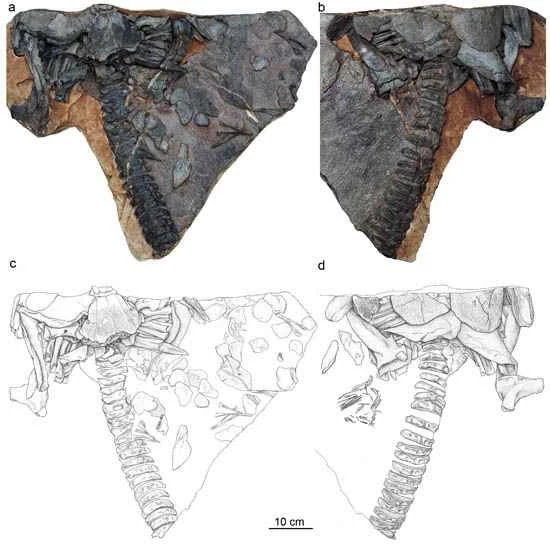
Figure 1. Photograph and sketch of the holotype specimen of *Amur corvina* (provided by Zhu Min)
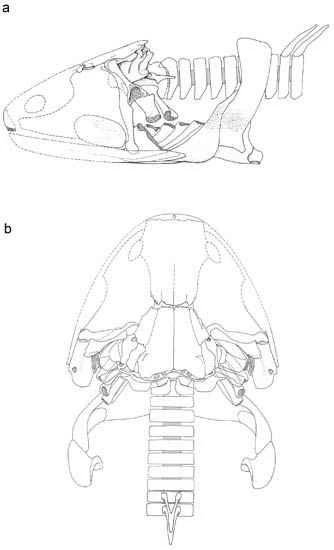
Figure 2. Reconstruction of the skeleton of the swan fish (provided by Zhu Min)
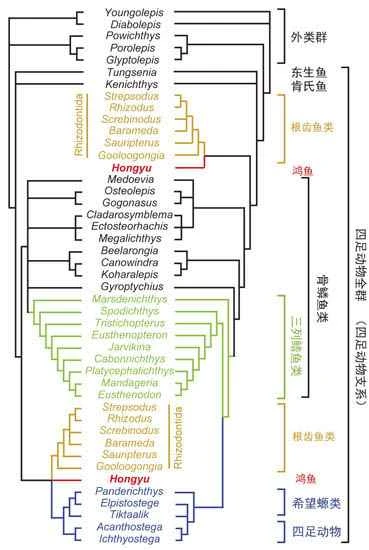
Figure 3. Classification of the scorpionfish (Image provided by Zhu Min)
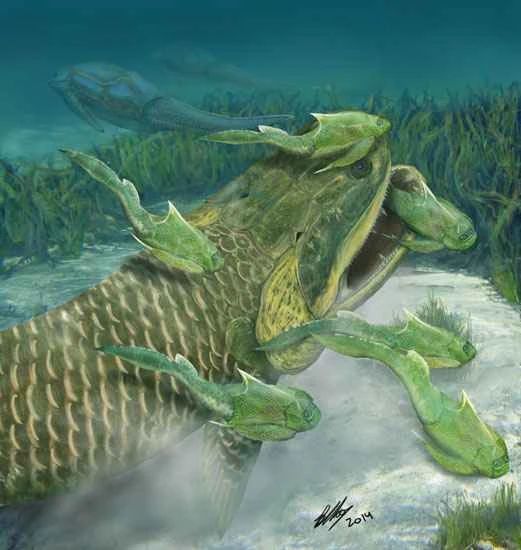
Figure 4. Ecological reconstruction of the Hongyu fish, which coexists with Ningxia fish and Paddlefish in a Devonian paleolake (illustrated by Brian Choo).