Felines are the most specialized group of carnivores, characterized by retractable claws, a short, blunt snout, well-developed canines and carnassial teeth, and the degeneration of teeth after the carnassial teeth. According to the current fossil record, the earliest feline was *Proailurus*, which appeared in Eurasia from the late Oligocene to the early Miocene. Subsequently, felines underwent rapid radiation and evolution, spreading to all continents except Australia, Antarctica, and South America by the end of the Miocene. After the formation of the Isthmus of Panama in the Pliocene, they rapidly invaded South America. Today, there are approximately 14 genera and 37 species of extant felines.
Traditionally, felines are divided into two main categories: conical-toothed cats, including all extant and related fossil species; and extinct saber-toothed cats, such as the well-known Machairodus, Homotherium, Megantereon, and the Ice Age star species Smilodon. Typical saber-toothed cats possess long, laterally compressed, dagger-like or curved upper canines, and a unique joint structure that allows the upper and lower jaws to open at a large angle. However, during early evolution, some intermediate types, resembling extant felines, appeared widely across Eurasia. These intermediate types had moderately developed, laterally compressed upper canines and unspecialized jaw joint structures. Paramachaerodus and Promegantereon belong to this type. These two genera of fossils, primarily discovered in Late Miocene strata across Eurasia, are indicator fossils of the Late Miocene fauna. Their study is of great significance for dating the fauna, cross-regional correlation, and the origin of the saber-toothed cat. For a long time, a considerable number of scholars believed that the two genera were not significantly different and might belong to the same genus. Other scholars, however, held the opposite view, supporting the validity of both genera. This long-standing controversy has impacted the successful study of this series of taxa.
Recently, Li Yu, a doctoral student supervised by Researcher Qiu Zhanxiang of the Institute of Vertebrate Paleontology and Paleoanthropology, Chinese Academy of Sciences, and Professor Nikolai Spassov, Director of the National Museum of Natural History of Bulgaria, conducted a collaborative study on several feline fossils discovered in Late Miocene strata at the Shilei site in the Linxia Basin of Gansu, China, and the Hadjidimovo-1 site in southwestern Bulgaria. Comparative studies showed that the morphological characteristics of the new materials from the two sites were very similar. Research on the accompanying mammalian fossil assemblage indicated that the new materials were stratigraphically close in age, suggesting they represent a new species of the genus *Paramachaerodus*. The presence of this species in East Asia (China) and southeastern Europe (Bulgaria) demonstrates its wide geographical distribution and adaptability to diverse habitats; therefore, it was named *Paramachaerodus transasiaticus* sp. nov. Detailed morphological comparisons and phylogenetic analyses show that the new species possesses mixed characteristics of both the genera *P. ogygia* and *P. orientalis*, placing it in an intermediate evolutionary position. This further demonstrates the continuity of the distribution of characteristics from these two groups, making its classification into a single genus more appropriate, with the genus name *P. ogygia* having priority. Thus, the genus *P. ogygia* now includes four valid species with consecutive chronologies: *P. ogygia*, *P. orientalis*, *P. transasiaticus*, and *P. maximiliani*. The discovery of this new material further enriches the fossil record of *P. ogygia* and represents the first discovery of fossils of this genus in the Linxia Basin of China and Bulgaria.
This research was recently published online in the journal Palötlogische Zeitschrift. It was supported by the National Natural Science Foundation of China and the Strategic Priority Research Program of the Chinese Academy of Sciences.
Original link: https://link.springer.com/article/10.1007/s12542-017-0371-7

Figure 1. Skull fossil of a saber-toothed tiger from the Shilei site in the Linxia Basin, Gansu Province (Photo provided by Li Yu)
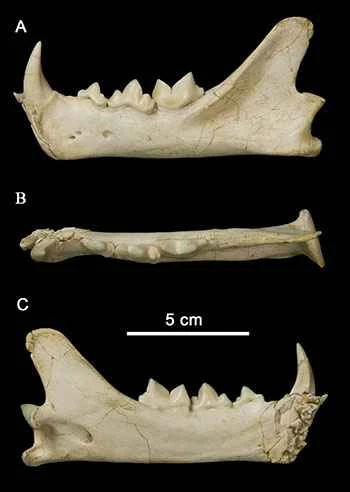
Figure 2. Fossilized lower jaw of a saber-toothed tiger from the Shilei site in the Linxia Basin, Gansu Province (Photo provided by Li Yu)
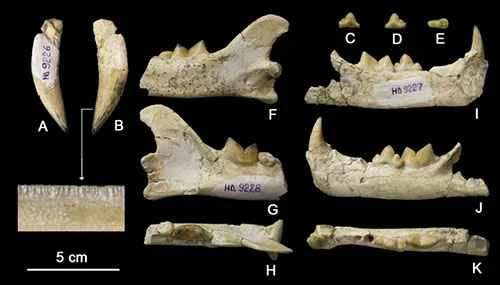
Figure 3. Fossilized upper canine and lower jaw of a saber-toothed tiger from the Hadjidimovo-1 site in Bulgaria (Photo provided by Li Yu)
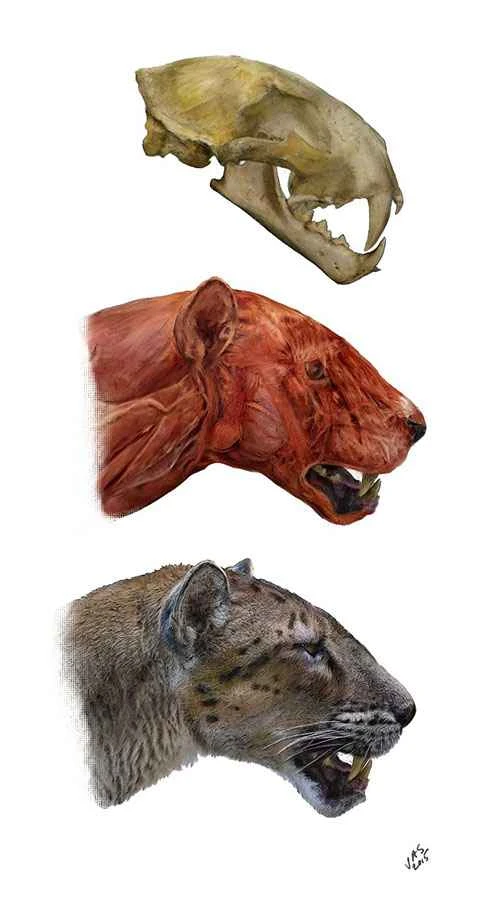
Figure 4. Reconstruction of Paramachaerodus transasiaticus sp. nov. (Drawn by Velizar Simeonovski)