Over the past decade, a series of skull fossils of *Indarctos*, *Agriotherium*, and *Ursavus* have been discovered in the Late Miocene Liushu Formation sediments of the Linxia Basin in Gansu Province. Previously, no complete skull of *Ursavus* had ever been discovered or reported worldwide, leaving many questions regarding the origin, phylogeny, and classification of the Ursinae subfamily unresolved. To better understand the early members of the bear family, particularly the nature of the genus *Ursavus*, Academician Qiu Zhanxiang and colleagues from the Institute of Vertebrate Paleontology and Paleoanthropology, Chinese Academy of Sciences, prioritized in-depth research on the *Ursavus* skull and mandible fossils discovered in the Linxia Basin. Their research findings were published as a cover article in the latest issue (No. 3, 2014) of *Vertebrata PalAsiatica*.
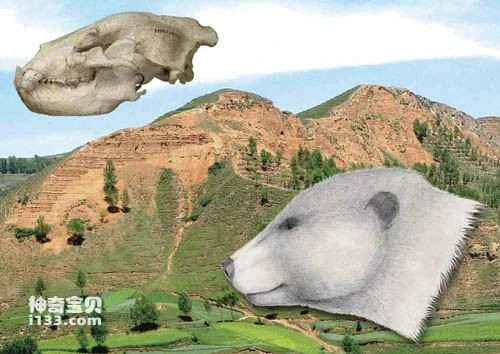
Figure 1. The skull fossil of the ancestral bear of the Dai family and its head reconstruction. The background is the Late Miocene red clay of the Linxia Basin.
This ancestral bear fossil was discovered near Huaigou Village, Guanfang Township, Guanghe County, Linxia Hui Autonomous Prefecture. Ancestor fossils of the Ursinae subfamily, especially those of the genus *Ursavus*, are frequently found in Miocene sediments of the Holocene realm, but are almost always represented by teeth and fragmented mandibles. The best previously known specimen was the anterior half of a skull from the Greek island of Euboea, described in detail in 1947. Another well-preserved specimen is the skeleton of *Ursavus orientalis* from Shanwang, Linqu County, Shandong Province, reported by Academician Qiu Zhanxiang et al. in 1985, but only describing some dental features. The Huaigou skull is the first and only complete early Ursinae fossil with a mandible.
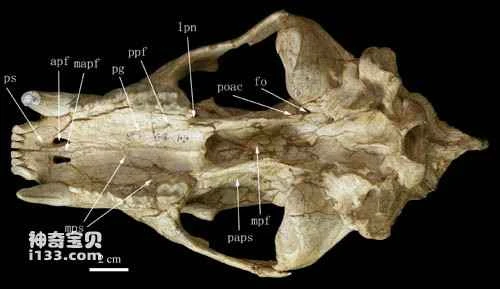
Figure 2. Ventral surface of the skull of Ursus deningeri.
Fossils of typical three-toed horse fauna from North China were also found at the Huaigou site, in the same stratigraphic layer as the ancestral bear specimen. These included the protoskeleton, hindcat, saber-toothed tiger, weasel hyena, hyena, three-toed horse, large-lipped rhinoceros, Chinese plate-toothed rhinoceros, ancient unicorn, and proto-Chinese antelope, with a geological age of approximately 8 million years ago.
Before the 1940s, *Ursavus brevirhinus* occupied a central position in the study of ancestral types of extant bears. Since the late 19th century, almost every researcher of bear-like carnivores considered *Ursavus brevirhinus* to be the sole ancestor of extant bears. The genus *Ursavus brevirhinus* was established in 1899 by the German paleontologist Schlosser, who primarily relied on material from three sites in Austria and Poland, including two incomplete mandibular ramus, a maxilla with a row of teeth, and some isolated teeth.
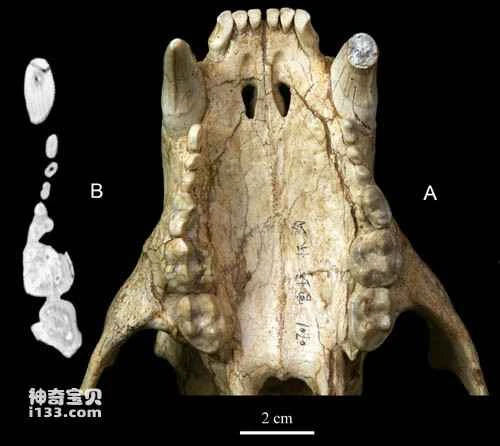
Figure 3. Upper cheek teeth of the ancestral bear of the Dai family.
Based on Shurose's description, the following characteristics of the ancestral bear are more significant for identification compared to modern bears: small body size, similar to that of a wolf; more laterally flattened canines with distinct anterior and posterior ridges; always four premolars with interdental spaces. Except for the upper fourth premolar, the other premolars are simple, lacking secondary cusps. The second and third premolars are double-rooted. The lower posterior cusp of the upper fourth premolar is blade-shaped, with its protocuscium positioned quite posteriorly, and a well-developed inner dentition. The crown surfaces of the molars are strongly folded. The upper molars are rectangular, slightly longer than wide, each with two external cusps and two internal cusps, a strongly convex inner base, and a well-developed external dentition. The upper second molar has a short calcarine. The lower first molar is large, with its lower triangular base much higher than its lower calcarine, possessing a strong but low lower secondary cusp and a small lower inner cusp. The lower second molar has a low protocuscium, but a fairly well-developed lower posterior cusp, lacking a lower anterior cusp. The lower third molar is tuberculate.
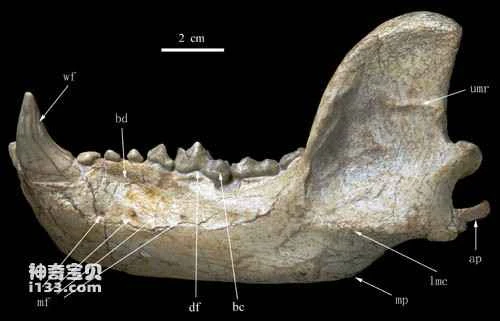
Figure 4. Lateral view of the mandible of the bear Dai's ancestor.
Later, with the increasing discovery of new material, primarily isolated teeth, in Early and Middle Miocene sediments, *Agriarctos* gradually became a rather mixed genus. To date, a total of 11 species have been described. Paleontologists have widely differing opinions on why these species were classified under the genus *Agriarctos*. At least two species, *U. depereti* and *U. elmensis*, were later formally excluded. When Kretzoi established the new genus *Agriarctos* in 1942 based on isolated teeth found in the latest Miocene strata of Hungary, he included the holotype of *U. depereti* within the new genus and classified it under the smaller species *Agriarctos vighi*. Primarily based on the identifying features of the lower first molar, such as its short and wide shape, with a strong, forward-displaced lower posterior cusp forming a fairly closed lower triangular base, *Agriarctos* was considered by Kretzoi to be a transitional type between *Agriarctos* and the *Agriarctos*-Indian bear lineage. In 1989, Qiu Zhanxiang and Qi Guoqin established a new genus and species, Ailurarctos lufengensis, belonging to the giant panda lineage, based on materials from fossil sites of Lufeng apes in Yunnan that were originally classified as ancestral bears.
In 1998, Ginsburg and Morales established a new genus, *Ballusia*, based on the original *Ursavus elmensis*. Identifying features of this new genus include: generally smaller size than the ancestral bear; upper molars with a wide lingual ridge formed by the protocones and posterior cusps, separating the anterior and posterior cusps on the labial side; a wider and more curved inner dentition band; a distinctly elliptical upper second molar with a short and wide radicular seat; and lower first molars similar to those of the hememicon and Plithocyon, both possessing a higher radicular seat. They considered the ancestral bear of the East to be close to the root of this lineage, therefore, in 2013, Qiu Zhanxiang and Qiu Zhuding temporarily reclassified *U. orientalis* into the genus *Ballusia*.
Recently, Abella et al. created a new genus, *Kretzoiarctos*, in 2012. The material used was a mandibular fragment with the left fourth premolar and first molar, discovered in Spain, previously described as a new species of *Panda benjamina*. Based on cladistic analysis, Abella et al. considered *Kretzoiarctos beatrix* to be the earliest known member of the giant panda lineage. Their subfamily *Ailuropoda* comprises two lineages: the Indian bear lineage and the giant panda lineage, with the genus *Ailuropoda* initially diverging from other members of its lineage. Cleavage analysis by Qiu Zhanxiang et al. showed that *Kretzoiarctos* is a sister group to the other two genera, *Panda benjamina* and *Panda spp.* Since *Panda spp.* is undoubtedly the earliest known ancestral type of the giant panda lineage based on dental morphology, *Kretzoiarctos* may not be a direct ancestor of the giant panda. In fact, *Kretzoiarctos* lacks the key traits of the giant panda: enlarged premolars, especially the anterior and posterior accessory cusps, and a short V-shaped lower triangular base of the lower first molar. On the other hand, these traits, as well as the small anterior accessory cusp and double protocusp of the upper fourth premolar, can be found in *Panda benjamina*. Therefore, it is highly likely that the Kerri Kerri is an ancestral type of the Indian bear lineage rather than the giant panda lineage.
In 1998, Ginsburg and Morales concluded that the earliest member of the Ursinae subfamily was *Ursus anluensis*, which gave rise to the ancestral bear-true bear (*Ursus*) lineage, while *Ailuropoda spp.* gave rise to *Ursus anluensis* and *Bear spp.*, and *Ailuropoda spp.* and *Ailuropoda spp.* formed a sister group relationship. Thus, the original members of the Ursinae subfamily included *Ballusia* (3 species), *Ursavus* (8 species), *Agriarctos* (3 species), *Ailurarctos lufengensis*, and *Kretzoiarctos beatrix*, totaling 5 genera and 16 species.
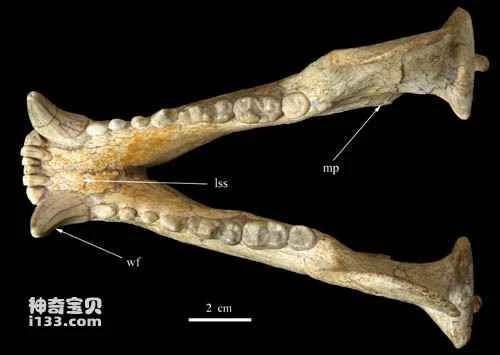
Figure 5. Crown surface of the mandible of Dai's Zu Xiong
To date, no complete skull or fused mandible has been found among early bears such as *Anlu bear*, *Archive bear*, *Ailuropoda clarifex*, *Panda sulphurus*, and *Ailuropoda ekota*. The best material is the anterior half of an *Archive bear* skull published in 1947 and two fragmented mandibles published in 1887. This gap has now been filled by fossil specimens from Linxia. Due to its latest existence (approximately 8 million years) and its highly advanced position among early bear ancestors, the Huaigou skull and mandible are very different from most species of the Early-Middle Miocene and Early Late Miocene, as they possess more advanced characteristics closer to modern bears.
Comparative studies have shown that the skull from Huaigou differs from all currently known ancestral bear types, thus establishing it as a new species: *Ursavus tedfordi*. The species name commemorates Richard Hall Tedford, the distinguished American Neogene biostratigrapher and paleomammalogian who passed away in 2011 and was a renowned expert in carnivore fossils. *Ursavus tedfordi* was a large ancestral bear, intermediate in size, proportion, and morphology between the extinct *Cephalogale minor* and the extant black bear (*Selenarctos thibetanus*). Key features of *Ursavus tedfordi* include: a short and wide snout compared to the posterior part of its skull; a very high sagittal crest extending posteriorly beyond the occipital surface; a relatively narrow cranium compared to the face; triangular auditory bullae with short, tubular external auditory canals; a robust mandible; premolars severely reduced to button-like shapes; and very faint enamel folds on the cheek teeth.
Based on the combined evidence, *Ursus deningeri* is undoubtedly the latest and most advanced ancestor of extant bears. However, because some of its precocious developmental features are not found in extant bears, *Ursus deningeri* is likely a side branch, forming the closest sister group to the extant bear lineage.