The terms "owl" and "cat owl" are often used interchangeably in Chinese, and many people believe they refer to the same bird. However, from a biological perspective, "owl" and "cat owl" are not entirely the same concept. Although they both belong to the same family— the Strigidae — there are significant differences between them. This article will use professional scientific analysis to explore the differences between owls and cat owls , and will detail their biological classification, physical characteristics, habitats, diet, and behavioral traits.
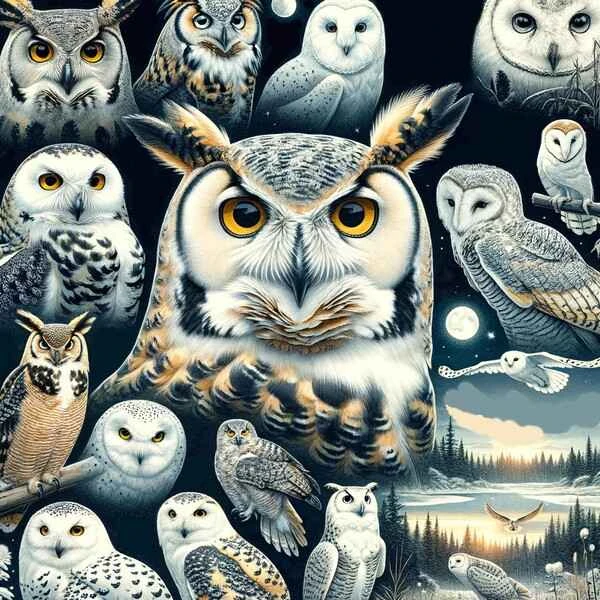
This article will analyze in detail the differences between owls and owls, helping you to better understand the differences between these two bird species and their respective ecological status.
Biological classification of owls and common owls: basic definitions and contextual distinctions
From a biological perspective, owls and common owls are not completely different species, but rather different names for the same species. In modern Chinese, "鸮" (xiāo) is usually used to refer to all birds belonging to the Owlidae family , especially those with a prominent facial disc. In some literary works and local dialects, "鸮" sometimes specifically refers to certain species of owls, such as the Scops Owl or the White-faced Owl.
The name "owl " is broader, generally referring to all birds belonging to the Owlidae family. It includes both owls with prominent facial discs and some owl species without such a prominent disc. In some formal biological literature, the term "owl" is used to refer to all birds in the Owlidae family, while the use of "owl" is more common in more colloquial and informal contexts.
Physical characteristics of owls and owls: distinguishing details
Physical characteristics of owls
Owls are typically distinguished by their distinctive facial discs and ear feathers. Below are some key physical characteristics of owls:
Facial disc : The facial disc of owls is usually round or heart-shaped, made of feathers, and has a significant auditory function. These facial discs help owls collect sounds, enabling them to locate prey in dim environments.
Ear feathers : Some owls, such as the scops owl ( Asio otus ), have prominent ear feathers that look like "horns," enhancing their visual camouflage and auditory sensitivity.
Small in size : Owls are relatively small, typically between 25-35 cm in length, with a moderate wingspan. Their plumage is usually a mix of brown, gray, and white, providing excellent camouflage.
Physical characteristics of owls
Owls exhibit a greater diversity in appearance, encompassing many species with different body sizes, shapes, and ecological adaptations. Here are some common characteristics of owls:
Facial disc diversity : Although most owl species possess facial discs, their shape varies considerably, ranging from round and heart-shaped to even U-shaped. The size and color of the facial discs also differ significantly among different owl species.
Size differences : Owls range in size from the very small pygmy owl ( Glaucidium passerinum ) to the large great owl ( Bubo bubo ), which can be over 60 centimeters long and have a wingspan of up to 2 meters.
Feather adaptability : Owls have a wide variety of feather colors, which help them adapt to different habitats. From brown and gray in forests to white and yellow in deserts, the colors of owl feathers usually help them camouflage themselves in their respective environments.
Habitat and Distribution: Habitat Habits of Owls and Other Owls
Owl Habitat
Owls typically choose to inhabit open forests , grasslands , and agricultural lands . As they are usually nocturnal predators, owls spend most of their daytime time in enclosed spaces such as tree hollows, caves, or man-made structures. Owl species often inhabit relatively remote areas to avoid disturbance from human activity. For example, the Scops Owl ( Asio otus ) typically inhabits forest edges or bushland, preferring concealed environments to better ambush prey.
Owl habitat
Owls have a very diverse range of habitats, found on almost every continent in the world (except Antarctica). Different species of owls inhabit various environments, including:
Forests : For example, the Great Scops Owl ( Bubo virginianus ) of North America usually inhabits dense forests.
Mountainous areas : For example, the snowy owl ( Bubo scandiacus ) inhabits the cold Arctic mountains.
Cities : Some owls, such as city owls , have adapted to the urban environment, living and breeding in the high-rise buildings of cities.
Owls have a wider range of habitats and can survive in a variety of ecosystems, from snow-covered polar regions to hot deserts.
Food and Hunting Habits: Dietary Preferences of Owls and Other Owls
Owl's food sources
Owls are typical nocturnal predators, relying primarily on their nighttime vision and hearing to hunt. Their main food sources are:
Small mammals : such as voles , rabbits , shrews and other small mammals.
Insects : Some small owl species also feed on insects, especially when they cannot find larger prey.
Owls typically hunt prey by flying out of their roosts, using their exceptional hearing and vision. Because their flight is almost silent, owls can approach their prey silently and capture it swiftly.
Owls' food sources
Owls have a more diverse diet, and in addition to preying on small mammals and insects, they may also hunt:
Larger mammals : such as rabbits , squirrels , fox cubs , etc.
Large birds : Some large owls, such as the great owl , even prey on other birds, including other birds of prey in the same genus.
Owls hunt in a similar way to owls, relying mainly on their keen eyesight and hearing, using quiet flight and powerful talons to capture prey.
Behavioral differences between owls and owls: Adaptability and territoriality
Owl behavior
Owls are typically solitary birds with a strong sense of territory . They are primarily nocturnal, using their night vision and excellent hearing to locate and hunt prey. Owl calls are usually mild, but during the breeding season or when threatened, their calls can be very loud to assert their territory.
Owl behavior and habits
Owls are also solitary animals , and most owl species are nocturnal . However, some large owls (such as the great owl ) are active at dusk or dawn in addition to nighttime. Owls are also strongly territorial animals, marking and defending their territory through calls, feather postures, and flight behaviors. Owl calls vary among species; some owls have deep, powerful calls, while others emit sharp, piercing calls.
Differences and similarities between owls and common owls
| feature | Owl | owl |
|---|---|---|
| Biological classification | This term generally refers to owl species with facial discs, and in some regions it also refers to birds of the Owlidae family. | It includes all species of the Owlidae family, and is a broader classification name. |
| Body shape and appearance | Smaller in size, with a prominent facial disc, usually with ear feathers, and a body length of about 25-35 cm. | Owls come in a variety of sizes, from small to large, such as the great owl, and their facial discs vary in shape. |
| Habitat | They prefer to inhabit relatively secluded places, such as tree holes, caves, and the edges of grasslands. | Widely distributed in various environments, from forests and cities to polar regions. |
| Food and Hunting | They primarily prey on small mammals and insects, are nocturnal, and hunt by silent flight. | Diverse prey, ranging from small mammals to large birds, including aerial hunting. |
| Behavioral Habits | Nocturnal, solitary, with a strong sense of territory, and a gentle call. | Nocturnal, solitary, some species are migratory, highly territorial, and their calls vary greatly. |
Through the above comparison, we can see that owls and owls share many similarities, but they also have subtle differences in classification, appearance, habitat, and certain behavioral habits. Understanding these differences will help us better recognize and protect these mysterious nocturnal hunters.
Conclusion: Differences and similarities between owls and common owls
In conclusion, owls and owls share many similarities, particularly in their hunting methods, habitat selection, and nocturnal characteristics. However, "owl" is often a more specific term referring to certain species of owls, while "owl" is a broad term encompassing all such birds. By understanding their physical appearance, habitats, food sources, and behavioral habits, we can gain a clearer understanding of the characteristics and differences between these two nocturnal creatures.