When you think of symbiotic relationships in nature, you might imagine mutually beneficial cooperation between species, like bees and flowers. However, in the world of ants and brain-eating fungi, the situation is quite different. The ant-brain-eating fungus symbiosis is one of the most chilling yet fascinating parasitic relationships in nature. This article will delve into how **Ophiocordyceps unilateralis** manipulates the ant's brain and how this parasitic relationship unfolds.
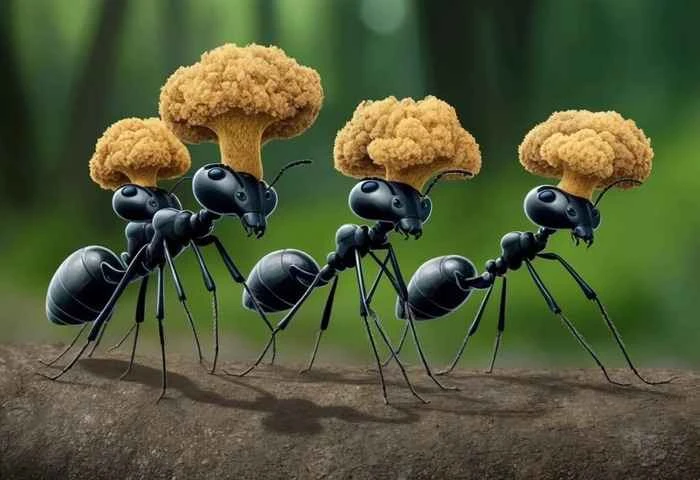
What is the symbiotic relationship between ants and brain-eating fungi?
The brain-eating fungus we're referring to is *Ophiocordyceps unilateralis*, a parasitic fungus that specifically attacks ants, particularly fire ants. Unlike typical symbiotic relationships, the relationship between brain-eating fungi and ants is unilateral; the fungus completely controls the ant's brain and body. Infected ants become "zombies," unconsciously carrying out the fungus's commands until they die. This parasitic relationship is an extreme example of symbiosis, demonstrating how some fungi achieve their own survival by manipulating insect behavior.
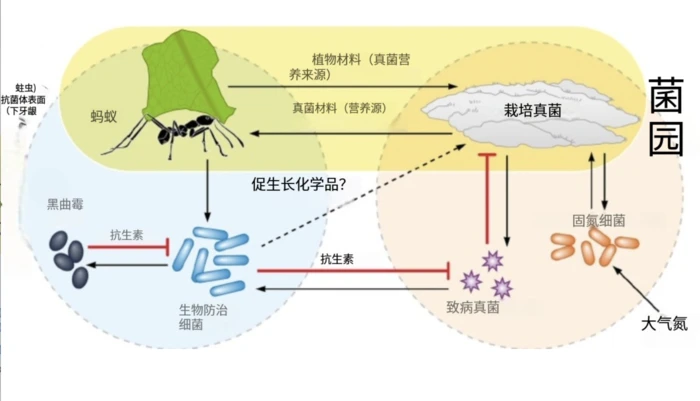
(The role in ant-fungus mutualism. Nutrient flow and inhibitory interactions between organisms are indicated by arrows and solid arrows, respectively. The main inputs of carbon (plant biomass) and nitrogen (plant biomass and nitrogen-fixing bacteria) provide the raw materials supporting the interaction network and are indicated by thick arrows. During fungal garden disinfection, ants transfer pathogenic Escovopsis fungi to their subchelic pockets.)
Unilateral sponge fungus and ants: perfect hosts
Ophiocordyceps is a parasitic fungus, and Ophiocordyceps unilateralis specifically infects ants. When an ant comes into contact with the fungal spores, the spores attach to the ant's exoskeleton and penetrate its body. Once inside, the fungus spreads throughout the ant's body and gradually takes control of its nervous system, leading it away from the colony and towards the tops of trees or plants.
How do brain-eating fungi control ants?
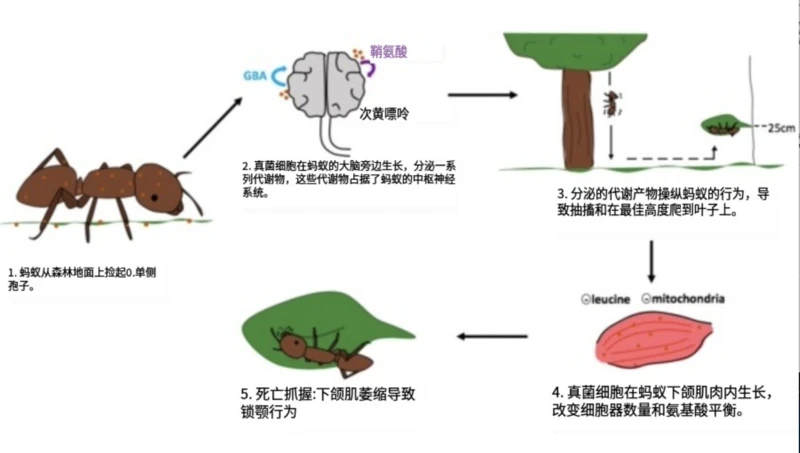
When a fungus infects an ant, it releases chemicals that manipulate the ant's brain, altering its behavior. The ant becomes a "zombie," forced to climb to high places and bite onto plant stems or leaves. This behavior, known as a "death bite," causes the ant to remain motionless until it dies. After the ant dies, the fungus extends a stem-like structure from the ant's head, releasing spores that fall to the ground, waiting to be picked up by other ants.
The life cycle of brain-eating fungi
The life cycle of *Ophiocordyceps* is one of the most brutal yet fascinating processes in nature. It begins with fungal spores coming into contact with an ant. The spores attach to the ant's body, begin to grow, and penetrate the ant's exoskeleton, entering its body. Over time, the fungus spreads throughout the ant's body, eventually taking control of its brain.
When the fungus completely controls the ant, it forces the ant to climb onto the plant and bite its leaves or stem. The ant, like a "zombie," will remain in a clinging position on the plant until it dies. Once the ant dies, the fungus grows a stem from the ant's head, releasing new spores that fall to the ground and await the arrival of other ants.
Zombie Ants: A Shocking Transformation
You may have heard of zombie ants, and yes, it sounds like something out of a horror movie. When ants are infected with *Ophiocordyceps unilateralis*, their brains and bodies are completely controlled. This "zombie ant" leaves its colony, climbs onto a plant, and bites onto a leaf or stem, remaining there until it dies. This transformation from a normal ant to a controlled zombie is a classic example of parasitism in nature.
While this might sound like something out of a horror movie, it's actually a clever evolutionary survival strategy for fungi. Ants act as hosts, helping the fungi spread spores, thus ensuring the fungi's successful reproduction.
Fungi that can control ant behavior
The role of ants in the fungal reproductive cycle
The symbiotic relationship between ants and brain-eating fungi is not mutually beneficial—it is a classic parasitic relationship. The ants gain nothing from this process; instead, they become mere tools for the fungus to spread its spores. The successful reproduction of the fungus depends on the behavior of the ants, who unwittingly climb onto the plant and firmly attach themselves, ultimately helping the fungal spores land in the optimal location.
In this way, the fungus ensures that its spores land in the most suitable location, maximizing the chances of the spores being picked up by other ants. This process clearly demonstrates how parasitic organisms use their hosts to reproduce.
The impact of brain-eating fungi on ant colonies
While the symbiotic relationship between ants and brain-eating fungi may seem chilling, it plays a crucial role in controlling ant populations. The fungus helps suppress overpopulation by infecting and killing large numbers of ants. This helps prevent ant colonies from becoming too large, thus avoiding threats to other species in the ecosystem.
In fact, parasitic fungi like *Hymenopterus unilateralis* help maintain ecological balance by controlling the populations of certain species. Without these parasitic species, some species might overproduce, negatively impacting the ecosystem.
Other fungi that can manipulate insect behavior
While *Ophiocordyceps unilateralis* is the most well-known brain-eating fungus, it's not the only fungus capable of manipulating insect behavior. Cordyceps are a class of parasitic fungi that can infect other insects, including caterpillars, beetles, and even spiders. These fungi operate similarly to *Ophiocordyceps*, turning their hosts into "zombies" by controlling their nervous systems and using them to spread their spores.
The ability of fungi to manipulate insect behavior is a fascinating manifestation of natural evolution, demonstrating how organisms use parasitic or symbiotic relationships to ensure survival.
Symbiosis or Parasitism: The Debate Between Ants and Fungi
The symbiotic relationship between ants and brain-eating fungi is actually parasitic, not mutually beneficial. The ants gain no benefit from the fungus's presence; on the contrary, the fungus relies entirely on the ants to spread its spores. In fact, "symbiosis" usually refers to a mutually beneficial relationship, but in the case of brain-eating fungi, it is one-sided. The fungus's manipulation of ant behavior is a classic example of a parasitic relationship.
What happens when an ant is infected with unilateral sponge bacteria?
When ants are infected with Ophiocordyceps, they begin to exhibit strange behavior. The fungus takes control of their brains, forcing them to leave the colony and climb onto plants. Once the ants have bitten the plant, they remain motionless until they die. After the ants die, the fungus extends a stem from their heads, releasing new spores that fall to the ground, waiting to infect other ants.
FAQ: The Symbiotic Relationship Between Ants and Brain-Eating Fungi
What are brain-eating fungi, and how do they affect ants?
**Ophiocordyceps unilateralis** is a parasitic fungus that infects ants and controls their brains, forcing the ants to climb to higher places, bite plants, and eventually die. The fungus spreads its spores in this way.How do brain-eating fungi control ant behavior?
The fungus releases chemicals that hijack the ants' brains, forcing them to leave the colony and climb to higher ground, where they bite the plants until they die.What role do ants play in the fungal life cycle?
Ants act as spreaders of fungal spores. They are forced to climb onto plants and bite them, and the fungus uses the ants' bodies to spread the spores to the ground, waiting for other ants to become infected.
The symbiotic relationship between ants and brain-eating fungi is one of the most bizarre and fascinating parasitic relationships in nature. Through parasitism, *Ophiocordyceps unilateralis* has evolved mechanisms to control ants, ensuring its reproductive success. This process, whether chilling or fascinating, profoundly reveals the complex interactions of life in nature.