In the world of wildlife, eagles and owls are both considered powerful birds of prey, each possessing unique advantages in hunting, flight, and survival. Many people, when discussing these two birds, often wonder, "Which is more powerful, an eagle or an owl?" Although both birds belong to the bird-of-prey class, their hunting strategies, size, strength, and habits differ significantly. This article will compare the strengths and differences between eagles and owls in detail, helping you understand the unique strengths of each bird.
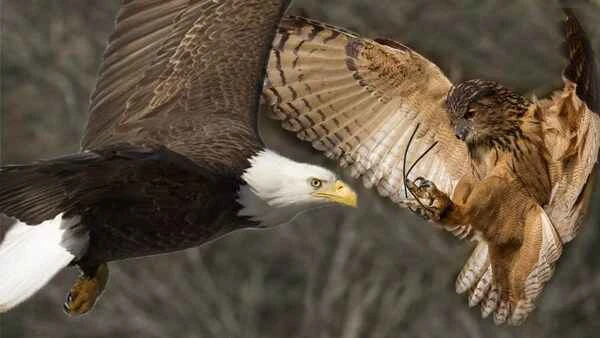
The fundamental differences between eagles and owls: size, flight ability, and hunting methods
The size and strength of an eagle
Eagles are large birds of prey, renowned for their powerful wings and sharp talons. Common eagle species, such as the golden eagle, bald eagle, and Hummus's eagle, are generally quite large. Eagles have very strong wings, adapted for high-speed flight and rapid dives. Their talons are extremely powerful, easily grasping prey heavier than themselves, such as rabbits, snakes, and even small deer.
Size: Most eagles weigh 2-5 kilograms and have a wingspan of 2-3 meters, with some species even larger.
Flight ability: Eagles fly very fast, especially when hunting, and can dive at speeds of up to 160 kilometers per hour, making them one of the fastest flying birds on Earth.
Hunting ability: Eagles primarily hunt with their powerful talons and hooked beaks, which can easily tear apart the flesh of their prey.
Owl size and hunting methods
Although owls are relatively small compared to eagles, their unique flight patterns, excellent night vision, and adaptation to nocturnal life make them extremely efficient hunters at night. A key characteristic of owls is their remarkably quiet flight; the special structure of their feathers reduces noise during flight, allowing them to approach their prey silently.
Size: Owls vary considerably in size, ranging from the elf owl, which is only about 5 inches long, to the snowy owl, which can reach 2 meters in length. Most owls weigh between 500 grams and 2 kilograms.
Flight ability: Owls primarily fly at low altitudes and are very quiet, making them particularly well-suited for nighttime hunting. The structure of their feathers makes their flight virtually silent.
Hunting ability: Owls primarily feed on small mammals, such as mice, rabbits, insects, and other small birds. They use their exceptional hearing and vision to precisely capture prey at night.
A comparison of the strength of eagles and owls
The power and aggression of eagles
An eagle's power primarily lies in its formidable flight ability and the strength of its talons. Eagles typically hunt by swooping down and seizing their prey with their powerful talons. The talons generate immense pressure, enough to kill their prey. An eagle's beak is also extremely sharp, capable of easily tearing through the muscles and bones of its prey.
Claw strength: Eagles have extremely strong claws; some species, such as the golden eagle, can exert more than 100 kilograms of force with their claws.
Aggressiveness: Eagles attack very directly, usually grabbing and tearing their prey with their powerful talons, making them suitable for catching large prey.
The strength and agility of owls
The owl's strength lies primarily in its quietness and precision during nocturnal hunts. Although owls are not as large as eagles, their superior night vision and silent flight make them extremely effective predators at night. Owls use efficient snipping and their relatively weak beaks to tear apart their prey, typically targeting smaller animals.
Claw strength: Owls have slightly weaker claws than eagles, but their prey is usually smaller, so their claw strength is sufficient to catch small prey.
Agility: Owls are more agile in flight, able to quickly adjust their direction and adapt to the nighttime environment to catch prey.
The adaptability and ecological role of eagles and owls
The ecological role and adaptability of eagles
Eagles play a vital role in ecosystems as predators. They not only control prey populations by hunting small mammals, birds, and fish, but also clean up carcasses in the environment, reducing the spread of disease. Eagle habitats are typically located in high mountains, cliffs, or forests, ideal for them to utilize their flight and hunting advantages.
Ecological role: Eagles are apex predators, controlling other species in the food chain.
Adaptability: Eagles can adapt to a variety of habitats, including forests, grasslands and high mountains, especially in areas with abundant prey.
The ecological role and adaptability of owls
Owls are highly adaptable, able to survive in a variety of environments, from forests and wetlands to urban areas. Their primary food source is small mammals, especially mice. Due to their silent flight and keen senses, owls have a unique advantage in hunting prey at night.
Ecological role: Owls are nocturnal hunters, control the population of small mammals, and also have a positive impact on agriculture by reducing the number of pests.
Adaptability: Owls can survive in a variety of environments, especially in areas with abundant prey, and are commonly found in cities and suburbs.
| Comparison items | eagle | owl |
|---|---|---|
| body shape | Larger size, wingspan can reach 2-3 meters, weight 2-5 kilograms | It is relatively small, with a body length of about 30-75 centimeters and a wingspan of about 1.5 meters. |
| Flight capability | High-speed dive, with a flight speed of up to 160 km/h. | Quiet flight, suitable for night hunting |
| hunting methods | Swooping down to hunt, targeting large prey (such as rabbits, snakes, etc.). | They ambush and hunt small mammals (such as mice) at night. |
| Ecological role | Top predators, controlling large prey populations | Nocturnal predators, controlling populations of small mammals |
| Claw force | Powerful, capable of exerting force exceeding 100 kilograms. | Weak, suitable for catching small prey |
The table and analysis above demonstrate the strengths of both eagles and owls. Their hunting and survival abilities complement each other, and they both play important roles in nature.
Conclusion: Eagles and owls each have their own strengths and weaknesses.
In general, the eagle's strength and aggressiveness make it unmatched in hunting large prey, especially when it swoops at high speed, demonstrating formidable power. With their powerful talons and sharp beaks, they can easily hunt large prey. Therefore, eagles often surpass owls in strength and speed.
However, owls' unique ability to hunt at night also gives them an important place in the ecosystem. Their quiet flight and excellent night vision allow them to silently capture small prey, playing a significant role in controlling the populations of pests and small mammals.
Therefore, eagles and owls excel in different ways. If strength and aggression are taken into account, eagles are more powerful; while if nocturnal hunting and stealthy survival are considered, owls are unparalleled hunters.