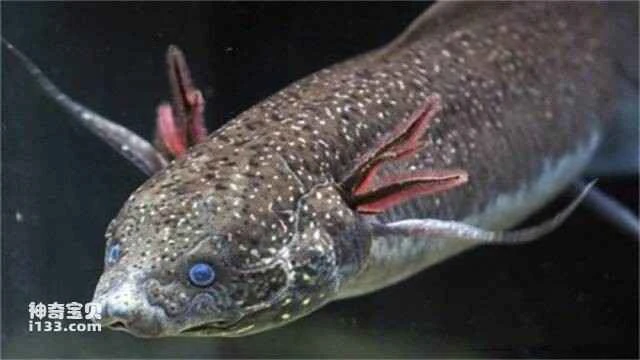
Because lungfish possess lungs and internal nostrils capable of breathing air, they were long considered the ancestors or close relatives of the earliest terrestrial tetrapod vertebrates—amphibians. In the late 19th century, lungfish were temporarily overtaken as the ancestor of amphibians by lobe-finned fishes, particularly fan-finned fishes, whose skeletal systems were closer to early amphibians. Furthermore, these lobe-finned fishes also possessed what were believed to be internal nostrils for respiration. Therefore, the scientific community gradually accepted that bony-scaled fishes of the family Pteranodontidae within the suborder Pteranodontidae of the order Lobefiniformes were the ancestors of amphibians. However, in the 1980s, Academician Zhang Miman of the Institute of Vertebrate Paleontology and Paleoanthropology, Chinese Academy of Sciences, conducted in-depth research using serial sections on a lobe-finned fish—*Yang's fish*, discovered in Yunnan Province, my country—and concluded that *Yang's fish* lacked internal nostrils. Therefore, she speculated that the so-called internal nostrils of the entire lobe-finned fish family might not actually exist. Thus, the theory that amphibians originated from lobe-finned fishes, which had been "accepted" by the world scientific community for over half a century, faced renewed challenges.
So, which type of lobe-finned fish did the earliest terrestrial vertebrates—amphibians—originate from? It seems we still need to find more and better fossil evidence.