The earliest representative of lobe-finned fishes is the bony-scaled fish from the Middle Devonian period. From it, we can already see some of the "signs" of early amphibians.

Bone-scaled fish
First, the skull and jaws of the bony fish are entirely made of hard bone, and the composition, location, and shape of many of the bones are similar to those of early amphibians.
Secondly, the teeth of bony-scaled fish are "labyrinthine." That is, when observing a cross-section of their teeth under a microscope, one can see that the enamel layer is highly wrinkled, forming a maze-like pattern. Interestingly, the teeth of early terrestrial amphibians also exhibited this labyrinthine shape.
Most significantly, the skeletal structure inside the paired fins of the bony scale fish is not as specialized as that of lungfish. On the contrary, the structure, position, and shape of each bone, and even the joints between the bones, are very similar to those of early amphibians.
Based on this, lobe-finned fishes developed into two major systems: fan-finned fishes (suborder) including bony-scaled fishes and coelacanths (suborder).
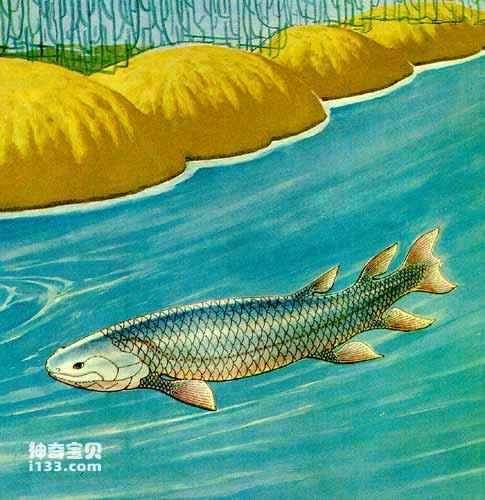
True palm-finned fish
Fanfin fish were large carnivorous fish that were discovered from the Devonian to the Early Permian periods. They mostly lived in freshwater areas and are now extinct.
Among the fan-finned fishes, there is a species called *Euonychus*, which lived in the Devonian period. They share even more similarities with early amphibians. Besides similarities in skull, teeth, and paired fins, they had a series of bony rings around their notochord, with small bony spikes between the rings, and each ring had a ridge projecting backward and upward. These structures are remarkably similar to the vertebral structure of early amphibians—the bony rings correspond to intervertebral bodies, the bony spikes to vertebral bodies, and the projecting ridges are identical to those on the amphibian vertebrae. Therefore, some scientists believe that the evolutionary leap from *Euonychus* to terrestrial vertebrates was just one short step: crawling onto land.
Coelacanths are a specialized group, characterized by a reduced number of skull plates and teeth. They were more abundant during the Mesozoic Era, with species such as *Gymnocypris* being representative. Fossil specimens of coelacanths discovered in my country include *Changxingyu*.