On July 21, 2022, we received heartbreaking news: the International Union for Conservation of Nature (IUCN) updated its Red List of Threatened Species, showing that the Yangtze River endemic species, the Chinese paddlefish (Psephurus gladius), had become extinct. This means that another unique species of my country has disappeared from the earth, and it was a living fossil species that had roamed the earth for 150 million years.
Basic characteristics of the Chinese paddlefish

The Chinese paddlefish (Sturgeon schlegelii) is a species endemic to the Yangtze River and the largest freshwater fish in China, hailed as the "King of Chinese Freshwater Fish." It is one of the very few ancient fish species that survived from the Cretaceous period, 150 million years ago, and is a Class I protected wild animal in China. In ancient China, the Chinese paddlefish was called "wei" (鲔). It is also known as the Chinese swordfish. Because its snout is long and resembles an elephant's trunk, it is also commonly called the elephant fish. It measures 2-3 meters in length and weighs approximately 200 kg. According to the records of the renowned zoologist Professor Bing Zhi, a 7-meter-long, one-ton individual was once caught in Nanjing. Sichuan fishermen also have a saying: "A thousand-jin Chinese sturgeon (Sturgeon schlegelii) is worth ten thousand jin of Chinese paddlefish (Sturgeon schlegelii)." Therefore, the title of "King of Chinese Freshwater Fish" is well-deserved.
Commemorative stamps were issued.
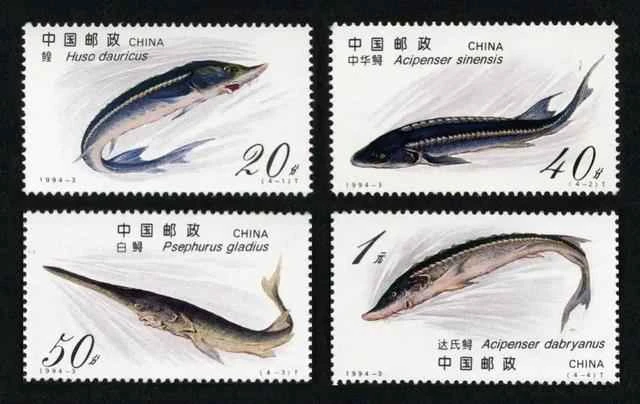
On March 18, 1994, China issued a set of four stamps entitled "Sturgeon," featuring the Chinese paddlefish (a Class I protected animal in China), the Dabry's sturgeon (also known as the Yangtze sturgeon), the Chinese sturgeon (also known as the king tuna, a Class I protected animal in China), and the beluga sturgeon. These fish belong to the families Acipenseridae and Acipenseridae, respectively, within the order Schizothorax. All are rare and endangered animals under national protection, and are highly valuable specialty fish from the Yangtze, Heilongjiang, and Pearl River basins. Their meat and caviar are renowned in the international market and are often referred to as "black gold." Due to the long sexual maturity cycles of sturgeon and beluga sturgeon (9-10 years for sturgeon and 11-18 years for beluga sturgeon), their regeneration rate cannot keep up with the rate of fishing, putting them at risk of extinction. In the 1980s, China gradually established some conservation and research institutions.
We never met, and now I hear of it, it's goodbye forever.
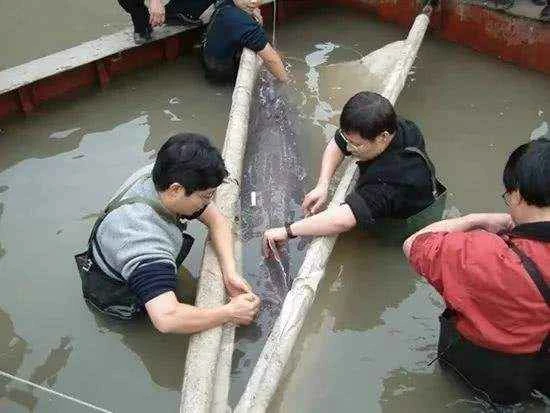
Many netizens expressed their sorrow upon hearing the news, while also noting that they had never seen one before. This is because there has been no news of the Chinese paddlefish for almost 20 years. Its last public appearance was in 2003.
On the afternoon of January 27, 2003, the wild Chinese paddlefish, dubbed the "giant panda of the water," returned to the Yangtze River in Yibin, Sichuan Province, after three days and three nights of meticulous care by Wei Qiwei, a researcher at the Yangtze River Institute of the Chinese Academy of Fishery Sciences and a member of the IUCN expert team. This white sturgeon, a female, was accidentally caught on the morning of January 24 by a fisherman in the Fuxikou section of the Yangtze River in Nanxi County. It was about 4 meters long, weighed over 150 kilograms, and was approximately 30 years old, with a large number of eggs in its belly. It had obvious wounds on its head and tail, and its snow-white skin was covered with red patches, resembling subcutaneous bruising. It was reported that an electronic tracking device was attached to the white sturgeon before its return to the Yangtze River, and experts would subsequently track its movements 24 hours a day. However, on the fourth day of tracking, the white sturgeon suddenly accelerated upstream, entering the turbulent section of the Yangtze River's main channel. The tracking boat accidentally struck a reef, and after repairs, the white sturgeon could no longer be found.
Researchers have not found any more Chinese paddlefish since then. The Chinese paddlefish is large, rare, and difficult to breed artificially. At that time, technology and communication were relatively underdeveloped, making it impossible to capture and artificially raise them. By the time technology matured and communication improved, they were already extremely difficult to find.
Wei Qiwei explained: "For wild populations like the Chinese paddlefish, the required living range and area are relatively large. Its spawning requires corresponding flowing water and pebbles on the riverbed. Small fish will swim to the middle and lower reaches and even the estuary, feeding on other fish and growing up there. Historically, the Chinese paddlefish may have been distributed in coastal areas, including where the Yellow River flows into the sea. Later, it could no longer return to the spawning grounds in the upper reaches of the Yangtze River, and thus the population gradually disappeared."
In fact, this is not the first time the word "extinction" has been associated with the Chinese paddlefish. In a research paper published in the international academic journal Science of the Total Environment in December 2019, Wei Qiwei pointed out that the Chinese paddlefish had become extinct between 2005 and 2010. Moreover, the species may have been functionally extinct as early as 1993.
Sturgeon species worldwide still face the threat of extinction.
In recent centuries, human activities have intensified, causing the natural population of sturgeon to decline sharply and become endangered, earning it the title of "the most threatened group in the world".
The IUCN Global Sturgeon Reassessment reveals that all 26 extant sturgeon species worldwide face extinction. Approximately two-thirds of these populations are critically endangered. River and freshwater biodiversity is vital to both humans and nature, yet global freshwater biodiversity continues to decline, and river ecosystems are degrading. Aina Luway, Chair of the IUCN Sturgeon Specialist Group, stated, “The results are shocking and saddening, but also expected. The assessment shows that sturgeon still cannot shed the title of ‘the most threatened group in the world.’”
Globally, the main threats to sturgeon include: illegal fishing due to the illicit trade in wild caviar and fish meat, dams blocking their migration routes, unsustainable sand and gravel mining destroying their spawning grounds, and habitat loss.
"The extinction of the Chinese paddlefish and the Yangtze sturgeon in the wild serve as a wake-up call for us," said Zhou Fei, Deputy Director General (Project) of WWF Beijing Office. "This update to the Red List reminds us that we need to reverse the trend of freshwater biodiversity loss through rescue protection, and we also need to plan and implement systematic protection measures to address long-term threats. Artificial measures and investment from a single department are far from enough. We need the participation and support of more institutions and social forces to help the Yangtze sturgeon be 'downgraded' as soon as possible, better protect the Chinese sturgeon migrating between rivers and the sea, and jointly create a better future for the river and sea ecosystem."
However, the recovery of rare and endemic species is extremely difficult, and researchers are still racing against time to try to mitigate the adverse effects of declining wild resources on the reproduction of rare aquatic species.
Protect wild animals and ban the consumption of wild game.
Maintaining ecological balance is everyone's responsibility!