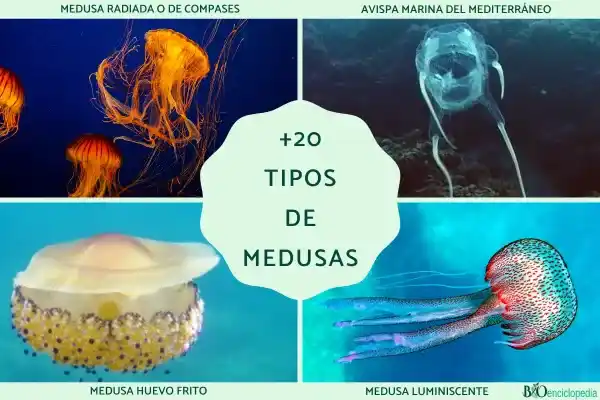
The Mediterranean Sea boasts a rich diversity of jellyfish. True jellyfish belong to the phylum Cnidaria and have nematocysts on their bodies. These nematocysts release toxins for predation or defense. Some Mediterranean jellyfish are almost harmless to humans, while others can cause significant burning, redness, swelling, or even severe skin reactions.
Below is a list of 20 jellyfish/"jellyfish-like" floating creatures that are representative of the Mediterranean or easily seen on beaches , described in terms of "appearance - common locations - sting risk".
Rapid classification of sting risk
Low risk
Most people experience only a slight stinging sensation or almost no sensation, but those with sensitive constitutions may still experience an allergic reaction.
Medium risk
Significant burning pain and wheal-like redness and swelling may occur, and symptoms can last from several hours to several days.
High risk
The pain is intense and there is a noticeable skin reaction; in severe cases, medical treatment is required.
1) Radiant jellyfish/Compass jellyfish (Chrysaora hysoscella)
The canopy is mostly white or light-colored, with brown stripes radiating outwards from the center, resembling "compass markings," making it very easy to identify. The canopy diameter can reach about 30 cm , and the tentacles are very long, sometimes reaching several meters in extreme cases.
Common sea areas
They mostly operate in the open sea, but are pushed closer to the shore or beach by ocean currents and tides.
risk of sting
Moderate : Common symptoms include burning pain, rashes, and linear wheals, which may subside slowly.

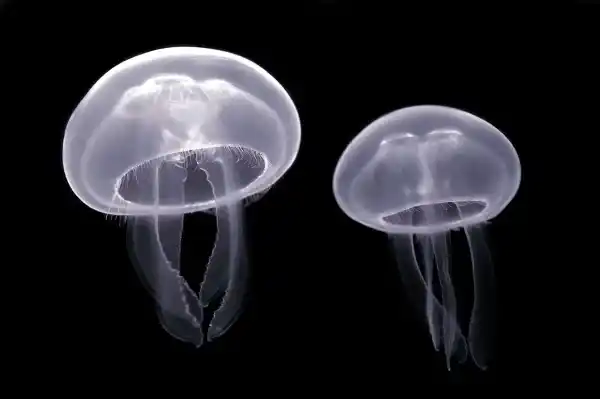
2) Moon jellyfish / Common jellyfish (Aurelia aurita)
The transparent umbrella has a light blue-white hue, and four clear circular structures (reproductive glands) can be seen under the umbrella. The umbrella diameter is mostly within 25 cm .
Common sea areas
Compared to the open sea, they are easier to observe near the shore, often leading to "jellyfish warnings" on beaches.
risk of sting
Low : In most cases, the stinging sensation is very mild, or even barely noticeable.
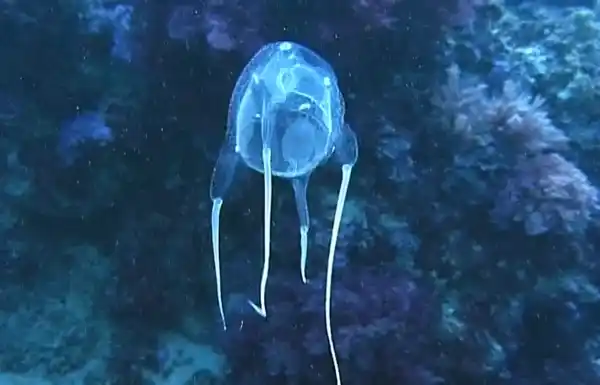
3) Mediterranean box jellyfish (Carybdea marsupialis)
It belongs to the box jellyfish family, with a nearly square bell-shaped body, each side measuring a few centimeters. The body is almost transparent, but it has four relatively long tentacles , reaching about 30 cm in length, densely packed with stinging cells.
Common sea areas
They prefer water depths of around 20 meters and are generally not considered "shore-clinging" jellyfish, but may still approach the coast during certain seasons.
risk of sting
High : Significant pain, prone to forming wheals and skin lesions.
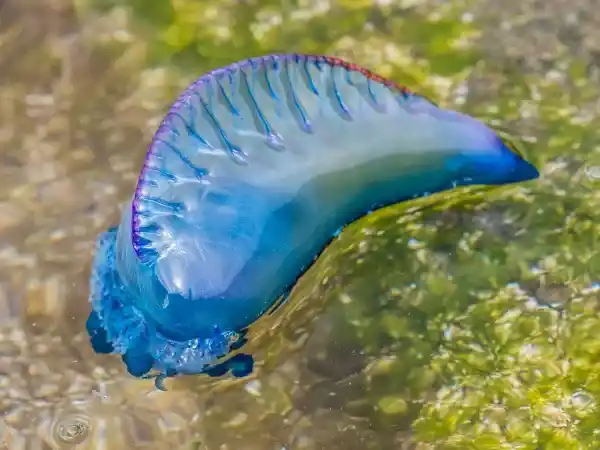
4) Portuguese warship / Portuguese man-of-war jellyfish (Physalia physalis)
Strictly speaking, it is not a true jellyfish , but a colony of hydroids composed of multiple individuals. Its bluish-purple "air sacs" are visible on the sea surface, and its tentacles are extremely long, extending far in extreme cases.
Common sea areas
It's not a frequent occurrence in the Mediterranean, but it can drift in with the wind and ocean currents and eventually wash ashore.
risk of sting
Extremely high : Highly toxic and risky; even if stranded and seemingly "dead," the tentacles can still sting.
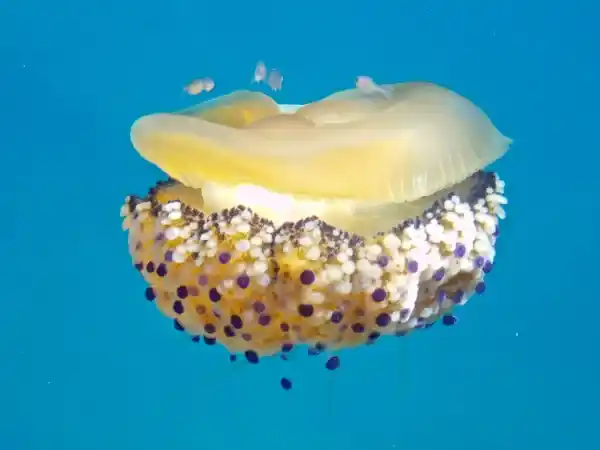
5) Egg-fried jellyfish (Cotylorhiza tuberculata)
The umbrella is yellowish with a raised "yolk-like" structure in the center, resembling a fried egg, making it highly recognizable. The umbrella diameter is mostly 30–35 cm , and the tentacles are short and thin.
Common sea areas
They are very common in the Mediterranean during summer and autumn , often coming ashore in groups with the warm currents.
risk of sting
Low : Generally not dangerous to humans, but more of a nuisance due to their large numbers.
6) Barrel jellyfish/Lung jellyfish (Rhizostoma pulmo)
One of the largest common species in the Mediterranean, with an umbrella diameter of up to about 90 cm . The umbrella is white or bluish in color, with leaf-like structures on the edges, and has a stout, distinctly branched oral arm.
Common sea areas
It can be seen in the Mediterranean Sea and the adjacent Atlantic Ocean, and also in some coastal areas.
risk of sting
Low to moderate : Usually not dangerous, but may cause skin irritation or allergic reactions.
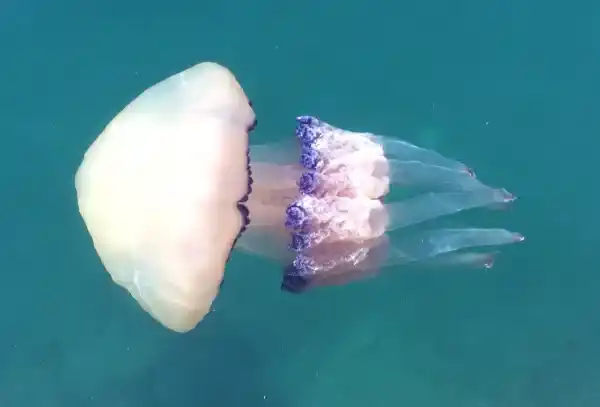
7) Bioluminescent jellyfish (Pelagia noctiluca)
The umbrella is pinkish-purple or purplish-red, with long tentacles that sting intensely. The umbrella diameter is usually less than 20 cm , and some individuals can exhibit a faint bioluminescence in the dark.
Common sea areas
Jellyfish are more common in the Mediterranean Sea, mostly in the open ocean, but they also come close to the shore in large numbers during jellyfish tides.
risk of sting
High : often causes intense burning pain, large areas of redness and swelling, and in severe cases, ulcer-like skin lesions may appear.

8) Sail jellyfish / "Sea sailboat" (Velella velella)
It's not a true jellyfish , but a floating, colony-like organism. It looks like a small blue disc with triangular "sails" on top, and its length is usually several centimeters.
Common sea areas
After strong winds and changes in ocean currents, large areas may wash ashore, forming "blue beaches".
risk of sting
Extremely low : Generally harmless or only slightly irritating to humans.
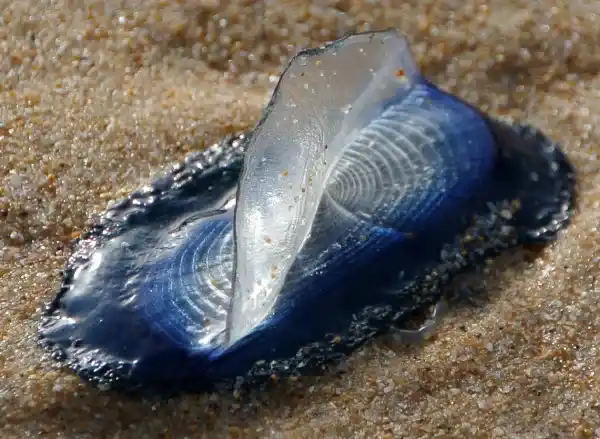
9) Ribbed Jellyfish / Aequorea (Aequorea forskalea)
The umbrella is transparent, revealing radiating white stripes resembling ribs. The diameter can reach approximately 20 cm , and the tentacles are short and thin.
Common sea areas
Mostly found in the open sea, but may also drift into nearshore waters with ocean currents.
risk of sting
Extremely low : The stinging sensation is usually very mild, and many people hardly feel it.
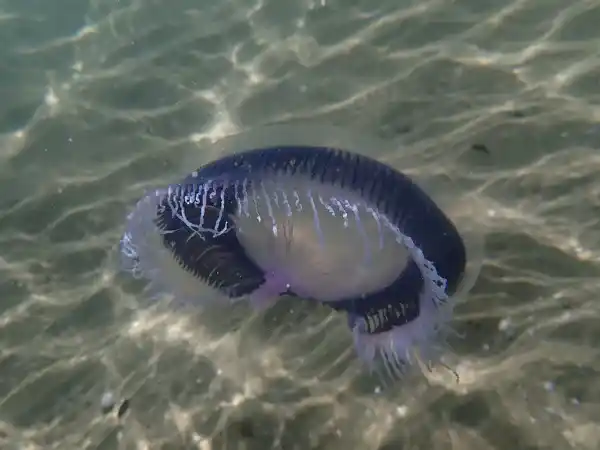
10) Mediterranean giant barrel jellyfish (Rhizostoma luteum)
It is enormous, with a canopy diameter of up to 70 cm and a weight of up to tens of kilograms. The canopy is white or pale yellow, with a thick, branching tip that can extend quite far.
Common sea areas
It is generally rare, but has been recorded in some areas of the Mediterranean (such as the Spanish coast).
risk of sting
Low : Generally not dangerous to humans, but may be more impactful on small fish.
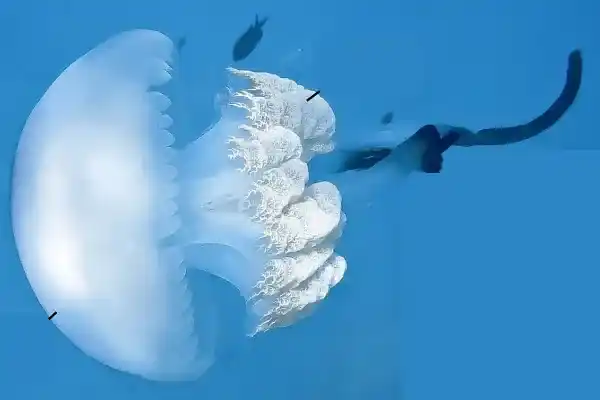
Other Mediterranean jellyfish and "jellyfish-like" planktonic organisms
Besides the 10 most frequently mentioned or most commonly seen species on beaches mentioned above, the Mediterranean also records many jellyfish or similar-looking floating creatures. Below are some common names and brief characteristics to help you expand your "species list" in your article.
11) Cicada Jellyfish (Olindias muelleri)
Occasionally found near the shore, mostly small to medium-sized individuals; contact may cause stinging and rashes, so it is recommended to avoid touching them.
12) Upside-down jellyfish (Cassiopea xamachana)
They are often found "lying" on the seabed in shallow waters with their oral arms extended upwards. They are more likely to be encountered in shallow lagoons or warm bays, and contact can cause skin irritation.
13) Melon Jellyfish (Cephea cephea)
The umbrella-shaped body is shaped like a melon or dome, and is relatively thick overall; it is mostly recorded in deeper or offshore waters.
14) Orange-striped jellyfish (Gonionemus vertens)
They are relatively small in size, and some individuals have striped patterns; contact may cause significant discomfort, so avoid touching them with bare hands.
15) Blue buttons (Porpita porpita)
They are not true jellyfish, but rather small, blue discs that float on the surface of the sea or are washed ashore. They usually have little impact on humans.
16) Lobonema smithii (Discoleaf Disc Jellyfish)
It has a disc-shaped body and a leaf-like structure; it may be recorded in specific sea areas and seasons.
17) Tagus jellyfish (Catostylus tagi)
They are relatively large, can be seen in some areas, and their overall danger level is usually not the highest.
18) Mawia benovici
It has been discussed extensively in the species record of the Mediterranean and may be observed in localized areas and under seasonal conditions.
19) Neotima lucullana
It belongs to a relatively less frequently mentioned jellyfish species, and its commonality depends on the specific sea area and monitoring conditions.
20) Tripedalia cystophora
Related to box jellyfish, it has a unique appearance. Box jellyfish stings are often more painful, so it is recommended to keep your distance.
Encountering jellyfish at the beach: Practical tips to reduce the risk of being stung.
Observe the sea surface and wave lines
If multiple jellyfish are seen in succession on the sea surface or near the wave line, it often means that there is a jellyfish swarm drifting nearby.
Do not touch stranded individuals with your bare hands.
Many jellyfish may still have nematocysts on their tentacles even when they are out of water or appear to have "lost their vitality," and they can still sting.
Wearing protective gear is more reliable
During peak jellyfish season, it is recommended to wear sun-protective jellyfish clothing or lightweight wetsuits to reduce the area of skin exposed.
First, perform basic treatment after being stung.
It is generally recommended to gently rinse with seawater to remove as many residual tentacle fragments as possible (avoid rubbing). If severe pain, extensive redness and swelling, breathing difficulties, or systemic reactions occur, seek medical attention as soon as possible.