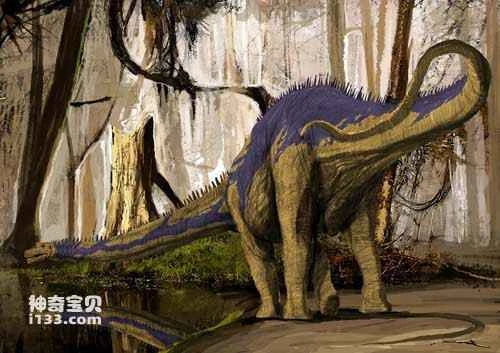
Diplodocus lived during the Late Jurassic period, 145 to 155 million years ago, and was a giant herbivorous dinosaur. Diplodocus had an extremely long body; fossils indicate that even when not fully extended, its body reached a length of 27 meters. It had an exceptionally long neck and tail, with the neck measuring 8 meters and the tail 14 meters. Therefore, despite its large size, its weight was not particularly impressive, typically around 10 to 20 tons.
The Diplodocus had a small head with nostrils located on the top of its head and flat teeth. It likely swallowed its food, such as pine needles, with little chewing, choosing the tenderest parts of plants to reduce the digestive burden on its stomach. Its forelegs were shorter than its hind legs, and its hips were higher than its shoulders; each foot had five toes. It laid many eggs but did not care for its young. Young Diplodocus developed rapidly, reaching full maturity in just 10 years. While a five-year-old elephant weighs about one ton, a Diplodocus of the same age could weigh up to 20 tons and reach 15 meters in length. For young Diplodocus not protected by their kin, rapid growth allowed them to quickly reach a size comparable to predators, increasing their survival rate.
Diplodocus's body was supported by a series of interconnected axial skeletons called vertebrae. Its neck consisted of 15 vertebrae, its chest and back had 10, and its long, slender tail contained approximately 70. While sauropods typically have long necks to allow them to reach treetops (like giraffes), Diplodocus did not use its neck in this way. It stretched its neck, sweeping it in an arc, to eat ground vegetation. Paleontologist Stephen reassessed the feeding habits of sauropods. Stephen used computer simulations to demonstrate feeding movements impossible with real bones. He carefully measured each vertebra that made up Diplodocus's neck and then created a computer model to study the movement of the entire neck. Stephen found that, based on the meshing of the bones, Diplodocus could not have raised its head too high above horizontal, because its neck did not bend like a medieval shepherd's crutch. However, it could easily reach its head to the ground (in fact, it could have reached below horizontal). No one had ever conducted such a study using real skeletons before, because Diplodocus was too large and heavy to be used in such experiments.
Chinese name: Liang Long
Latin name: Diplodocus
Period of life: Late Jurassic
Fossil sites: Colorado and Montana, USA
Utah, Wyoming
Physical characteristics: 27 meters long
Diet: Plants
Species: Sauropods
Meaning: Lizard with double the crossbeams