The excavation of the Yellow River Giant Dragon began in 2002 and lasted for three years. The fossils include: a nearly complete sacrum, an anterior caudal vertebra, a middle caudal vertebra, several incomplete cervical ribs, a missing distal venous arc, a left scapula, and a coracoid bone. It belongs to a primitive giant sauropod dinosaur that lived in the Early Cretaceous period. Its discovery is of great significance for studying the origin and early evolution of giant sauropod dinosaurs.
In 2004, scholars including You Hailu and Ji Qiang from the Institute of Geology, Chinese Academy of Geological Sciences, and Li Daqing from China University of Geosciences described a new sauropod dinosaur fossil from the Lower Cretaceous Hekou Group in the Lanzhou Basin, Gansu Province, and named it Liujiaxia Yellow River Giant Dragon. The genus name Yellow River Giant Dragon means "giant dragon on the banks of the Yellow River," and the species name indicates that it was discovered in the Liujiaxia area of Yongjing County, Gansu Province.
The Yellow River Giant Dragon possesses a unique sacral vertebrae, with a very low neural crest that extends laterally at its apex. Furthermore, it is characterized by its broad hips and long forelimbs, making it the fattest known dinosaur in China. It was approximately 20 meters long, with its sacral vertebrae (the middle part of the hip bones) less than half a meter high yet reaching 1.1 meters in length, and its scapulae, 1.23 meters long, reaching a maximum width of 0.83 meters. The largest dinosaur previously discovered in China—the Mamenchisaurus—could reach over 30 meters in length, but its slender build suggests it weighed less than the newly discovered Yellow River Giant Dragon.
The discovery of the Yellow River Giant Dragon adds a new member to the list of Early Cretaceous giant sauropods in Asia. In recent years, research on giant sauropods has made significant progress. Giant sauropods are no longer confined to the Southern Hemisphere; many new discoveries have been made in the Early Cretaceous of the Northern Hemisphere, and a distinct monophyletic group may exist in Asia. At the same time, with the increasing discovery of giant sauropods, the traditional Cretaceous terrestrial plant ecosystem dominated by hadrosaurs and ceratopsians is being challenged.
The dinosaur fossils in the Lower Cretaceous Hekou Group of the Lanzhou Basin have only become known in recent years thanks to extensive fieldwork by the Paleontological Research and Development Center of the Third Geological and Mineral Exploration Institute of Gansu Province, but their potential is enormous. Since the late 1990s, numerous trace fossil assemblages, primarily consisting of dinosaur footprints, have been discovered in the western part of the basin. In 2002, the first dinosaur skeleton fossil was discovered in the western basin. Subsequently, a dinosaur fossil excavated in 2003, after research, was identified as the world's largest-toothed herbivorous dinosaur and named *Lanzhouosaurus megalodon*. Based on this discovery, the Liujiaxia Dinosaur National Geopark officially opened in 2005. Extensive fieldwork continues, and a vertebrate fossil assemblage including fish, turtles, and various types of dinosaurs is gradually being revealed.
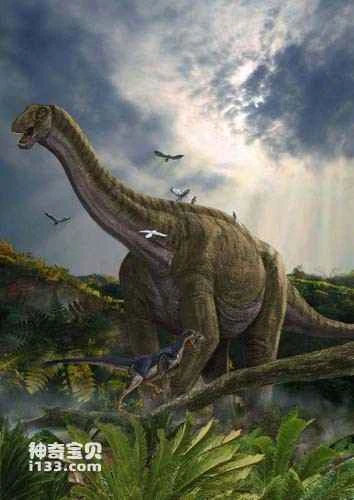
Chinese name: Yellow River Giant Dragon
Latin name: Huanghetitan
Era: Early Cretaceous
Fossil sites: Gansu and Henan provinces, China
Physical characteristics: 20 meters long
Diet: Plants
Species: Sauropods
Meaning: A giant dragon from the Yellow River