People used to think that dinosaurs, like reptiles today, laid eggs and left without caring about their offspring. However, paleontologists later discovered that the teeth of some young dinosaur fossils showed obvious wear, indicating that they had begun to eat. However, these young dinosaurs' limbs were not fully developed, clearly indicating they hadn't yet begun truly independent movement. This seems to suggest that the young dinosaurs were raised by their parents in the nest.
Furthermore, analysis of dinosaur footprint fossils indicates that they often went out in processions, with larger dinosaurs on either side and smaller dinosaurs in the middle, much like the elephant herds we see today. However, many people believe that this evidence alone is insufficient to prove that dinosaurs intentionally raised their offspring, as no reptile in the world today exhibits such devotion. Crocodiles, perhaps the best example, simply carry their hatchlings in their mouths to the water's edge, considering their task complete; whether the baby crocodiles can swim or hunt is of no concern to them.
In the summer of 1978, two years before the extraterrestrial extinction theory was proposed, Horner and Makeira discovered Egg Mountain. We now know that three types of dinosaurs lived on Egg Mountain: Maiasaura (a hadrosaurid), Runnerosaurus (a basalt), and Troodon (a basalt). Maiasaura nests were the most numerous, with over 40 discovered within an area of 1 square kilometer. Maiasaura built their nests on high ground, about 2 meters in diameter, basin-shaped, and lined with soil and small stones. These nests could be used for many years. During the breeding season, Maiasaura returned to lay eggs, about 25 eggs per nest, arranged in a circle, covered with plants for insulation. Evidence discovered at the same time, including Maiasaura hatchling skeletons, regurgitated food, and footprints near the nests, indicates that Maiasaura carefully cared for their young for a long period. The hatchlings' joints were in a semi-developed state, so they could not move independently and relied entirely on their parents for care. Currently, over 300 Maiasaura skeletons have been discovered, covering various age groups, which is of great significance for studying the growth process of dinosaurs.
Today, the best way to visit Egg Mountain is through the Ancient Trail Museum. Because Egg Mountain is desolate and remote, with sharp rocks and numerous maze-like paths, it is essential to have a guide from the museum to lead the way.
Currently, the Ancient Road Museum offers a complete course on excavation, including a dinosaur research project at the Egg Mountain mass grave, an introduction to dinosaur ecology, paleontology studies, and fossil identification. This course is fully booked every year since its inception and usually needs to be booked six months in advance. A friendly reminder: be sure to take a photo with Mrs. Bulendo, the first person to discover the embryos!
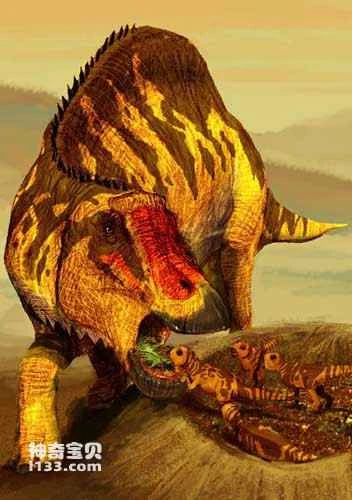
Chinese name: Maiasaura
Latin name: Maiasaura
Age of existence: Late Cretaceous
Fossil origin: Montana, USA
Physical characteristics: 9 meters long
Diet: Plants
Species: Ornithopods
Meaning: Good Mother Lizard