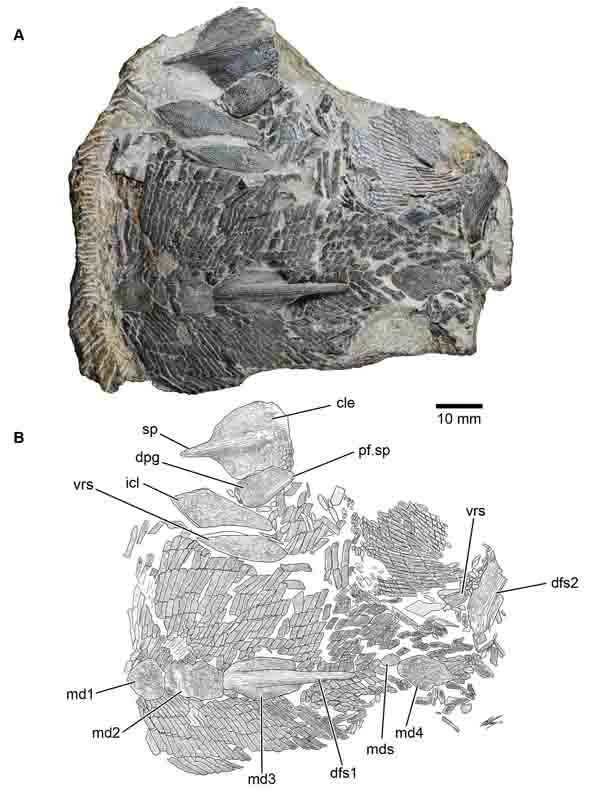
In 1999, Li Daqing, a senior engineer at the Paleontological Research and Development Center of the Third Geological Exploration Institute of Gansu Province, led a research team on a field expedition in the Lanzhou Basin of Gansu Province. Near the summit of a mountain, in Early Cretaceous rock strata, they discovered small pieces of exposed bone, resembling dinosaur ribs. As the rock was peeled back layer by layer, a relatively complete dinosaur vertebral fossil was revealed to the researchers. Their first impression was its size; a single rib was nearly a meter long. Everyone was astonished, but no one could be certain what kind of dinosaur it belonged to. This field expedition collected approximately 100 skeletal fossils, including a complete mandible, mandibular teeth, maxillary teeth, a sternum, a phalanx, multiple ribs, and parts of the cervical and dorsal vertebrae.
Subsequently, these skeletal fossils were transported to Beijing and sent to the Institute of Geology, Chinese Academy of Geological Sciences. After preliminary skeletal restoration, researcher You Hailu, specializing in dinosaur studies, began analyzing and studying them. Based on the morphology of the tooth fossils, You Hailu initially identified them as ornithopod dinosaurs. This is because the teeth of this dinosaur were very different from those of other dinosaurs, such as theropods. Carnivorous theropod dinosaurs typically have sharp, knife-like teeth, while the teeth of herbivorous ornithopod dinosaurs usually have a worn cross-section at the tip due to long-term grinding of plants. The tooth fossils sent to us clearly belonged to the latter category.
However, what puzzled Yu Hailu, who has been studying dinosaurs for many years, was that these tooth fossils were completely different from the teeth of ornithopod dinosaurs that had been discovered before. Ornithopod dinosaur teeth from the Early Cretaceous period were generally only 3 to 4 centimeters long, such as those of Iguanodon. However, the maxillary tooth fossil discovered this time was 14 centimeters long and 4 centimeters wide, making it the largest herbivorous dinosaur tooth discovered to date.
How is the species of this dinosaur determined? According to You Hailu, this is a complex and systematic process, not something that can be concluded simply by experience or by looking at a few bones. Currently, the main research method used in paleontology is cladistics, which involves selecting dinosaurs most closely related to the subject of study and comparing their characteristics. You Hailu selected a total of 19 dinosaurs, all closely related to this one and discovered around the world, such as a Late Jurassic dinosaur found in North America and a hadrosaur from the Late Cretaceous of Canada. Based on previous research experience, 79 identifying features, including the head, teeth, spine, and limbs, were selected for comparison.
The entire research process lasted about a year. You Hailu discovered that this dinosaur differed from other known ornithopod dinosaurs. For example, its upper jaw teeth had a prominent ridge on the surface, while its lower jaw teeth were relatively smooth. This is a more primitive feature compared to its closely related Late Cretaceous ornithopod dinosaur, the hadrosaur, which also had prominent ridges on both the upper and lower jaw teeth. Therefore, it can be determined that this dinosaur was more primitive and may have lived in the Early Cretaceous. Furthermore, its sternum had a handle-like structure, resembling an axe, but compared to the sternums of later axolotlitosaurs, the handle length was clearly insufficient, suggesting it belonged to an early axolotlitosaur. After preliminary research, You Hailu concluded that this dinosaur should be a new genus and species. Because the dinosaur was discovered in the Lanzhou Basin, it was named Lanzhouosaurus.
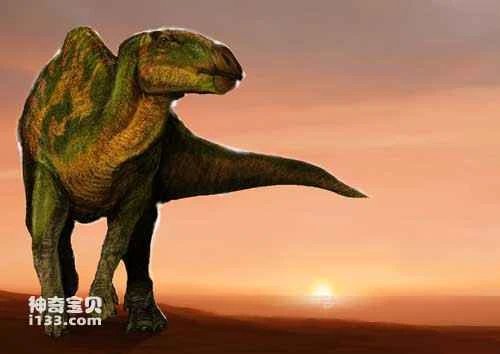
Chinese name: Lanzhou Dragon
Latin name: Lanzhousaurus
Era: Early Cretaceous
Fossil origin: Gansu, China
Physical characteristics: 10 meters long
Diet: Plants
Species: Ornithopods
Meaning: Lizard from Lanzhou