Iguanodon was the first dinosaur to be officially discovered, but it was not the first to be named. It was the second dinosaur to be named after Megalosaurus (1824).
Mantel, a family doctor in Lewis, Sussex, England, and his wife Marian discovered Iguanodon, meaning "ivy's tooth" (16 years before the word "dinosaur" appeared). The discovery of Iguanodon slowly brought to the realization that some enormous and awe-inspiring animals once lived on our planet.
At the time, using the size of iguana teeth as a reference, Professor Irwin of Oxford University estimated that Iguanodon was 30-60 meters long—about half the size of a football field! Later, Mantel and many amateur researchers continued excavating, discovering fossils of vertebrae, ribs, and many other bones over 15 years. The size of these bones forced Professor Irwin to revise his initial hypothesis, reducing the length of Iguanodon to 7 meters. These fossils also showed that Iguanodon was much larger and heavier than modern monitor lizards; its sternum structure was similar to that of crocodiles, suggesting it had four chambers of the heart, an advancement over the three chambers of other reptiles. Therefore, Professor Irwin believed that Iguanodon's heart and circulatory system were already similar to those of warm-blooded vertebrates.
The fossils also indicate that Iguanodon was a social animal. In 1878, in Benissat, a small town in Belgium, coal miners encountered a pile of fossilized bones while working 322 meters underground. It was the skeleton of an Iguanodon! Ultimately, 39 Iguanodon skeletons were discovered there, pieced together like a giant jigsaw puzzle. These complete Iguanodon skeletons can still be seen today in the Royal Museums of Belgium.
They always roamed in small groups, searching for food. Numerous fossilized footprints of ornithopods have been discovered in many places, providing us with a wealth of information about their numbers, walking style, speed of movement, age, and more.
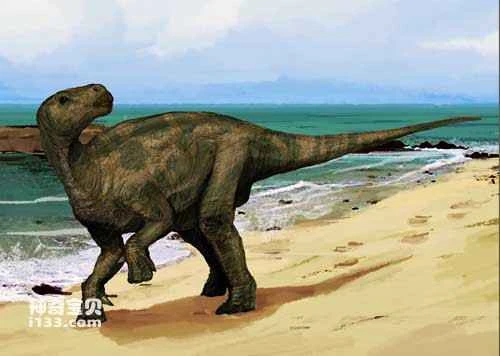
Chinese name: Iguanodon
Latin name: Iguanodon
Era: Early Cretaceous
Fossil sites: Belgium, United Kingdom, Germany, North Africa, China
Physical characteristics: 9-10 meters in length
Diet: Plants
Species: Ornithopods
Definition: Iguana's teeth