The Egyptian mongoose (scientific name: *Herpestes ichneumon*) is a small mammal belonging to the family Meerkats in the order Carnivora. Native to Africa and western Asia, it has been introduced to Spain and Portugal. Due to its agile hunting abilities and unique lifestyle, the Egyptian mongoose holds an important place in the wild. This article will provide a detailed introduction to the Egyptian mongoose's physical characteristics, distribution range, diet, reproduction, and behavioral patterns, helping you to fully understand this mysterious animal.
Key characteristics of Egyptian mongooses
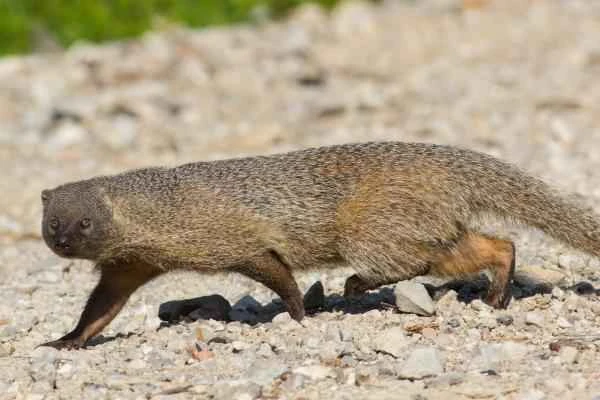
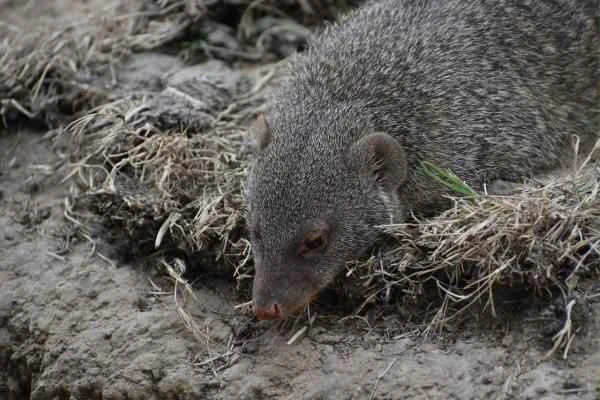
With its slender body and agile movements , its appearance can sometimes be mistaken for that of a reptile.
The tail is relatively long, with a dense tuft of hair at the end , used for balance and communication.
Its coat color varies , commonly gray with dark spots, sometimes reddish-brown with yellow spots. When threatened, it will raise its fur and arch its body to appear twice as large.
It has a long, slender head, rounded ears, and hairless skin rings around its eyes to enhance its sensory abilities.
Medium-sized , with a body length of about 48-60 cm, a tail length of 33-54 cm, and a weight of 2-4 kg.
With short limbs and long claws with five fingers, it is well-suited for digging .
It has large anal glands with two openings , which are used to release scents to mark territory and transmit information.
Habitat distribution
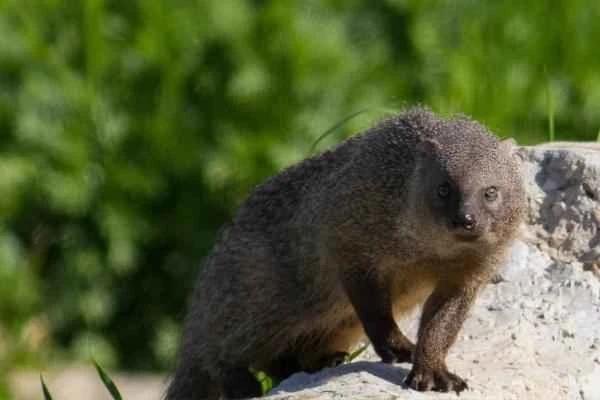
The Egyptian mongoose is native to parts of Africa and western Asia. Historically, due to human activity, it was introduced to Spain and Portugal, where it became a common wild animal in some areas.
In Spain and Portugal , Egyptian mongooses are mainly found in lush vegetation areas near water sources, such as riverbanks, swamps, farmland, and irrigation canals.
They often build nests in hollow tree trunks, earthen caves, and rock crevices , and hide to rest at night.
In its native Africa and Asia, the Egyptian mongoose adapts to a variety of environments, but prefers moist areas near water.
Dietary habits
The Egyptian mongoose is a typical carnivore with teeth specially adapted for hunting, enabling it to effectively tear apart prey tissue. Its diet is extensive, including:
fish
Birds and their eggs
Small mammals
Reptiles and amphibians (especially snakes)
Invertebrates (insects, crustaceans, etc.)
Egyptian mongooses are renowned for their ability to prey on snakes. They raise their fur to confuse snakes and then swiftly attack their heads, displaying agility and high efficiency. For eggs, they use their hind legs to grasp the shells and throw stones or hard objects to crack them open and eat.
Reproduction methods
Males and females look similar and there is no obvious sexual dimorphism.
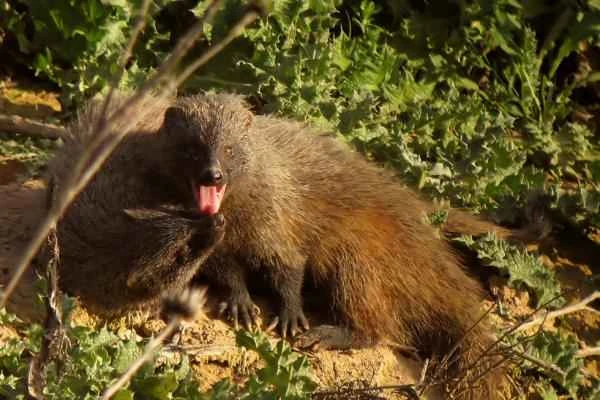
During the breeding season, males court females by bringing their mouths close to the female's neck, accompanied by specific calls. The female responds with echoes and playful gestures to indicate acceptance.
During a woman's estrus cycle, the vulva becomes red and swollen, and the cycle can quickly return to normal within 10 days postpartum.
Internal fertilization, pregnancy approximately 11 weeks.
Each litter produces 2-4 pups. The pups are born hairless and with closed eyes, and begin to open their eyes after about 8 weeks.
Their lifespan in the wild is about 12 years, while in captivity they can live up to 20 years.
Behavioral characteristics
Egyptian mongooses exhibit diverse social behaviors; some individuals live solitary lives, while others form small groups of 2 to 7 members to hunt together, reducing internal competition.
She is a strong swimmer and enjoys sunbathing.
They are active during the day, agile and energetic, and sometimes exhibit a strong wildness.
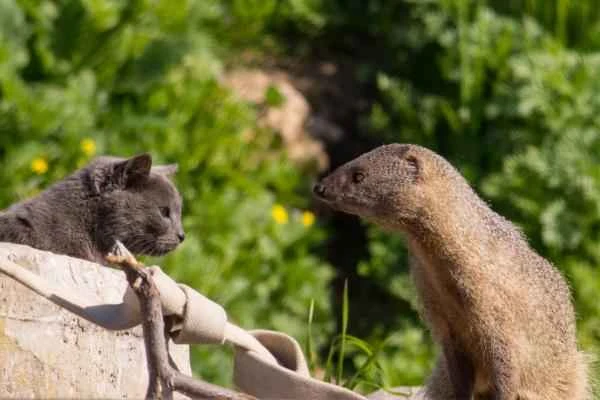
They were domesticated by humans and have a history of being kept as pets predating cats.
The unique anal glands secrete a strong odor, and individuals sometimes cover their noses with their tails.
Scent plays a crucial role in group orientation and communication: group leaders lead the way, other members follow by scent, and mothers also use scent to communicate when leading their young.
This scent can also indicate the reproductive status of females and distinguish members of different groups.
bibliography
González-Broco, C., Vázquez, J., Larios-López, JE, Fernández, A., Cortés, S., Blanca, I., and Virgós, E. (2016). Distribution of the meerkat (Herpestes ichneumon) in the Granada province. Gallemis, 28, 41–51.
Biss, L. (2002). “Herpestes ichneumon” Animal Diversity Network. URL: https://animaldiversity.org/accounts/Herpestes_ichneumon/