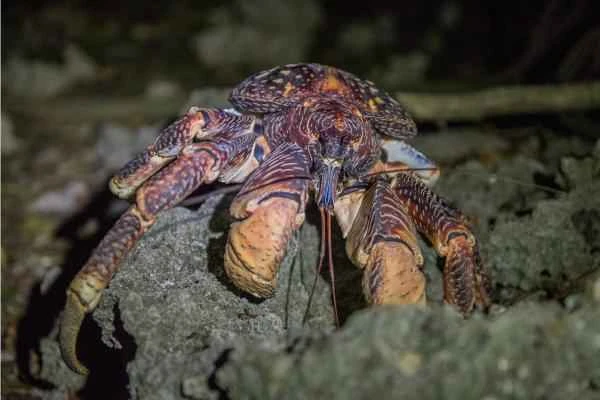
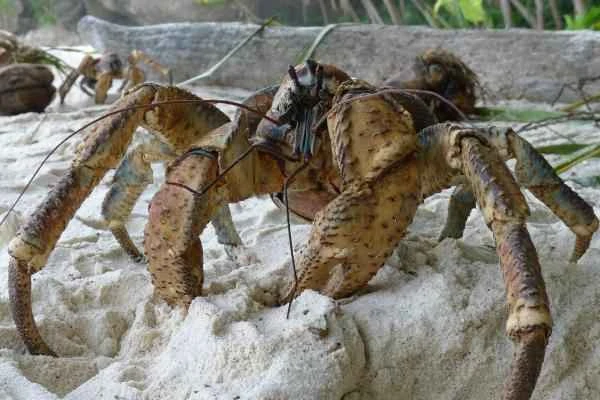
The coconut crab (scientific name: *Birgus latro *) is a terrestrial crab and the largest crab species in the world, weighing up to 4 kilograms and nearly 1 meter in length. It is known primarily for its diet of coconuts, but also possesses a diverse diet, being both omnivorous and scavenging. Coconut crabs are mainly distributed on small islands in the Pacific and Indian Oceans, particularly favoring limestone coastal forests. This article will take you on a journey through the physical characteristics, habitat, diet, and reproductive behavior of the coconut crab, unveiling the mysteries of this unique animal.
Distinctive features of coconut crabs
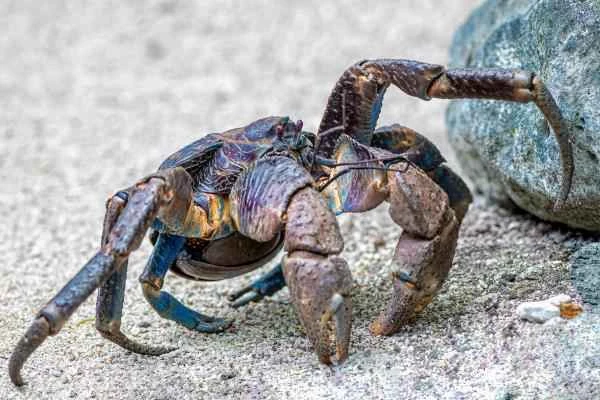
Huge size : Coconut crabs can weigh up to 4 kilograms and span 1 meter, making them the largest and heaviest living terrestrial arthropods.
It has four pairs of legs, totaling eight legs . The first two pairs have evolved into strong pincers used for climbing and foraging, and can easily lift objects weighing up to 30 kilograms.
It is famous for opening coconuts , and its name comes from the powerful pliers used to open the coconuts.
Adult crabs use coconut shells to protect their abdomens , rather than relying on shells for shelter.
Their keen sense of smell allows them to detect scents from a distance, aiding in finding food and avoiding predators.
They have lung-like gills and rely on a moist environment to breathe. They cannot fully submerge, otherwise they will suffocate and die.
Coconut crab habitat
Coconut crabs primarily inhabit tropical islands in the Indian and Pacific Oceans, such as Zambia, the Cook Islands, the Mariana Islands, Easter Island, and the Seychelles. Their larvae are aquatic and are dispersed to the islands via ocean currents.
They inhabit limestone coastal forests and usually nest in rock crevices or under tree roots, and also use cracked coconuts as nests.
Their habitat needs to be kept moist in order to maintain lung and gill function.
Local residents consider it a delicacy and a traditional medicinal food, so human hunting has seriously threatened its population, causing its numbers to plummet in some areas and even to the brink of extinction.
On uninhabited islands, coconut crabs thrive and have virtually no natural predators.
Diet of coconut crabs
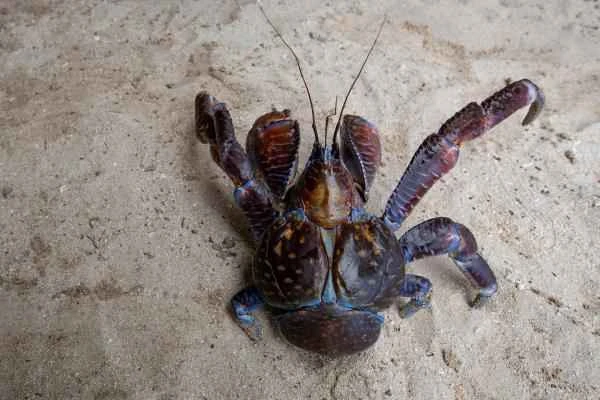
Coconut crabs are nocturnal and rely on their keen sense of smell to find food. Their diet is broad and varied, consisting of both scavenging and primarily feeding on coconuts.
They primarily feed on coconuts , and are able to crack open the shells to eat the coconut meat and juice, demonstrating a high level of intelligence and skill.
They also eat rotten wood, dead animal carcasses, cicada shells, banana trees and other plants, as well as other small crabs and carrion.
They are considered important scavengers in island ecosystems, contributing to the recycling of matter.
Reproduction methods of coconut crabs
Reproduction is achieved through internal fertilization, where the male transfers its spermatophore to the female for internal fertilization.
After fertilization, female crabs carry thousands of eggs in their abdomen. The eggs are about 0.6 mm in size. Once they develop to 1 mm, the female crabs migrate to the seashore to release the larvae.
After about 8 weeks of aquatic life, the larvae enter the glaucothoe stage, at which time they seek out empty shells or coconut shells to live in and gradually grow into terrestrial juvenile crabs.
Through multiple molts and growth, coconut crabs gradually develop into adults.
They have an extremely long lifespan, living for more than 60 years, far exceeding that of most arthropods.
As the largest land arthropod, the coconut crab is not only remarkable for its unique lifestyle but also an indispensable part of the island's ecosystem. Protecting its habitat and reducing human hunting will help maintain ecological balance and biodiversity.
References
Amesbury, SS (1980). Biological study of the Mariana Islands coconut crab (Birgus latro). Agricultural Experiment Station, College of Agriculture and Life Sciences, University of Guam.