Crinoids (scientific name: Crinoidea) are marine invertebrates belonging to the phylum Echinodermata, and are closely related to starfish and sea urchins. Despite having "lily" in their name, they are not actually plants, but rather an ancient group of animals that live in deep-sea areas above 200 meters .
What is a sea lily?
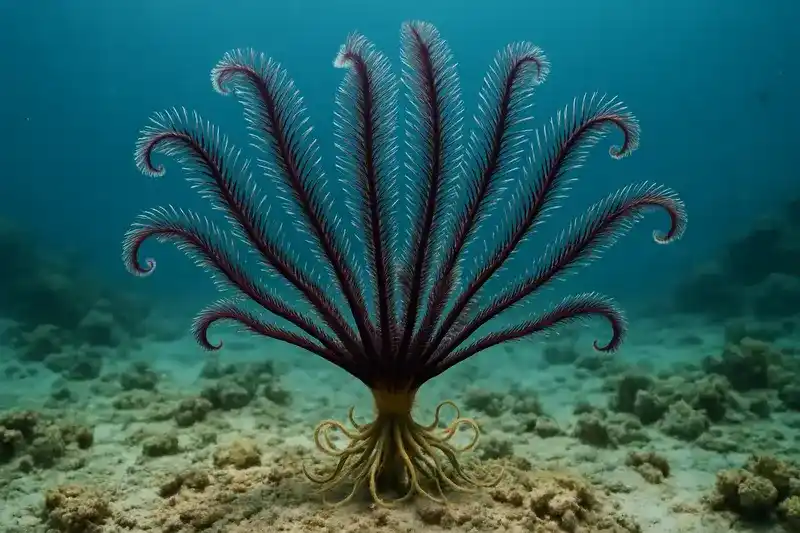
Crinoids, also known as feathery brachiopods , are echinoderms that resemble flowers in appearance. They possess a central cup-shaped body from which feathery, branching arms extend, used for hunting and locomotion.
They were once widely distributed during the Paleozoic Era and were an important part of biodiversity. Studies indicate that after the Permian-Triassic extinction event, only a few crinoid groups survived and evolved into the ancestors of the approximately 700 extant crinoid species .
During the Cretaceous period, crinoids migrated from shallow seas to deep seas and now mainly inhabit the deep waters of the Atlantic and western Pacific Oceans .
Morphological characteristics of sea lilies
Body structure : It has a central cup-shaped body (cáliz) from which several feathery branches extend.
Stalked species : Some species have a stalk for attaching to seabed rocks or coral surfaces.
Free movement : Some can float freely through the broken stalk to escape predators.
Arm length : usually between 1–35 cm , with a stem up to 1 meter .
Low metabolic rate : More resistant to starvation and low oxygen levels than other marine animals.
Strong regenerative ability : It can regenerate a broken wrist or the entire wrist crown.
Sexual differentiation : dioecious, with distinct sex differences.
Sea lilies' habitat
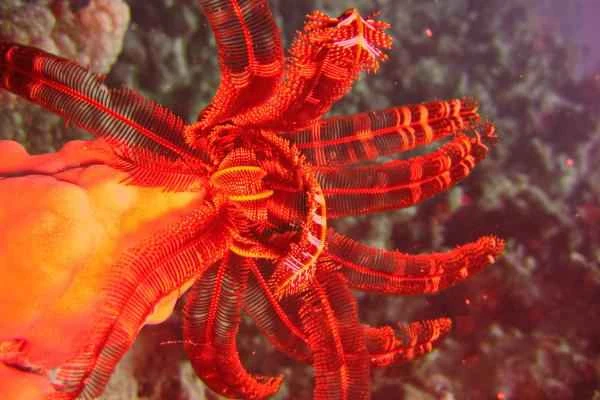
Today, crinoids mainly live in the deep sea at depths of over 200 meters , attaching themselves to hard substrates such as rocks and corals. In some areas, they form dense "underwater forests," becoming habitats for other marine life.
Some crinoids can slowly swim or float on the seabed by swinging their feathery arms in order to find new habitats or avoid threats.
Sea lilies' feeding methods
Crinoids feed on plankton and suspended organic particles . They use their feathery, winged surfaces to secrete mucus to attract tiny food particles, and then use their tube feet (podia) to deliver the food to their mouths.
Its digestive system is simple— it has no stomach structure . After food enters the mouth, it passes through the esophagus and intestines in sequence, and is finally expelled through the anus on the side of the mouth.
They adjust the angle and spread of their arms to optimize hunting efficiency, and in special circumstances they will also feed on carcasses or prey on small animals.
Sea lilies' reproductive methods
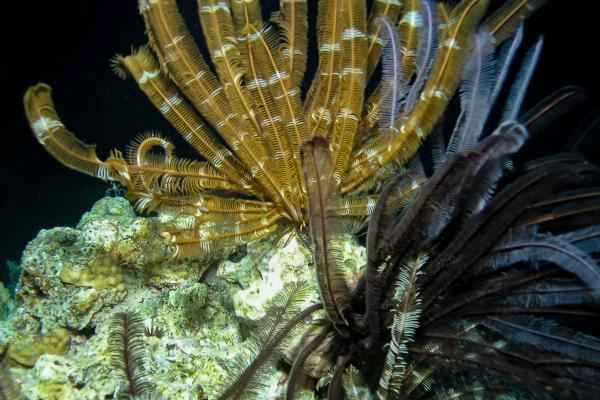
Dioecious : having differentiated sexes.
In vitro fertilization : sperm and eggs are released into seawater to combine.
Planktonic larvae : hatching larvae that do not feed and float by ocean currents.
Benthic colonization : After implantation, the larvae become fixed adults and live a filter-feeding life.
In addition, crinoids possess an amazing ability to regenerate severed limbs , making them more adaptable to the stresses of deep-sea survival.
Representative species of sea lilies
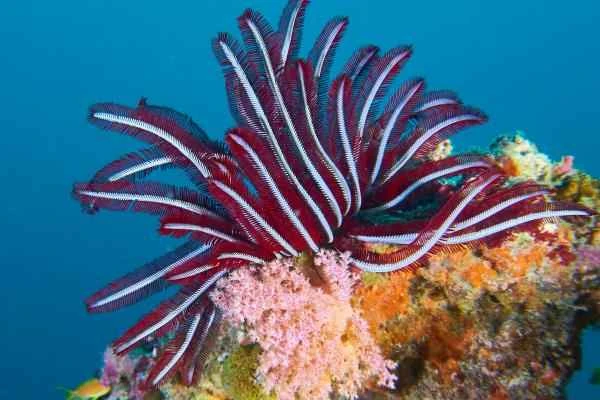
Leptometra celtica : lives in the Atlantic Ocean and has 10 feathery arms that are 7–10 cm long.
Ptilometra australis : A species found along the southeast coast of Australia, with 18–20 arms bearing small barbs.
Stephanometra indica : Distributed in the Indo-Pacific region, with arms arranged in a fan shape.
Tropiometra carinata : It has 10 arms, the longest of which can reach 18 centimeters.
Metacrinus rotundus : A common species in the deep sea off the west coast of Japan, with densely branched arms surrounding the central mouth, resembling a feather duster.