The discovery of ancient human fossils at Zhoukoudian greatly excited Johan Gunnar Andersson, who was deeply involved in the "Central Asia craze." He decided to include the excavation and research at Zhoukoudian as a "connected additional project" in his Central Asia expedition plan in collaboration with Andersson. Therefore, even before the official announcement of the new discovery at Zhoukoudian, he began the operational activities for this plan. On October 5, he drafted a report to Hu Hengde, then head of the administrative committee of Peking Union Medical College, suggesting that the Rockefeller Foundation provide funding to support further systematic excavation at Zhoukoudian and to establish a physical anthropology research structure; then he approached Weng Wenhao, director of the Geological Survey of China, to discuss specific cooperation plans.

Weng Wenhao
After much deliberation, they finally drafted an agreement in early February 1927 entitled "Agreement between the Geological Survey of China and Peking Union Medical College on Cooperative Research on Tertiary and Quaternary Deposits in North China." With financial support from the Rockefeller Foundation, they officially began systematic excavations at Zhoukoudian in the spring of 1927.
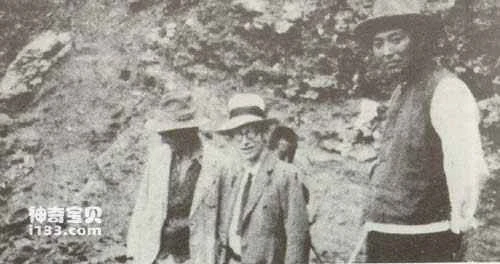
Li Jie [right] and Bu Lin [center]
The Zhoukoudian collaborative project was chaired by Mr. Ding Wenjiang, one of the founders of Chinese geology, with specific details handled by Bu Dasheng and Weng Wenhao. The personnel sent to Zhoukoudian for practical work were: Li Jie, a geologist from the Geological Survey of China, serving as the director of fieldwork affairs; Bu Lin, a Swedish paleontologist, serving as a fieldwork consultant; Liu Delin, a technician for the renowned American paleontologist Glenn, serving as a technical assistant for field excavations and handling fossil repair work indoors; and Xie Renfu, Bu Dasheng's clerk, sent to Zhoukoudian as Liu Delin's assistant.
The first year of excavation was a resounding success, yielding 500 boxes of fossils. Moreover, on October 16, Bulin discovered a well-preserved human tooth fossil, unearthed in a location very close to where Zdansky had discovered the first human tooth.
B.D. described and studied the newly discovered human tooth fossil in detail, concluding that it was an adult's first lower left molar, similar in nature to the molar discovered by Szdansky. Therefore, he suggested establishing a new genus and species of hominid based on these tooth fossils, namely "Sinanthropus pekinensis" or "Peking Man".
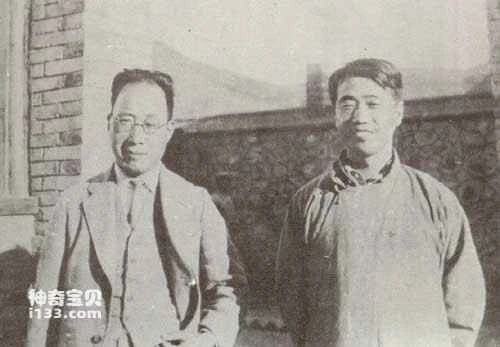
Yang Zhongjian [left] and Pei Wenzhong [right]
At the end of 1927, Davidson returned to Canada, and the work in Zhoukoudian in 1928 was overseen by Weng Wenhao and Fowton of Peking Union Medical College. That year, two figures who would later become giants of Chinese science also arrived in Zhoukoudian: Yang Zhongjian and Pei Wenzhong.
Yang Zhongjian graduated from the Department of Geology at Peking University in 1923 with a Bachelor of Science degree. In 1927, he went to Germany to study paleontology at the Department of Geology, Munich University, where he received his Ph.D. in philosophy. In 1928, he succeeded Li Jie as the official agent of the Geological Survey in Zhoukoudian.
Pei Wenzhong, just 24 years old, had just graduated from the Department of Geology at Peking University. He went to Zhoukoudian with Yang Zhongjian, where he was initially in charge of manpower and accounting management, while also participating in the excavation, becoming Bu Lin's capable assistant.
The harvest this year was even better than the first year, with 575 boxes of fossil materials unearthed. In addition, a right mandible of a Peking Man girl and a right mandible of an adult with three complete molars were also discovered.
By the end of the year, the work at Zhoukoudian faced a new situation. The special funding from the Rockefeller Foundation was due to expire in March of the following year, but two years of excavation had revealed that the amount of fossil deposits at the Peking Man site far exceeded initial estimates, making it impossible to excavate it completely in the short term. Furthermore, the site was not only rich in content but also presented highly complex issues. If researchers limited their focus to this site without expanding to the surrounding areas, it would be very difficult to fully understand the geological and paleontological problems reflected by the Peking Man site.
Therefore, Bu Dasheng, Ding Wenjiang, Weng Wenhao and others began to consult in the winter of 1928, considering a more comprehensive cooperative plan to continue the research at Zhoukoudian, and to establish the "New Generation Research Laboratory" as the organizational structure to implement the new plan.
After repeated consultations, Weng Wenhao and Bu Dasheng drafted the "Organizational Regulations of the Cenozoic Research Laboratory of the Geological Survey of China" on February 8, 1929. Thus, the Cenozoic Research Laboratory of the Geological Survey of my country—the predecessor of the Institute of Vertebrate Paleontology and Paleoanthropology of the Chinese Academy of Sciences, which is now the leading authority in vertebrate paleontology and paleoanthropology in Asia—was officially established. The establishment of this institution opened a new chapter in Cenozoic research in China, leading to the discovery of the world's first complete Peking Man skull, which we will discuss shortly, thus laying the foundation for China's vertebrate paleontology and paleoanthropology research.
That same year, Bu Lin resigned from his post at Zhoukoudian to join the Northwest Expedition, and Yang Zhongjian also went with Teilhard de Chardin to Shanxi and Shaanxi to investigate Cenozoic geology. As a result, the excavation work at Zhoukoudian was handed over to Pei Wenzhong by Weng Wenhao, director of the Geological Survey of China, and Bu Dasheng, honorary director of the Cenozoic Research Laboratory.
Spring work concluded at layers 8-9, where several more Peking Man teeth fossils were discovered. As autumn work progressed, the volume of the deposit gradually narrowed, and the excavable area shrank. However, when the excavable area became so narrow that it could only accommodate a few people for excavation, a breakthrough occurred: the fissure extended further southward.
Pei Wenzhong and a worker, with ropes tied around their waists and held onto by people on the cave ceiling, carefully descended to examine the extended fissure. They discovered a large number of fossils buried inside. It was already late November, and the weather was very cold; it should have been time to wrap up work. However, seeing so many fossils, Pei Wenzhong decided to extend the work for a few more days.
At the time, probably no one could have imagined the profound significance of this small rift and Pei Wenzhong's impromptu decision. The astonishing discovery a few days later once again demonstrated to the people how crucial the most arduous efforts to persevere to the very end were.
Around 4 p.m. on December 2nd, the sun had already set, but Pei Wenzhong and several technicians were still working diligently in the biting cold wind. As the cave was dug deeper and deeper, the lighting during the excavation had long been provided by gas lamps; however, at this point, the space at the excavation face was too cramped for the gas lamps to be used, so the excavators had to dig with one hand and hold a candle in the other to provide light.
Suddenly, Pei Wenzhong shouted, "What is this? It's a human head!" The moment the word "human head" was uttered, everyone who had been digging crowded around, craning their necks to look. The long-awaited sight had finally been revealed, and everyone was incredibly excited.
The skull fossil was half buried in hard soil and half in loose soil. Pei Wenzhong dug away the soil around the fossil and then gently pried it off with a crowbar. Part of the skull cracked due to the vibration, which Pei Wenzhong deeply regretted; however, he also saw the thickness of the skull and the structure of the brain surface. The crack was later glued back together and remained intact, without affecting subsequent research.
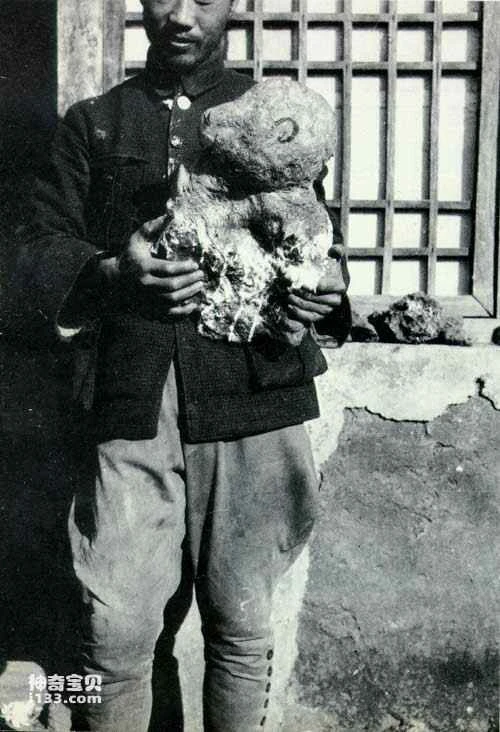
Pei Wenzhong holding the Peking Man skull
When the skull was unearthed, it was very damp and easily broken. Pei Wenzhong and two technicians worked day and night, using a charcoal brazier to dry it. After drying it, they covered it with several thick layers of cotton paper, then covered it with plaster burlap sacks, and dried it again. Once the outer plaster became dry and hard, the fossil inside would not be easily damaged. We call this protective plaster shell for fossils "pilok" (a transliteration of the Russian word meaning "plaster shell").
Finally, Pei Wenzhong wrapped the Pilaoke containing the skull of the first Peking Man in his two old cotton quilts, and then tied it up with a mattress and blanket like ordinary luggage. On December 6, he personally delivered it to the Cenozoic Research Laboratory of the Geological Survey of China in Beijing by long-distance bus.
The discovery of the first complete Peking Man skull shocked the academic world like a clap of thunder. It further confirmed that Peking Man was indeed an ancient human species, an ancestor of modern humans, and the earliest known human ancestor at the time.