The Sanjiangyuan region, located in southeastern Qinghai Province, boasts a unique geographical location and ecological environment, and has long been considered a hotspot for plateau biodiversity. It is an important habitat for rare animals such as snow leopards, Pallas's cats, Tibetan foxes, blue sheep, and Himalayan vultures, with the snow leopard being particularly renowned. However, due to its high altitude, intense ultraviolet radiation, and low temperatures, the Sanjiangyuan region suffers from very low amphibian and reptile diversity.
From 2016 to 2017, the Institute of Vertebrate Paleontology and Paleoanthropology of the Chinese Academy of Sciences, in collaboration with Shenyang Normal University and other institutions, conducted an investigation into the diversity of amphibians and reptiles in the Sanjiangyuan region of Qinghai Province. A new species of plateau viper was discovered in the Tongtian River basin. Through a combination of methods, including traditional morphological comparison, three-dimensional reconstruction of the skull using CT scans, and molecular phylogenetic analysis, this viper was identified as a previously undescribed species and named "Gloydius rubromaculatus Shi, Li and Liu, 2017" based on its unique morphological characteristics. This research was published in Amphibia-Reptilia, the journal of the European Society for Herpetology (SEH), Vol. 4, 2017.
Vipers have pit organs used to detect infrared radiation emitted from the body surface of small warm-blooded animals. However, this study found in field observations that the red-spotted mountain viper feeds on moths (Sideridis sp.), which is relatively rare in the Asian viper genus and even in the entire snake suborder.
The discovery and reporting of the new species, the red-spotted alpine viper, adds an important record to the diversity of Chinese vipers and even the world's reptiles, revises the classification system of Asian vipers to some extent, and also lays a foundation for the study of reptile adaptation to the plateau environment.
CT 3D reconstruction technology has greatly facilitated the morphological study of fossils and extant animals' skeletons, allowing for research without damaging the bones. Currently, the 225micro CT scanner used by the Institute of Vertebrate Paleontology and Paleoanthropology of the Chinese Academy of Sciences, developed by the Institute of High Energy Physics of the Chinese Academy of Sciences, boasts a maximum resolution of 5 micrometers. Traditional methods for observing and studying the anatomical structure of extant animal skeletons have significant limitations and cause considerable damage to specimens. CT 3D reconstruction, however, can clearly reveal the internal skeletal structure of a specimen without causing damage.
Original link: http://booksandjournals.brillonline.com/content/journals/10.1163/15685381-00003134

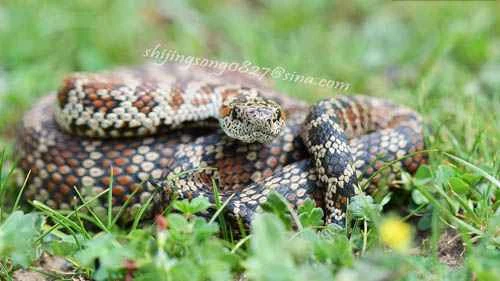
Figure 1. New species of red-spotted alpine viper (Photo by Shi Jingsong)
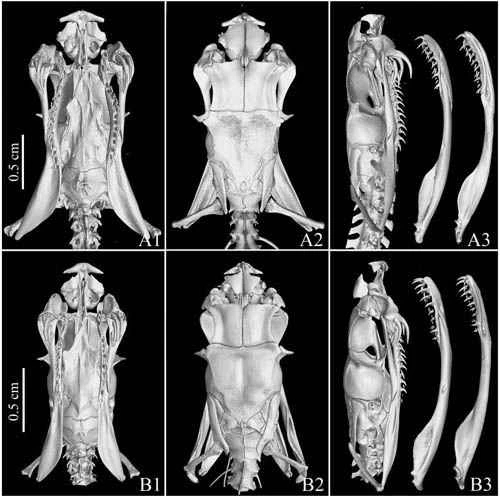
Figure 2. Three-dimensional reconstruction model of the skull of the newly discovered species of Red-spotted Mountain Viper (provided by Hou Yemao).