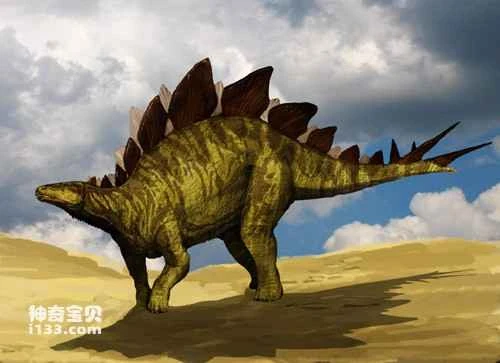
Stegosaurus was a typical herbivorous dinosaur, measuring 8 to 9 meters in length, 2.75 meters in height (excluding the bony plates), and weighing 3.1 tons. The Latin name Stegosaurus means "lizard with a roof," a very vivid and descriptive name. It had a very small head, 20 large bony plates, each 76 centimeters high, distributed along its vertebrae like roof tiles, and four symmetrical nail-like ridges at the end of its tail.
Stegosaurus walked on all fours and likely foraged for low-lying vegetation. Its head was often positioned about one meter above the ground, as its hips were very high while its shoulders were relatively low. During the Middle and Late Jurassic periods, water sources were typically covered with dense, green carpets of low-lying ferns, areas generally devoid of tall trees. Stegosaurus's small, gnawing teeth were perfectly suited for feeding in such open spaces, making it resemble a slow-moving harvester.
Stegosaurus's habitat was far from safe; it was teeming with predatory dinosaurs, including Allosaurus from North America and Aerosaurus from Asia—brutal killers interested in any kind of meat, constantly eyeing its prey. However, Stegosaurus had developed a unique defensive weapon: the spiked ridges at the tip of its tail. When attacked, it would maneuver its body into a favorable position, pointing the bony plates that protected its entire body at the attacker, while simultaneously lashing out with its long, spiked tail. While these weapons and this defensive method weren't powerful enough to kill large predators, they were usually sufficient to deter them. Imagine stepping on four thumbtacks! Therefore, to avoid injury, predators would cease their pursuit of the Stegosaurus and instead seek out easier prey.
A close examination of Stegosaurus reveals one of its most distinctive features: its extremely small head. Imagine a massive creature weighing 1.8 to 2.5 tons – how could it be controlled by a brain smaller than a dog's? Later, paleontologists discovered a small groove on the Stegosaurus skeleton, a feature never before seen in other dinosaurs. The discoverers initially believed this groove contained a "second brain" for the Stegosaurus. However, paleontologists now generally believe that the groove was actually a special nerve junction that assisted the brain in controlling the nerves of the hind limbs and tail.
Another peculiar feature of Stegosaurus is its bony plates. These plates, arranged in two rows, are made of bone, not keratin, unlike the horns of ceratopsians. Their purpose is debated, with the mainstream theory suggesting they were defensive armor. Other theories include thermoregulation. The surface of the plates has branching grooves, possibly venous grooves. Internally, numerous perforations form branching channels, allowing for control of blood flow and temperature regulation. The stegosaurus's pentagonal, interlaced plates also facilitate airflow to dissipate heat, suggesting that the plates may have served two distinct purposes. Another theory is that the plates were brightly colored to attract mates. However, this theory lacks strong evidence, as fossils do not preserve pigments.
Chinese name: Stegosaurus
Latin name: Stegosaurus
Era of Survival: Late Jurassic
Fossil sites: Colorado, Utah, and Wyoming in the United States; Madagascar in Africa.
Physical characteristics: 8 to 9 meters in length
Diet: Plants
Species: Stegosaurus
Meaning: A lizard with a roof