Ankylosaurus was named in 1908 and primarily inhabited Montana in the United States, Mexico, and Bolivia in South America. Currently, three very complete fossil skeletons exist, giving us a comprehensive understanding of this dinosaur's appearance. It had short, stout limbs, a short, retracted neck, a wide skull, and measured approximately 7.5 to 10.7 meters in length, 1.8 meters in width, and 1.2 meters in height, weighing only 3 to 4 tons. How did this seemingly small ankylosaurus contend with larger carnivorous dinosaurs? How did it defend itself? Let's examine its defensive mechanisms; the ankylosaurus had developed them to their fullest potential.
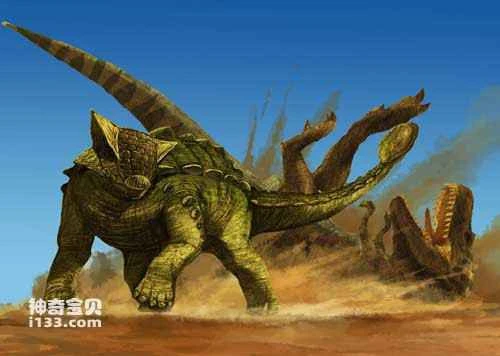
This dinosaur's armored vehicle had bony plates covering its sides, formed by the fusion of many bones, and these plates were densely covered with ridges. The same structure was found on the head of the ankylosaur; fossils show that there was also bone in the eye area, indicating that its eyelids were also armored. The skull, formed by the fusion of bones, was quite strong, but this also reduced the space available for the brain—a trade-off. The ankylosaur had sharp, dagger-like spines erected from its hip to most of its tail, and there was also a row of sharp spines on each side of its body.
The only offensive (or rather, active defensive) weapon of the Ankylosaurus was its club-shaped tail bone, which was double-egg-shaped and located at the very end of the tail. It's worth noting that the club wasn't solid; it had holes. While it's generally believed that the tail with the club was used as a weapon, another theory suggests that the club-shaped tail was used to raise it in the air, making it resemble a dinosaur's head, allowing them to hide among hadrosaurs. This is highly unlikely, as hiding among hadrosaurs would offer little advantage when attracting predators. Therefore, we are certain that the club was a powerful active defensive weapon. When used, the club was swung in a fan-shaped motion from side to side. With its 2-ton weight, low-slung profile, and the tail's elasticity and power, the Ankylosaurus's club was a formidable weapon. Tyrannosaurus rex leg bones were easily broken by its attack, and a broken leg bone in a Tyrannosaurus rex usually meant certain death, as it lost the ability to hunt or even move.
Chinese name: Ankylosaurus
Latin name: Ankylosaurus
Age of existence: Late Cretaceous
Fossil origins: Bolivia, South America; Montana, USA; Mexico
Physical characteristics: 7.5 to 10.7 meters in length
Diet: Plants
Species: Ankylosaurus
Meaning: A sturdy lizard