The Shandong dragon was discovered at the Zhucheng fossil site in Shandong Province. Located 10 kilometers southwest of Zhucheng City in Longgujian (Dragon Bone Ravine), the site has long been known for its fossilized bones, commonly referred to as "dragon bones," found by local residents in the stream. Discovered in 1963 by an oil geology exploration team, the site was excavated between 1964 and 1967 by a team from the Beijing Geological Museum, yielding over 30 tons of dinosaur remains. Currently, the fossil area is under further investigation and excavation by the Zhucheng Dinosaur Museum and the Institute of Vertebrate Paleontology and Paleoanthropology of the Chinese Academy of Sciences. The dinosaur fossils buried here are diverse and complete, including small psittacosaurus, large hadrosaurus, ferocious tyrannosaurus, bulky sauropods, and numerous dinosaur egg fossils. Dinosaur fossils are ubiquitous near Longgujian, some exposed on steep slopes, others mixed in with sand and gravel. Therefore, this area is known as the "Dinosaur Hometown" of northern China.
The type specimen of Shandongosaurus, measuring approximately 14.72 meters in length, is the largest ornithopod dinosaur in China. It possesses a long, narrow, and low-set head, with a total of 60 to 63 alveoli in its dentition. Generally speaking, its dental structure is very similar to that of Edmontosaurus.
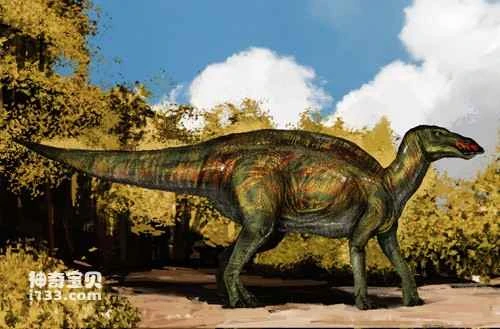
Chinese name: Shandong Dragon
Latin name: Shantungosaurus
Age of existence: Late Cretaceous
Fossil origin: Shandong, China
Physical characteristics: 12 to 15 meters in length
Diet: Plants
Species: Ornithopods
Meaning: A lizard from Shandong