Have you ever wondered why giraffes can't get up after falling? These elegant giants of the savanna, though seemingly unperturbed, have incredibly difficult movements due to their towering stature and unique physiology. Let's explore the reasons!
The giraffe's body structure: designed for height, but sacrificing flexibility.
Giraffes are known for their long necks and slender limbs, but this unique body design brings some limitations:
The Challenge of a High Center of Gravity <br />Giraffes have necks that can reach up to 2 meters in length, resulting in an unusually high center of gravity. After a fall, coordinating their long necks and legs to stand up is extremely difficult.
Heart and Blood Circulation <br />Their enormous hearts work hard to pump blood to their high-up brains. Special valves in the jugular veins help blood flow, but if a giraffe lies down for a long time, blood circulation can be obstructed, making it more difficult to get up.
The Dilemma of Long Legs <br />Long limbs are suitable for foraging at high places, but it is a challenge to use these legs to support the body and stand up, especially in places with uneven terrain.
Why is it risky for a giraffe to lie down?
Although giraffes occasionally lie down to rest, they mostly choose to nap or rest standing up.
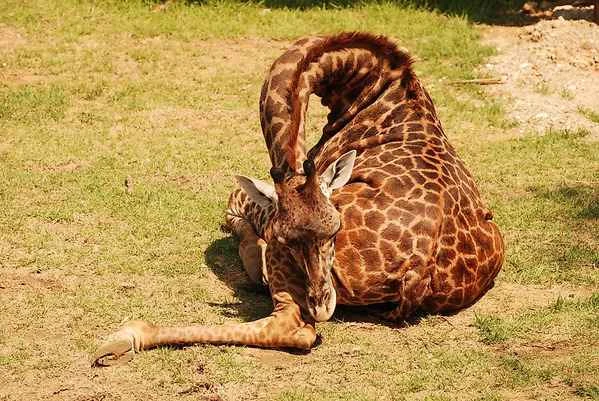
Threat from predators : Giraffes lying down become easy targets for lions and hyenas. They only risk lying down for a short nap with their heads resting on their backs to allow for rapid eye movement (REM) sleep.
It is difficult for giraffes to get up after falling down . When giraffes fall down, it is difficult and time-consuming for them to get up again due to their clumsy limbs and center of gravity.
How do giraffes avoid falling?
Giraffes have adapted to reduce the risk of falling through a series of mechanisms:
Cautious Movements <br/>When they lie down or drink water, they are very careful, first spreading their front legs or kneeling down in order to slowly lower their bodies.
The protective function of height : Giraffes' height not only helps them find food, but also provides defense against predators. An upright giraffe can use powerful kicks to repel enemies.
Birth and Early Survival: The Miracle of From Falling to Standing
Giraffes even give birth standing up! Newborn giraffe calves land from a height of nearly 2 meters, but they adapt quickly, learning to stand within hours of birth. This evolutionary feature allows the calves to quickly escape predators.
Dynamic balance between predators and prey
Giraffes' height allows them to spot potential predators early, but their vulnerability increases significantly when they fall. Lions and hyenas often target weakened or injured giraffes, as these prey are easier to catch.
Protecting Giraffes: From Understanding to Action
As the number of wild giraffes declines, understanding their behavior and vulnerabilities is crucial for conservation:
Species diversity <br/>Giraffes are divided into four main species—Masai giraffe, reticulated giraffe, southern giraffe, and northern giraffe—each adapted to different ecological environments in Africa.
Threats and Challenges <br />Habitat loss, poaching, and climate change have exacerbated their survival crisis. Organizations like the Giraffe Conservation Foundation are working to protect their natural habitats and raise public awareness.
Interesting facts about giraffes
Giraffes only need to sleep for about 30 minutes a day, and spend most of their time standing.
They can sprint at speeds of up to 56 kilometers per hour, which they use to quickly escape threats.
Despite their long necks, giraffes, like humans, only have seven cervical vertebrae!
The giraffe's elegance and challenge coexist.
While giraffes are perfectly suited for treetop life, their physical structure also makes falls exceptionally dangerous. From their height advantage to their physical weaknesses, every detail highlights the miracle of their survival in a perilous world. The next time you see a giraffe, you'll better understand their uniqueness and the hardships they endure!